
Server Support Services for Hybrid and Cloud Environments: Unified Management in 2026
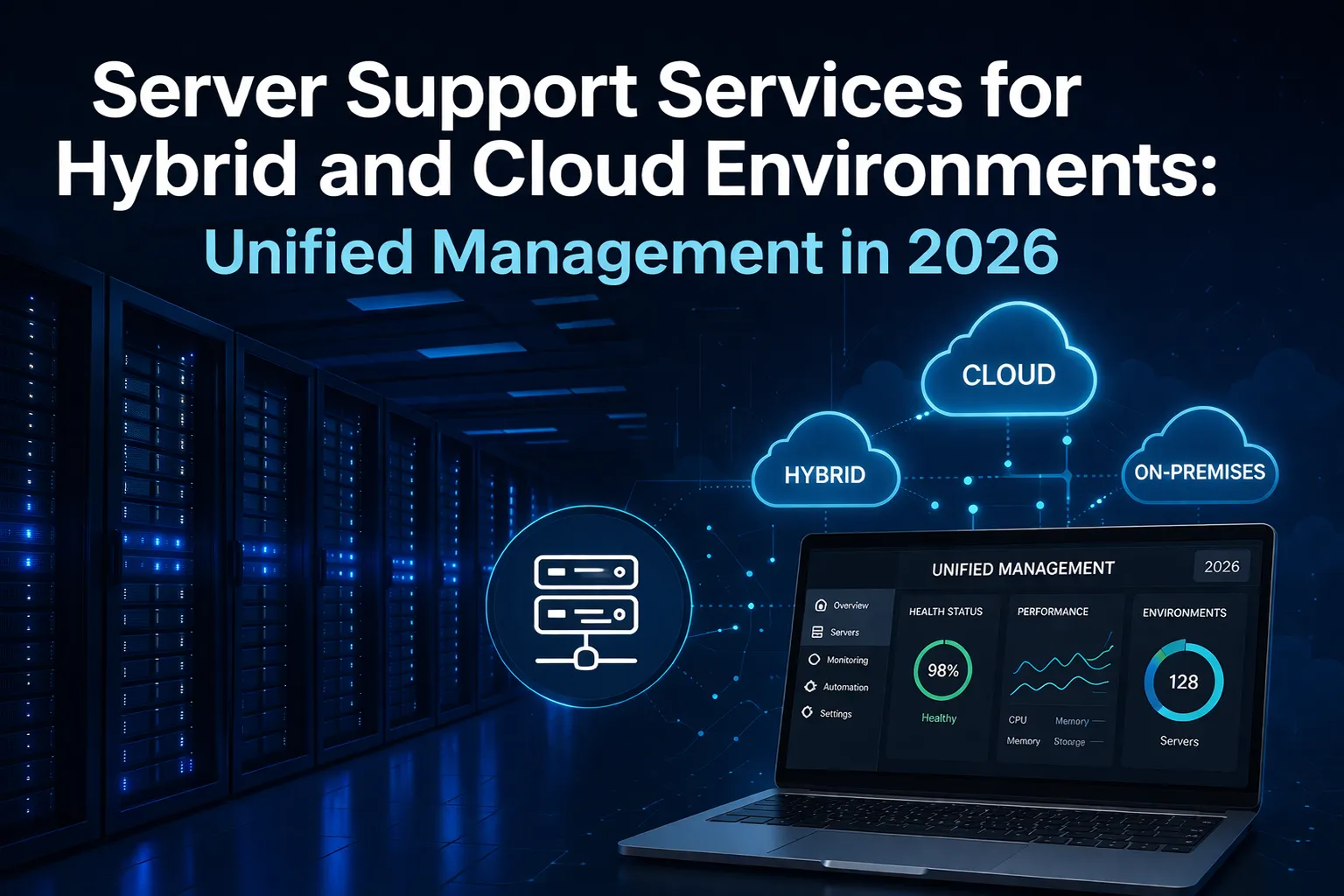
The IT manager stares at three different dashboards on three different screens. One monitors the physical servers in the office closet. Another tracks virtual machines running in AWS. A third watches the Azure environment hosting customer-facing applications. When an alert fires, determining whether the problem originates on-premises, in the cloud, or somewhere in between requires switching contexts, comparing timestamps, and correlating events across disconnected systems.
This fragmented approach to server management reflects reality for most businesses in 2026. The days of purely on-premises or entirely cloud-based environments have largely passed. Organizations now operate hybrid infrastructures combining physical servers, private cloud resources, and public cloud services across multiple providers. This complexity demands server support services capable of managing the complete infrastructure spectrum through unified approaches.
The hybrid cloud market continues explosive growth, projected to exceed $150 billion by 2026. Over 90 percent of organizations now operate some form of hybrid infrastructure. Yet many businesses still manage these environments through disconnected tools and siloed expertise, creating gaps where problems hide and opportunities go unrealized.
Modern server support services address this reality by providing unified management across all server environments. Whether your workloads run on physical hardware, virtual machines, containers, or serverless platforms, comprehensive support ensures consistent monitoring, security, and optimization regardless of where servers reside.
This guide explores how server support services have evolved to address hybrid and multi-cloud complexity, what unified management includes, and how to ensure your diverse server infrastructure receives the coherent support it requires.
The Hybrid Infrastructure Reality
Understanding why hybrid environments have become dominant reveals why server support approaches must evolve accordingly.
Why Pure Approaches No Longer Work
Organizations rarely choose hybrid infrastructure deliberately from the start. Instead, hybrid environments emerge organically as businesses adopt cloud services while maintaining existing on-premises investments. Legacy applications that cannot easily migrate coexist with cloud-native services. Regulatory requirements keep certain data on-premises while cost optimization pushes other workloads to public clouds.
The result is infrastructure sprawl across multiple environments, each with different management interfaces, security models, and operational requirements. A typical mid-size business might operate physical servers for core business applications, virtual machines in a private cloud for development environments, AWS for customer-facing web applications, and Azure for Microsoft 365 backend services.
Each environment made sense when adopted. Together, they create management complexity that threatens operational effectiveness. Without unified approaches, support teams struggle to maintain visibility, ensure security consistency, and optimize performance across the complete infrastructure.
The Scale of Complexity
Modern hybrid environments introduce challenges that single-environment expertise cannot address. Support teams must understand physical server hardware, virtualization platforms, multiple cloud provider consoles, containerization technologies, and the networking that connects everything together.
Security complexity multiplies with each environment added. Each cloud provider implements different security models, identity frameworks, and compliance tools. Ensuring consistent security posture across on-premises servers, AWS workloads, and Azure deployments requires expertise spanning all environments plus understanding of how they interconnect.
Cost optimization becomes particularly challenging in hybrid environments. Workloads placed incorrectly consume unnecessary resources. Data transfer between environments generates unexpected charges. Reserved capacity sits unused while on-demand resources run at premium rates. Without visibility across all environments, identifying optimization opportunities proves nearly impossible.
The Integration Challenge
Hybrid environments must function as unified systems despite their distributed nature. Applications running in the cloud need to access data stored on-premises. User authentication must work consistently regardless of where resources reside. Monitoring must correlate events across environments to reveal problems that span infrastructure boundaries.
This integration requirement transforms server support from environment-specific expertise into infrastructure orchestration. Support teams cannot specialize exclusively in AWS or on-premises servers—they must understand how everything connects and ensure those connections remain secure, performant, and reliable.
What Unified Server Support Includes
Effective server support for hybrid environments provides comprehensive management regardless of where servers operate.
Single-Pane Visibility
Unified monitoring platforms aggregate data from all server environments into coherent dashboards. Rather than switching between AWS CloudWatch, Azure Monitor, and on-premises monitoring tools, support teams see complete infrastructure status through integrated views.
This consolidated visibility enables correlation that separate tools cannot provide. When application performance degrades, unified monitoring reveals whether the problem originates in cloud resources, on-premises servers, or the network connecting them. Without this correlation capability, troubleshooting becomes guessing game across disconnected systems.
Modern server support services deploy monitoring solutions that connect to all major cloud platforms while simultaneously tracking on-premises infrastructure. This enables the cross-environment visibility that hybrid operations require.
Consistent Security Management
Security in hybrid environments demands consistent policies applied across all infrastructure regardless of location. Data protected by encryption on-premises must remain encrypted when processed in the cloud. Access controls enforced for physical servers should extend to cloud resources. Vulnerability management must address all environments without gaps.
Server support services implement security frameworks that span hybrid infrastructure. This includes unified identity management that controls access across all environments, consistent encryption standards for data at rest and in transit, vulnerability scanning that covers cloud and on-premises resources equally, and security monitoring that detects threats wherever they emerge.
Zero-trust security principles have become essential for hybrid environments. Since resources span multiple locations and network boundaries, traditional perimeter-based security proves inadequate. Every access request requires verification regardless of where it originates or what resource it targets.
Cross-Environment Automation
Manual management does not scale across hybrid environments. The same configurations, patches, and maintenance tasks must execute consistently across on-premises servers, multiple cloud platforms, and everything in between. Human operators cannot maintain consistency when managing dozens or hundreds of servers across disparate environments.
Server support services leverage infrastructure-as-code approaches and automation platforms that operate across all environments. Configuration changes deploy consistently whether targeting physical servers or cloud instances. Patch management reaches all systems through unified workflows. Routine maintenance executes automatically according to policies rather than requiring manual intervention for each environment.
Automation also enables intelligent workload placement. Based on performance requirements, cost factors, and utilization patterns, automated systems can recommend or implement workload migration between environments to optimize the overall infrastructure.
Unified Backup and Recovery
Data protection in hybrid environments requires backup strategies that span all locations where data resides. Critical data may exist in on-premises databases, cloud storage, SaaS applications, and edge locations simultaneously. Backup approaches focused on single environments leave gaps that become apparent only during recovery attempts.
Comprehensive server support includes backup management that addresses all data locations through coordinated strategies. This ensures consistent protection regardless of where data resides while enabling recovery options that account for hybrid architecture.
Disaster recovery planning becomes particularly complex in hybrid environments. Recovery procedures must account for dependencies across environments, data synchronization requirements, and the possibility that disasters might affect some environments while others remain operational.
Performance Optimization Across Environments
Optimizing hybrid infrastructure requires understanding how workloads perform across environments and identifying opportunities for improvement. This includes right-sizing resources in cloud environments, ensuring on-premises capacity meets demands, and optimizing the data flows between locations.
Server support services provide performance monitoring and analysis that spans all environments. This reveals bottlenecks regardless of where they occur and enables optimization recommendations based on complete infrastructure visibility.
Cost optimization represents a particular focus for hybrid environments. Cloud resources incur ongoing charges that depend on utilization, configuration, and purchasing arrangements. Professional support helps identify waste, right-size resources, and leverage cost-saving options like reserved instances or spot pricing where appropriate.
Managing Different Server Types
Hybrid environments include diverse server types that require different management approaches while still fitting into unified support frameworks.
Physical On-Premises Servers
Physical servers remain relevant for many organizations despite cloud adoption. Performance-sensitive workloads, regulatory requirements, legacy applications, and cost considerations keep on-premises infrastructure in the mix.
Managing physical servers requires hardware expertise that cloud-native approaches do not provide. Support teams must understand server hardware, storage systems, network equipment, and the physical infrastructure that keeps everything running. This includes monitoring hardware health indicators, managing firmware updates, and coordinating with hardware vendors when failures occur.
Remote management capabilities enable professional support teams to address most on-premises server issues without physical presence. Out-of-band management interfaces provide access even when operating systems fail. However, some situations still require hands-on intervention that remote support cannot provide.
Virtual Machines in Private Clouds
Private cloud environments running VMware, Hyper-V, or other virtualization platforms occupy middle ground between physical servers and public clouds. They provide cloud-like flexibility with on-premises control.
Supporting private cloud infrastructure requires virtualization expertise including hypervisor management, virtual networking, storage virtualization, and capacity planning. Support teams must understand how virtual resources map to underlying physical infrastructure and how virtualization layer issues affect running workloads.
Private cloud environments often serve as stepping stones toward public cloud adoption. Support services should help organizations optimize current private cloud operations while planning migration paths for workloads that might benefit from public cloud deployment.
Public Cloud Virtual Machines
Public cloud platforms like AWS, Azure, and Google Cloud provide virtually unlimited server capacity without physical infrastructure ownership. Managing cloud servers requires understanding provider-specific services, pricing models, and operational practices.
Each cloud provider implements different approaches to networking, storage, security, and management. Support teams working across multiple cloud providers must understand these differences while implementing consistent management practices.
Cloud server support includes instance right-sizing to balance performance against cost, security group and access management, backup and snapshot scheduling, and integration with other cloud services that workloads depend upon.
Containers and Orchestration Platforms
Container technologies like Docker and orchestration platforms like Kubernetes have transformed how applications deploy and run. While containers abstract away many server management concerns, the underlying infrastructure still requires support.
Container platforms introduce their own management complexity including cluster operations, networking configuration, persistent storage management, and security considerations specific to containerized environments. Support teams must understand both the container orchestration layer and the infrastructure it runs upon.
Kubernetes environments in particular require specialized expertise. The platform’s power comes with complexity that many organizations struggle to manage effectively. Professional support helps ensure container infrastructure operates reliably while enabling the agility benefits that drove container adoption.
Serverless and Platform Services
Serverless computing and platform-as-a-service offerings shift server management responsibility to cloud providers. Organizations deploy code without managing underlying servers, paying only for execution time consumed.
While serverless reduces server management burden, it does not eliminate support needs. Applications running on serverless platforms still require monitoring, security oversight, cost management, and integration with other infrastructure components. Professional support helps organizations leverage serverless effectively while maintaining visibility and control.
Security in Hybrid Environments
Security represents perhaps the greatest challenge in hybrid infrastructure. Maintaining consistent protection across multiple environments with different security models requires deliberate strategy and comprehensive expertise.
The Expanded Attack Surface
Hybrid environments expand attack surfaces significantly compared to single-environment infrastructure. Each cloud connection, API integration, and data transfer pathway creates potential entry points for attackers. The network boundary that once defined security perimeters no longer exists when infrastructure spans multiple locations and providers.
Server support services address expanded attack surfaces through defense-in-depth strategies. Multiple security layers protect against threats that penetrate outer defenses. Security controls apply at every level from network perimeter through individual workloads.
Identity and Access Management
Identity management becomes critical when users and services need access across multiple environments. Employees accessing on-premises applications, cloud workloads, and SaaS services should authenticate through unified systems rather than maintaining separate credentials for each environment.
Professional server support implements identity federation that extends consistent access controls across hybrid infrastructure. Single sign-on reduces credential sprawl while enabling granular access policies. Privileged access management ensures administrative credentials receive appropriate protection regardless of which environment they access.
Data Protection Across Environments
Data flowing between on-premises and cloud environments requires protection at every stage. Encryption must apply consistently regardless of where data resides or travels. Access controls must follow data as it moves between environments. Compliance requirements must be satisfied across all locations where regulated data exists.
Server support services ensure data protection consistency through unified encryption standards, consistent access policies, and monitoring that tracks data movement across environment boundaries. This prevents the security gaps that emerge when different environments implement different protection approaches.
Compliance in Multi-Environment Infrastructure
Regulatory compliance becomes significantly more complex in hybrid environments. Requirements like HIPAA, PCI DSS, or GDPR apply regardless of where data resides, yet each environment may require different implementation approaches to satisfy the same requirements.
Professional support helps organizations maintain compliance across hybrid infrastructure through consistent policy application, comprehensive audit logging, and documentation that demonstrates compliance regardless of which environment regulators examine.
Cost Management Across Environments
Hybrid infrastructure creates cost management challenges that single-environment approaches cannot address. Different pricing models, hidden charges, and optimization opportunities span environmental boundaries.
Understanding True Costs
Cloud pricing complexity makes true cost understanding difficult. Compute charges, storage costs, data transfer fees, and various service charges combine into monthly bills that may surprise organizations unfamiliar with cloud economics. Meanwhile, on-premises infrastructure carries different cost structures including capital expenses, maintenance costs, power consumption, and space requirements.
Server support services provide cost visibility across all environments through consolidated reporting that reveals total infrastructure costs regardless of where they originate. This enables informed decisions about workload placement and resource allocation.
Optimization Opportunities
Cost optimization in hybrid environments requires considering where workloads run, how resources are sized, and what purchasing arrangements apply. Workloads running on expensive on-demand cloud instances might cost less on reserved capacity or on-premises servers. Oversized cloud instances waste money on unused capacity. Data transfer between environments generates charges that architecture changes might eliminate.
Professional support identifies optimization opportunities through continuous analysis of utilization patterns, cost trends, and pricing options. Recommendations consider not just immediate costs but total cost of ownership including management overhead and operational efficiency.
Avoiding Bill Shock
Cloud cost surprises plague organizations new to public cloud infrastructure. Misconfigured services, forgotten resources, and unexpected data transfer charges generate bills far exceeding expectations. By the time bills arrive, the charges have already accrued.
Server support services implement cost monitoring that alerts to unusual spending patterns before they compound into major charges. Budget thresholds trigger notifications when costs approach limits. Regular cost reviews identify trends requiring attention.
Choosing Server Support for Hybrid Environments
Selecting support providers capable of managing hybrid infrastructure requires evaluating capabilities across all relevant environments.
Multi-Environment Expertise
Providers must demonstrate genuine expertise across the environments you operate. Claims of cloud capability should include specific experience with your cloud providers. On-premises expertise should span your hardware platforms and software stack. General IT knowledge does not substitute for environment-specific competence.
Evaluate provider certifications, partnership levels, and demonstrated experience with similar hybrid environments. Ask for references from clients operating comparable infrastructure complexity.
Unified Management Capabilities
Assess whether providers offer genuinely unified management or merely separate teams for different environments. True unified support correlates monitoring across environments, implements consistent security policies, and addresses problems that span infrastructure boundaries.
Ask how providers handle issues that cross environment boundaries. If cloud performance degrades due to on-premises connectivity problems, how do their teams collaborate to identify and resolve the complete issue?
Integration and Automation
Modern hybrid support requires automation that spans all environments. Evaluate provider capabilities for infrastructure-as-code, configuration management, and automated remediation across your complete infrastructure. Manual processes that work for single environments do not scale to hybrid complexity.
Security Comprehensiveness
Security capabilities should address all environments through unified approaches rather than separate security programs for each infrastructure component. Evaluate how providers implement identity management, vulnerability scanning, threat detection, and incident response across hybrid infrastructure.
Cost Optimization Focus
Providers should help optimize costs across all environments rather than focusing solely on technical operations. This includes cloud cost management, workload placement optimization, and total cost visibility that enables informed decisions.
FAQs About Server Support for Hybrid Environments
Why is hybrid infrastructure support more complex than single-environment support?
Hybrid environments combine multiple technologies, management interfaces, security models, and operational requirements. Support teams must understand physical servers, virtualization platforms, multiple cloud providers, and the networking connecting everything. Each environment has different tools and practices. Coordinating across all of them while maintaining consistency requires broader expertise and more sophisticated approaches than single-environment support.
Can one provider manage all my server environments effectively?
Quality managed service providers have developed multi-environment capabilities to address hybrid infrastructure reality. However, evaluate specific capabilities carefully. Providers strong in one area may lack depth in others. The best hybrid support comes from providers who have invested in genuine expertise across cloud platforms, on-premises infrastructure, and the integration technologies connecting them.
How do I maintain security consistency across hybrid environments?
Consistent security requires unified approaches to identity management, access controls, encryption, vulnerability management, and monitoring. Professional server support implements security frameworks designed for hybrid environments, applying consistent policies regardless of where servers reside while accounting for environment-specific requirements. Zero-trust security principles help maintain protection when traditional network perimeters no longer apply.
What monitoring capabilities should hybrid server support include?
Effective hybrid monitoring provides single-pane visibility across all environments, enabling correlation of events that span infrastructure boundaries. Look for monitoring that integrates with all your cloud providers while simultaneously tracking on-premises resources. Alert correlation, performance trending, and capacity planning should address complete infrastructure rather than individual environments separately.
How do I control costs across hybrid infrastructure?
Cost control requires visibility across all environments through consolidated reporting that reveals total infrastructure spending. Professional support helps identify optimization opportunities including workload right-sizing, appropriate use of reserved capacity, data transfer optimization, and workload placement decisions. Regular cost reviews and budget alerting prevent surprises.
Should I consolidate to fewer environments to reduce complexity?
Consolidation can reduce complexity but may sacrifice benefits that drove multi-environment adoption. Different environments serve different purposes—cost optimization, regulatory compliance, performance requirements, or application compatibility. Rather than consolidating purely for simplicity, focus on unified management approaches that handle complexity effectively while preserving the benefits each environment provides.
Conclusion
Server infrastructure in 2026 rarely exists in single environments. Businesses operate hybrid configurations spanning physical servers, private clouds, public cloud platforms, and various specialized services. This distributed reality creates management complexity that traditional server support approaches cannot address.
Unified server support services have evolved to manage this complexity through consolidated visibility, consistent security, cross-environment automation, and integrated management regardless of where servers reside. Rather than treating each environment as separate infrastructure requiring separate expertise, modern support provides coherent management across complete hybrid ecosystems.
The challenges of hybrid infrastructure—fragmented visibility, inconsistent security, optimization complexity, and integration requirements—become manageable with appropriate support. Organizations no longer need to choose between infrastructure flexibility and operational effectiveness. Professional support enables both.
Server support providers serving hybrid environments must demonstrate genuine multi-environment expertise rather than capabilities bolted onto single-environment foundations. Evaluate providers based on unified management capabilities, automation sophistication, security comprehensiveness, and ability to optimize across all your infrastructure.
Your servers span multiple environments because business requirements demanded that flexibility. Your support should span those same environments with equal sophistication.
Hybrid infrastructure is the reality. Unified support makes it manageable.
The complexity of modern server environments does not require simplification—it requires expertise capable of managing that complexity effectively. Professional server support provides exactly that capability, ensuring your hybrid infrastructure delivers its intended benefits without overwhelming your organization with operational burden.
Your infrastructure spans environments. Your support should unify them.





No comment