
VoIP Support Services: Protecting Your Business Communications from Threats and Downtime in 2026
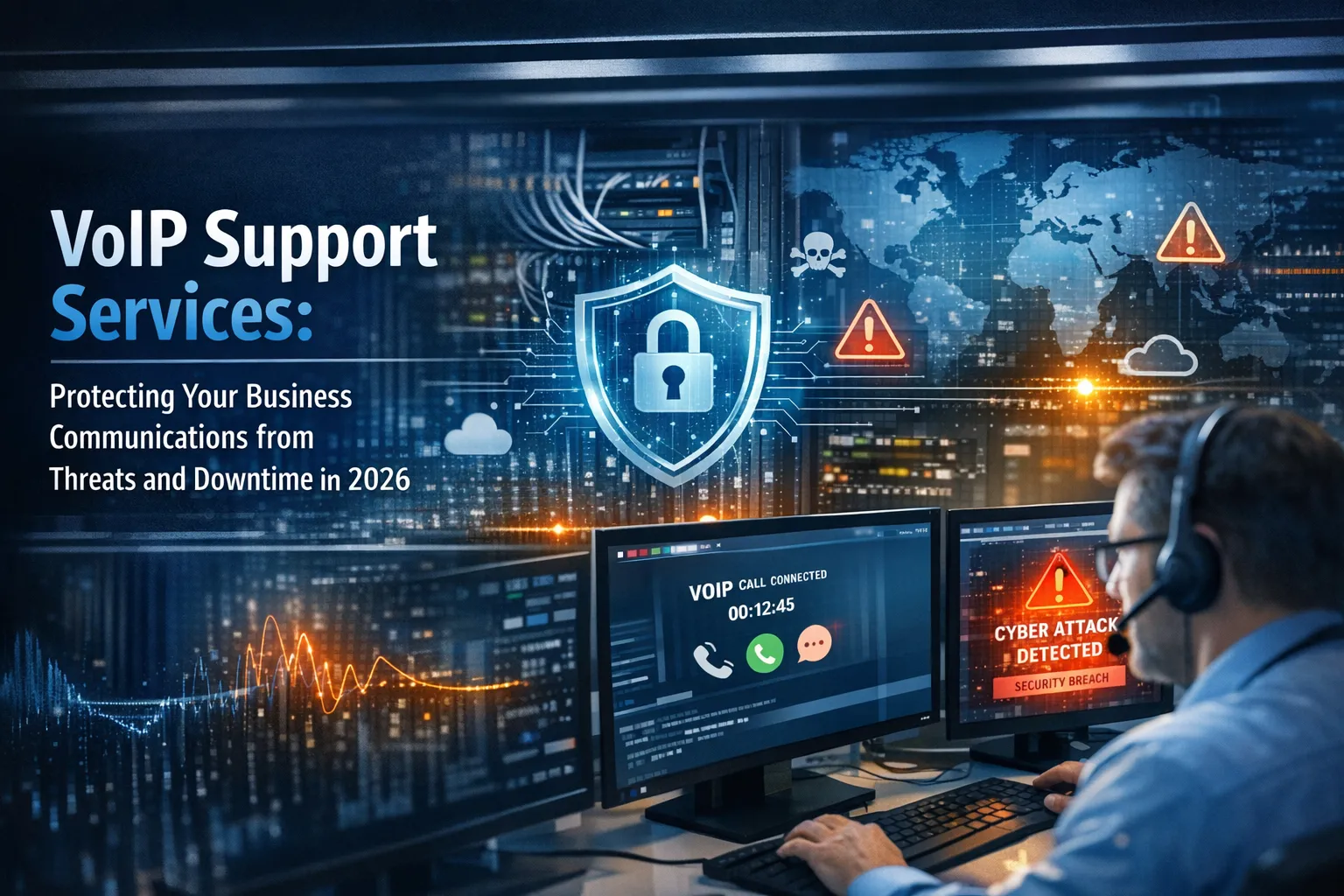
Your business phone system carries conversations that competitors would pay to hear, credentials that attackers want to steal, and communications that operations depend upon every hour. When that system faces security threats or unexpected failures, the consequences extend far beyond missed calls into territory that threatens business survival.
The VoIP industry lost $50 billion to fraud and attacks in the past year alone. Voice phishing attacks increased by 442% in 2024, fueled by AI-powered deepfake technology making voice impersonation devastatingly effective. Meanwhile, communication failures cost businesses an average of $14,056 per minute in downtime, and major telecom outages have demonstrated that even industry giants experience failures lasting twelve hours or longer.
These statistics explain why VoIP support services have evolved from optional convenience into essential business protection. Professional support provides the security expertise, monitoring capabilities, and disaster recovery planning that keeps business communications both protected and operational regardless of what threats or disruptions emerge.
This guide explores how VoIP support services protect businesses from the security threats and operational failures that increasingly target modern communication systems in 2026.
The Evolving Threat Landscape for Business Communications
Understanding the threats targeting VoIP systems reveals why professional support has become necessary rather than optional. Attackers have recognized that communication systems offer valuable targets, and their methods grow more sophisticated each year.
Financial Fraud Targeting VoIP Systems
Toll fraud remains one of the most financially damaging attacks businesses face, costing organizations billions annually. Attackers gain unauthorized access to VoIP systems and make expensive international calls or route calls through premium-rate services, leaving businesses with astronomical phone bills that sometimes exceed $100,000 before detection.
Modern toll fraud schemes have become increasingly sophisticated, with criminals using AI algorithms to identify vulnerable systems and automate exploitation. Attackers often target businesses during off-hours, weekends, or holiday periods when monitoring is reduced. They exploit weak authentication mechanisms, compromised credentials, or misconfigured auto-attendant systems to gain access.
Once inside a system, attackers can make thousands of calls within hours, generating massive charges before anyone notices unusual activity. Businesses with international operations face particularly high exposure since their legitimate international calling patterns can mask fraudulent activity initially.
Professional VoIP support services implement monitoring that detects unusual calling patterns immediately, authentication controls that prevent unauthorized access, and configuration reviews that eliminate the vulnerabilities attackers exploit.
Social Engineering and Voice Phishing
Vishing represents the convergence of social engineering and VoIP technology, with attackers using phone calls to manipulate victims into revealing sensitive information or transferring funds. Nearly 70% of IT professionals have encountered vishing attacks, making this threat pervasive across organizations of every size.
In 2026, AI-powered voice synthesis has made these attacks devastatingly effective. Criminals create convincing voice deepfakes that impersonate executives, vendors, or trusted partners. An attacker might call an accounts payable employee using a synthesized voice matching the CFO, requesting an urgent wire transfer to a new account. The technology has advanced to the point where these impersonations can fool even employees who know the impersonated person well.
Caller ID spoofing compounds this threat by displaying seemingly legitimate information to confuse victims. Attackers appear to call from trusted phone numbers, whether your bank, a government agency, or an executive’s direct line. The combination of convincing voices and legitimate-appearing caller identification makes modern vishing extremely difficult to detect.
VoIP support services help businesses implement verification procedures, caller authentication systems, and employee training that reduces susceptibility to these sophisticated attacks.
Technical Attacks on Communication Infrastructure
Beyond fraud and social engineering, attackers target VoIP infrastructure itself through technical exploits. Denial of Service attacks flood VoIP networks with fake traffic, overwhelming systems and making them unavailable for legitimate calls. Some attackers use these attacks as cover for more sinister activities, distracting security teams with service restoration while simultaneously executing data theft operations.
Eavesdropping attacks intercept unencrypted voice packets, allowing criminals to listen to sensitive business conversations. Call tampering disrupts ongoing calls by injecting noise or delaying transmission. Specialized VoIP malware targets communication systems specifically, hijacking devices, redirecting calls, and using compromised systems as platforms for launching additional attacks.
VoIP-specific ransomware has emerged as a particularly concerning threat, encrypting communication system configurations and call databases while demanding payment for restoration. The operational paralysis extends beyond typical data encryption since organizations lose their primary communication capability entirely.
Professional support services implement the encryption, monitoring, and security controls that protect against these technical attacks while maintaining the detection capabilities needed to identify compromises quickly.
Why Internal Teams Struggle with VoIP Security
Many organizations attempt to manage VoIP security internally but find the challenge exceeds their capabilities. Understanding these limitations explains why professional support provides essential value.
Specialized Knowledge Requirements
VoIP security demands expertise that spans telecommunications, networking, and cybersecurity disciplines. The protocol stack differs from typical IT systems, with vulnerabilities and attack vectors that general IT staff may not recognize. Securing SIP trunks, configuring session border controllers, implementing proper encryption, and monitoring for VoIP-specific threats requires specialized knowledge that most organizations lack internally.
The rapid evolution of both VoIP technology and attack methods compounds this challenge. Attackers continuously develop new techniques while defenders must simultaneously understand legacy systems, current platforms, and emerging technologies. Maintaining this expertise requires ongoing training and certification that organizations struggle to justify for internal staff who also handle many other responsibilities.
Professional VoIP support providers concentrate expertise that would be impractical to develop internally. Their teams focus exclusively on VoIP technologies and threats, developing deep knowledge through experience across many client environments.
Monitoring and Detection Gaps
Effective VoIP security requires continuous monitoring that most organizations cannot sustain internally. Attacks often occur during nights, weekends, and holidays when monitoring attention decreases. Toll fraud schemes specifically target these periods, knowing that hours may pass before anyone notices unusual activity.
Internal teams also lack the comparative baseline that comes from monitoring many environments. Recognizing anomalous behavior requires understanding what normal looks like across diverse VoIP implementations. A pattern that seems unremarkable within a single organization might immediately flag as suspicious to analysts who observe traffic patterns across hundreds of deployments.
VoIP support services provide the around-the-clock monitoring and cross-environment visibility that detects threats internal teams would miss.
Incident Response Capabilities
When security incidents occur, response speed determines damage extent. Organizations discovering toll fraud at 2 AM on Saturday need immediate action to stop ongoing losses. Systems compromised by ransomware require rapid restoration from clean backups. Social engineering attacks demand quick investigation to understand what information was disclosed.
Internal teams rarely maintain the availability and specialized skills needed for rapid VoIP incident response. The employee who manages your phone system also handles many other responsibilities and probably sleeps at night. When incidents occur, organizations find themselves scrambling to reach someone with relevant expertise while damage accumulates.
Professional support provides defined incident response procedures, available specialists, and the experience that comes from handling similar situations across many clients.
Building Communication Resilience Through Support Services
Beyond security protection, VoIP support services ensure communication systems remain operational through disruptions that would otherwise interrupt business operations.
Understanding Communication Vulnerability
Traditional phone systems connected to physical infrastructure face obvious vulnerabilities. Storms damage lines, floods destroy equipment, fires consume communication closets. VoIP eliminates some of these vulnerabilities by moving communication to the internet, but creates others that require different protection strategies.
VoIP depends on internet connectivity, electrical power, and functioning endpoint devices. Local internet outages silence cloud-hosted phone systems. Power failures disable desk phones and network equipment. Misconfigured firewalls or network changes can suddenly block voice traffic. Cyberattacks targeting general IT infrastructure impact communications as collateral damage.
The shift to cloud-based communication creates resilience opportunities that traditional systems never offered, but realizing these benefits requires intentional design and ongoing management that professional support provides.
Disaster Recovery Planning and Implementation
Cloud-based VoIP systems offer inherent disaster recovery advantages when properly configured. Since the core phone system lives in geographically redundant data centers rather than on-premises equipment, local disasters do not destroy communication infrastructure. Calls can automatically reroute to alternate devices when primary systems become unavailable.
Realizing these benefits requires planning that many organizations neglect. Failover configurations must be established before emergencies occur. Alternate routing paths need testing to verify they actually work. Employees need training on procedures for maintaining communication during disruptions. Without this preparation, organizations discover their disaster recovery capabilities only when disasters strike, often finding them inadequate.
VoIP support services implement comprehensive disaster recovery planning, configure automatic failover systems, conduct regular testing to verify capabilities work as expected, and train staff on emergency procedures. When disruptions occur, communications continue seamlessly while the support team manages restoration of primary systems.
Business Continuity Integration
Communication enables coordination during emergencies, making voice continuity foundational to executing other recovery procedures. Organizations cannot effectively manage crisis response if they cannot communicate with employees, customers, vendors, and partners.
VoIP support services integrate communication resilience into broader business continuity frameworks. This includes coordinating with IT disaster recovery plans, establishing communication procedures for various emergency scenarios, and ensuring voice systems align with organizational recovery objectives.
The support provider understands how communication requirements change during emergencies. Normal call routing may need immediate modification. Capacity requirements shift as emergency response activities increase communication volume. Integration with emergency notification systems enables rapid broadcast to affected parties.
Essential VoIP Support Services for Security and Resilience
Professional VoIP support encompasses specific services that together create comprehensive protection and resilience for business communications.
Continuous Security Monitoring
Round-the-clock monitoring forms the foundation of VoIP security. Support services watch for unusual calling patterns that might indicate toll fraud, authentication failures that suggest credential attacks, and traffic anomalies that could signal denial of service attempts or reconnaissance activities.
Effective monitoring goes beyond simple alerting to include investigation and response. When systems detect suspicious activity, trained analysts investigate immediately rather than waiting for business hours review. Quick response limits damage from ongoing attacks and prevents minor indicators from developing into major incidents.
Monitoring also tracks system health and performance, identifying degradation before it impacts users. Increasing latency, growing packet loss, or declining call quality all warrant investigation before they cause noticeable problems.
Proactive Vulnerability Management
VoIP systems require regular updates and configuration reviews to maintain security. Firmware updates for phones and network equipment patch vulnerabilities that attackers actively exploit. Configuration settings that were secure when implemented may need adjustment as threats evolve or business requirements change.
Recent examples demonstrate the importance of proactive updates. Critical vulnerabilities in widely-deployed VoIP phones have enabled attackers to remotely take full control of devices and intercept calls. These vulnerabilities exist in default configurations and can be exploited without authentication if management interfaces are reachable. Organizations using affected equipment require immediate firmware updates to close these security gaps.
VoIP support services track vulnerability disclosures affecting client equipment, test and deploy updates promptly, and conduct periodic configuration reviews to identify security weaknesses before attackers exploit them.
Authentication and Access Control
Strong authentication prevents many VoIP security incidents. Support services implement password policies that resist guessing and credential stuffing attacks. Multi-factor authentication protects administrative access to phone systems. Device certificates verify that only authorized equipment connects to the voice network.
Access control extends beyond authentication to include authorization limiting what authenticated users can do. Administrative privileges should be restricted to personnel who genuinely need them. Call permissions can prevent unauthorized international calling. Network segmentation isolates voice traffic from other systems, limiting the impact if other parts of the network are compromised.
Professional support services design and implement authentication and access control frameworks appropriate for each organization, balancing security requirements against operational needs.
Encryption and Privacy Protection
Encryption protects voice communications from eavesdropping and tampering. Transport Layer Security secures signaling information while Secure Real-time Transport Protocol encrypts voice traffic itself. Together, these technologies prevent attackers from intercepting conversations even if they access network traffic.
End-to-end encryption ensures that voice data remains protected throughout its journey, not just across specific network segments. For organizations handling sensitive information, this protection may be required for regulatory compliance as well as business confidentiality.
VoIP support services implement and verify encryption across all communication paths, ensuring that conversations remain private and protected against interception.
Incident Response and Recovery
Despite protective measures, some incidents will occur. Professional support includes defined procedures for responding to various incident types, from toll fraud discovery to ransomware attacks to service outages.
Incident response begins with rapid detection and triage to understand incident scope and severity. Containment actions stop ongoing damage while investigation determines root cause. Recovery restores normal operations using clean backups and verified configurations. Post-incident review identifies improvements that prevent similar incidents in the future.
For security incidents specifically, response may include forensic investigation to understand what attackers accessed, evidence preservation for potential legal proceedings, and notification procedures if the incident affected customer data.
Selecting VoIP Support for Security and Resilience
Choosing a support provider focused on security and resilience requires evaluating specific capabilities beyond basic technical support.
Security Expertise Assessment
Evaluate provider security capabilities specifically rather than accepting general claims about security focus. Ask about certifications held by security staff, security incident response procedures, and specific security measures implemented for clients.
Request information about security monitoring capabilities. How quickly do they detect unusual activity? What analysis do they perform on detected events? How do they communicate security findings to clients?
Understand their vulnerability management processes. How do they track vulnerabilities affecting client systems? What is their typical timeline from vulnerability disclosure to patch deployment? How do they handle emergency patches for critical vulnerabilities?
Resilience Capability Verification
Assess disaster recovery and business continuity capabilities. What failover configurations do they implement for clients? How do they test disaster recovery procedures? What was the outcome of recent tests?
Ask about their own operational resilience. Where are their operations centers located? What happens if their primary facility becomes unavailable? How do they maintain service to clients during disruptions affecting their own operations?
Review their service level agreements regarding availability. What uptime do they guarantee? What are the remedies if guarantees are not met? How have they performed against these commitments historically?
Response Capability Evaluation
Understand response capabilities across different scenarios. What is the response time commitment for security incidents? Who responds to issues outside business hours? What escalation procedures exist for severe incidents?
Request references specifically regarding incident response. Speaking with organizations that have experienced actual incidents reveals how providers perform under pressure, which differs from routine operations.
Integration and Communication
Effective security and resilience require integration with your broader IT and business operations. How does the provider coordinate with your internal IT team? How do they communicate during incidents? What reporting do they provide regarding security status and incident history?
Consider how well their processes align with your organizational requirements. Regulated industries may have specific security and compliance requirements that support providers must accommodate.
FAQs About VoIP Security and Support Services
What are the biggest security threats to VoIP systems in 2026?
The most significant threats include toll fraud that generates thousands of dollars in unauthorized calls before detection, voice phishing attacks using AI-generated deepfakes to impersonate trusted individuals, denial of service attacks that make communication systems unavailable, and VoIP-specific ransomware that encrypts phone system configurations. Each threat requires different protective measures that professional support services implement comprehensively.
How do support services protect against toll fraud?
Protection involves multiple layers including strong authentication preventing unauthorized system access, call permission controls limiting what calls can be placed, real-time monitoring detecting unusual calling patterns immediately, and automated alerts when spending thresholds are exceeded. Quick detection limits damage since toll fraud typically generates charges rapidly once attackers gain access.
Can VoIP systems remain operational during internet outages?
Yes, with proper configuration. Cloud-based VoIP systems can automatically redirect calls to mobile devices, alternate locations, or backup numbers when primary internet connections fail. Support services configure these failover options in advance and test them regularly to verify they work when needed. The key is establishing these capabilities before emergencies occur rather than attempting to configure them during actual outages.
What encryption should VoIP systems use?
Comprehensive VoIP security requires Transport Layer Security for signaling traffic and Secure Real-time Transport Protocol for voice traffic. These protocols should be enabled for all communication paths, not just connections that seem obviously sensitive. Support services verify encryption configuration and monitor for any unencrypted traffic that might indicate misconfiguration or attack.
How often should VoIP systems be updated for security?
Critical security updates should be deployed as quickly as practical after release, typically within days for severe vulnerabilities. Routine firmware and software updates can follow a regular schedule, often monthly or quarterly depending on vendor release patterns. Support services track vulnerabilities affecting client systems and manage update deployment to balance security with operational stability.
What should be included in a VoIP disaster recovery plan?
Comprehensive plans include failover configurations that activate automatically during outages, documented procedures for manual intervention when needed, contact information for support providers and vendors, communication procedures for notifying stakeholders during extended outages, and regular testing to verify capabilities work as expected. Plans should address various scenarios including local internet outages, building emergencies, and broader regional disruptions.
Conclusion
Business communications face threats from sophisticated attackers and operational disruptions that can silence phone systems at the worst possible moments. Toll fraud drains bank accounts overnight. Voice phishing attacks manipulate employees into revealing sensitive information or transferring funds. Denial of service attacks make communication systems unavailable during critical business periods. Local emergencies or infrastructure failures can interrupt communications precisely when coordination matters most.
Professional VoIP support services provide the protection and resilience that internal teams cannot practically achieve alone. They bring specialized security expertise developed through experience across many environments. They maintain around-the-clock monitoring that detects threats regardless of when they occur. They implement disaster recovery capabilities that keep communications operational through disruptions. They respond to incidents with the speed and skill that limits damage and restores normal operations quickly.
In 2026, VoIP security and resilience cannot be afterthoughts addressed only when problems emerge. The sophistication of threats and the business dependency on communication systems require proactive protection built into how organizations manage their voice infrastructure.
Organizations that invest in quality VoIP support services protect their communications from the threats that increasingly target these systems while ensuring business operations continue regardless of what disruptions occur. Those that neglect this protection accept risks that can result in significant financial losses, operational disruptions, and competitive disadvantage.
The question is not whether your organization will face VoIP security threats or communication disruptions. The question is whether professional support services will be protecting your business when those challenges arrive.





No comment