
Server Support Services: The Essential Guide to Maximizing Uptime and Business Performance

Introduction
Your server infrastructure forms the backbone of virtually every business operation. From customer transactions and employee productivity to internal communications and data storage, everything depends on servers running reliably around the clock. When servers fail, the consequences ripple across every department, every customer interaction, and every revenue stream.
The global server market has grown to $117.87 billion in 2026, reflecting the critical importance organizations place on reliable computing infrastructure. Yet having powerful servers means little without proper support to keep them running optimally. Server support services have evolved from simple break-fix arrangements into sophisticated partnerships that combine artificial intelligence, predictive analytics, and continuous monitoring to prevent problems before they impact business operations.
The competitive landscape in 2026 leaves little room for downtime or inefficiency. Customers expect fast, always-available applications. Partners expect reliable data integrations. Regulators expect continuous compliance. All of this depends on server infrastructure performing flawlessly every single day.
This comprehensive guide explores what modern server support services offer, why they matter for businesses of every size, and how to select the right provider for your organization’s needs.
The True Cost of Server Downtime
Many businesses underestimate how expensive downtime truly becomes. Direct costs include lost sales, failed transactions, and idle employees who cannot work without system access. Indirect costs compound the damage through emergency repair fees, data recovery expenses, and overtime charges for engineers scrambling to restore service.
Research consistently shows that IT downtime costs organizations an average of $5,600 per minute. For larger enterprises, that figure climbs to $300,000 per hour or more during critical outages. Even small businesses face disproportionate damage relative to their size when critical systems go offline unexpectedly.
Small businesses experience an average of 14 hours of IT downtime annually, with costs extending far beyond immediate revenue loss. Hidden impacts include lost productivity from employees unable to work, recovery costs for data restoration and system repairs, and long-term reputation damage that erodes customer confidence.
Financial losses are measurable. Reputational damage proves harder to quantify but often lasts longer. Studies indicate that 40% of customers will switch to competitors after experiencing service disruptions. For businesses that rely on personal relationships and local reputation, this damage can take months or years to repair.
What makes these statistics particularly frustrating is that most downtime incidents are entirely avoidable. Studies consistently demonstrate that server failures come with early warning signs. Rising CPU temperatures, unusual memory spikes, disk read and write errors, and irregular network traffic all signal trouble ahead. Traditional support models miss these signals because they wait for impact before taking action, turning preventable issues into expensive emergencies.
What Server Support Services Include
Professional server support encompasses a wide range of activities designed to keep your server infrastructure running smoothly, securely, and efficiently. Understanding what these services include helps organizations evaluate their current capabilities and identify gaps.
Continuous Monitoring and Proactive Management
Modern server support operates on a fundamentally different model than traditional break-fix arrangements. Rather than waiting for problems to occur, support teams continuously monitor server health metrics, analyzing patterns that human technicians might miss.
24/7 monitoring tracks performance metrics, security events, and system health in real time. When issues arise, support teams respond immediately regardless of time zone or business hours. This continuous coverage ensures that problems detected at midnight get addressed before they impact morning operations.
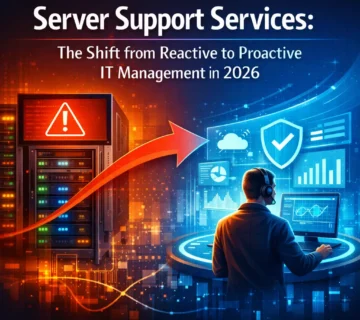
Proactive monitoring detects anomalies and performance degradation before they cause failures. Regular maintenance prevents issues from developing in the first place. This shift from reactive to predictive support has reduced unplanned downtime by up to 70% for organizations that have adopted these advanced monitoring systems.
Predictive Maintenance with AI and Analytics
Artificial intelligence has transformed server support from reactive troubleshooting into predictive infrastructure management. Machine learning algorithms continuously analyze server performance data, predicting potential failures weeks before they occur by identifying subtle performance degradation that signals impending hardware issues.
The practical impact is significant. Instead of experiencing unexpected server crashes during business hours, organizations receive proactive alerts about components that need replacement. Support teams can schedule maintenance during planned windows, order replacement parts in advance, and ensure zero-impact transitions.
By 2026, 87% of managed service providers plan to increase AI investments, with service desk automation expected to reduce ticket volume by 40 to 60 percent. Forward-thinking providers deploy AI agents that deliver three times faster resolution for common issues.
Security Management and Threat Protection
Server support and cybersecurity go hand in hand in 2026. Unpatched servers represent a top entry point for cyberattacks. A proactive support model applies patches promptly, flags suspicious activity quickly, and contains threats before damage spreads.
Cybersecurity has emerged as the fastest-growing segment of managed services, expanding at 18% annually through 2026 and outpacing the overall managed services market growth of 14%. This acceleration reflects both escalating threat landscapes and evolving expectations that support providers serve as comprehensive security partners.
Modern server support includes vulnerability assessments, intrusion detection, security patching, and incident response capabilities. Businesses that unify security and support gain significantly stronger protection than those treating these functions separately.
Disaster Recovery and Business Continuity
Server support services in 2026 have fully integrated business continuity and disaster recovery capabilities as fundamental components rather than optional add-ons. Support providers recognize that keeping servers running is only part of the equation. Ensuring business operations can continue during any disruption has become equally critical.
Modern support packages include regular disaster recovery testing, automated failover configurations, and recovery time objectives measured in minutes rather than hours. Studies show that companies with effective disaster recovery strategies are significantly more likely to resume operations quickly after incidents.
Performance Optimization
Beyond preventing problems, server support services continuously optimize performance to ensure infrastructure operates at peak efficiency. This includes resource allocation adjustments, configuration tuning, capacity planning, and recommendations for infrastructure improvements.
Performance optimization ensures that servers handle current workloads efficiently while providing headroom for growth. Support teams identify bottlenecks, recommend upgrades, and implement changes that improve application response times and user experience.
Benefits of Professional Server Support Services
Organizations that invest in professional server support consistently report improvements across multiple dimensions. Understanding these benefits helps business leaders make informed decisions about their infrastructure management strategies.
Dramatic Reduction in Downtime
Perhaps the most immediate benefit of professional server support is significantly reduced downtime. Server support services minimize downtime through several mechanisms. Continuous monitoring detects anomalies before they cause failures. Regular maintenance prevents issues from developing. When problems do occur, expert support means resolution times measured in minutes rather than hours or days.
Many server support providers offer Service Level Agreements guaranteeing specific uptime percentages, often 99.9% or higher. Quality providers offer response times measured in minutes for critical issues, with many guaranteeing 15-minute or faster initial response for emergencies.
Cost Efficiency and Predictable Expenses
While server support services require investment, they typically reduce total IT costs significantly. Savings come from multiple sources including reduced downtime costs, fewer emergency repairs, extended hardware lifespan, optimized resource utilization, and decreased need for specialized in-house staff.
Many businesses find that outsourcing server support is more cost-effective than maintaining a full in-house team with the necessary expertise across all required specialties. Server support services provide access to a team of specialists for a predictable monthly cost, allowing you to budget more accurately and avoid the expenses associated with hiring, training, and retaining IT staff.
Most businesses see a 70 to 80 percent reduction in IT issues within the first 90 days of implementing proper managed IT services. Given that the average small business experiences two to three significant outages annually, the return on investment typically exceeds 200 to 300 percent.
Access to Specialized Expertise
Server environments have grown enormously complex. In 2026, most organizations no longer run simple on-premises setups. They manage hybrid environments blending physical servers, private clouds, public cloud workloads, and edge computing nodes. This complexity demands specialized knowledge that few internal teams can maintain across all required domains.
Professional support providers maintain teams of specialists who stay current on evolving technologies, security threats, and best practices. This expertise proves particularly valuable when implementing new systems, addressing complex technical challenges, or responding to security incidents.
Enhanced Security Posture
Security threats have become more sophisticated, with attackers shifting toward destructive ransomware and AI-enabled techniques. Organizations need robust security measures that evolve alongside the threat landscape.
Professional server support includes security monitoring, vulnerability management, patch deployment, and incident response capabilities. Support providers implement security best practices, monitor for suspicious activity, and respond quickly when security events occur.
Scalability for Business Growth
As businesses expand, their server infrastructure requirements grow correspondingly. Professional server support scales effortlessly to accommodate growth without requiring organizations to build additional internal capabilities.
Cloud-based support solutions enable businesses to quickly expand capacity, add resources, or integrate new systems without significant upfront investments. Whether scaling up during growth periods or adjusting resources during seasonal fluctuations, professional support provides the flexibility modern businesses require.
Server Support for Different Business Sizes
Server support is relevant for organizations of all sizes, though the specific needs and approaches may differ.
Small and Medium Businesses
Small and medium-sized businesses often feel downtime more acutely because they have fewer resources to absorb financial and operational shocks. Professional server support services in 2026 are scalable and affordable, making enterprise-quality support accessible to organizations of every size.
SMBs represent the fastest-growing segment of managed service customers. Research indicates that 72% of small and medium businesses plan to increase managed IT spending, recognizing that outsourcing provides access to enterprise-grade capabilities at predictable costs without maintaining large internal IT teams.
Enterprise Organizations
Larger organizations benefit from server support through standardized operations, round-the-clock coverage across multiple time zones, and access to specialized expertise that would be expensive to maintain internally.
Enterprise server support often includes dedicated account teams, customized SLAs, and integration with existing IT operations. The strategic partnership model helps large organizations maintain consistent service quality while controlling costs.
Organizations with Hybrid Infrastructure
Modern server environments rarely consist of a single platform. Most organizations operate hybrid configurations spanning on-premises servers, private cloud, public cloud services, and edge computing deployments.
Professional support providers offer unified management across these diverse environments, providing consistent monitoring, security, and optimization regardless of where workloads run. This comprehensive approach eliminates the fragmentation that occurs when different teams manage different platforms.
What to Look for in a Server Support Provider
Selecting the right server support partner requires evaluating several factors to ensure the provider matches your organization’s needs and expectations.
Response Time Guarantees
When server issues occur, response speed directly determines how much damage results. Evaluate provider SLAs carefully, paying attention to guaranteed response times for different severity levels.
Leading providers respond to critical incidents within 15 minutes or less. Some offer five-minute response commitments for the highest severity events. Always review SLA documentation and ask for historical performance data before committing to a provider.
24/7 Availability
Servers operate continuously, and problems do not wait for business hours. True 24/7 server support combines continuous monitoring with around-the-clock human expertise, ensuring every alert receives a qualified, timely response regardless of when it occurs.
Monitoring without support means alerts appear but no one responds until business hours resume. Confirm that providers offer genuine round-the-clock support, not just automated monitoring with delayed human response.
Technical Expertise and Certifications
Server support requires knowledge spanning hardware, operating systems, virtualization, cloud platforms, security, and networking. Evaluate provider credentials, certifications, and experience with environments similar to yours.
Ask about staff training programs and how providers stay current with evolving technologies. Request references from organizations with similar infrastructure to understand real-world performance.
Security Capabilities
With cybersecurity increasingly critical, evaluate provider security practices thoroughly. Ask about vulnerability management, patch deployment processes, intrusion detection, and incident response procedures.
Providers should demonstrate understanding of current security threats and explain how their services protect against them. Security certifications and compliance attestations provide additional assurance.
Proactive vs. Reactive Approach
The best server support providers emphasize prevention over reaction. Ask about monitoring capabilities, predictive analytics, and maintenance processes. Providers should demonstrate how they identify and address potential issues before they cause disruptions.
Reactive providers who primarily respond after problems occur will cost more in downtime and emergency repairs than proactive partners who prevent issues from developing.
Server Support Trends Shaping 2026 and Beyond
Several developments are transforming server support capabilities and expectations.
AI-Powered Automation
AI and automation have moved from experimental features to core requirements. Leading managed service providers report 15 to 25 percent technician productivity gains and 40 to 70 percent reductions in ticket resolution times through AI adoption.
AI capabilities include automated diagnostics, predictive failure detection, intelligent ticket routing, and autonomous remediation for common issues. These tools handle routine tasks while freeing human experts for complex problems requiring judgment.
Hybrid and Multi-Cloud Management
Organizations increasingly operate across multiple cloud platforms alongside on-premises infrastructure. Server support providers must offer unified management across these diverse environments.
Multi-cloud expertise is no longer optional as clients expect flexibility, resilience, and cost control across multiple platforms. Support providers help with cloud optimization, security, cost management, and integration between different environments.
Edge Computing Support
As Internet of Things adoption and remote work accelerate, edge computing has become increasingly important for industries requiring low-latency, real-time data processing. This allows manufacturers to analyze data on factory floors and enables banking customers to access services on mobile devices without data privacy risks.
Server support is expanding to include edge infrastructure alongside traditional data center and cloud environments, providing consistent management across all locations where computing occurs.
Sustainability Focus
Environmental considerations are influencing server support practices. Support providers help organizations optimize power consumption, extend hardware lifecycles through strategic upgrades, and properly decommission equipment for recycling.
Sustainability-focused IT practices reduce both environmental impact and operating costs, making them increasingly attractive for organizations balancing financial and environmental objectives.
Frequently Asked Questions
What are server support services?
Server support services encompass all activities that keep server infrastructure running smoothly, securely, and efficiently. This includes continuous monitoring, proactive maintenance, security management, performance optimization, disaster recovery, and technical troubleshooting for physical servers, virtual environments, and cloud infrastructure.
How much does server downtime cost?
Research shows that IT downtime costs organizations an average of $5,600 per minute. Costs vary significantly based on business size and industry, with larger enterprises facing $300,000 per hour or more during critical outages. Beyond direct financial losses, downtime damages reputation and customer relationships.
Do small businesses need server support services?
Absolutely. Small and medium-sized businesses often feel downtime more acutely because they have fewer resources to absorb financial and operational shocks. Modern server support services are scalable and affordable, making professional support accessible to organizations of every size.
What is the difference between reactive and proactive server support?
Reactive support responds after problems occur, resulting in downtime while issues get diagnosed and resolved. Proactive support continuously monitors systems, predicts potential failures, and addresses issues before they cause disruptions. Proactive approaches reduce unplanned downtime by up to 70%.
Does server support cover cloud environments?
Yes, modern server support extends to cloud environments including AWS, Azure, Google Cloud, and hybrid configurations. Support providers help with cloud optimization, security, cost management, and integration with on-premises systems.
How quickly should server support providers respond to critical issues?
Quality providers offer response times measured in minutes for critical issues, with many guaranteeing 15-minute or faster initial response for emergencies. Some providers offer five-minute response commitments for the highest severity events. Response time directly determines how much damage incidents cause.
Conclusion
Server support services have transformed from optional break-fix arrangements into strategic partnerships that directly impact business performance, security, and competitive positioning. The evolution from reactive troubleshooting to proactive, AI-powered infrastructure management reflects the critical importance of reliable server operations in modern business.
The costs of inadequate server support have never been higher. With downtime costing thousands of dollars per minute and cyber threats growing more sophisticated, organizations cannot afford infrastructure failures or security breaches. Professional server support provides the continuous monitoring, predictive maintenance, and expert response capabilities that prevent these costly disruptions.
Whether operating on-premises servers, cloud infrastructure, or hybrid environments, businesses benefit from support partners who understand the complexity of modern IT operations. The right provider delivers more than technical expertise. They become strategic partners who ensure technology infrastructure enables business success rather than limiting it.
For organizations still relying on reactive support models, the message is clear. Every hour without proactive monitoring represents undetected exposure. Every delayed response extends the damage from incidents that should have been prevented or quickly contained.
Professional server support services represent a strategic investment that transforms IT infrastructure from a source of concern into a competitive advantage. By minimizing downtime, enhancing security, optimizing performance, and providing expert guidance, these services enable businesses to operate more efficiently, serve customers more effectively, and grow more confidently.
The question is not whether your business can afford professional server support services. The question is whether you can afford to operate without them.





No comment