
Equipment Financing in 2026: Smarter Capital for a Faster Economy
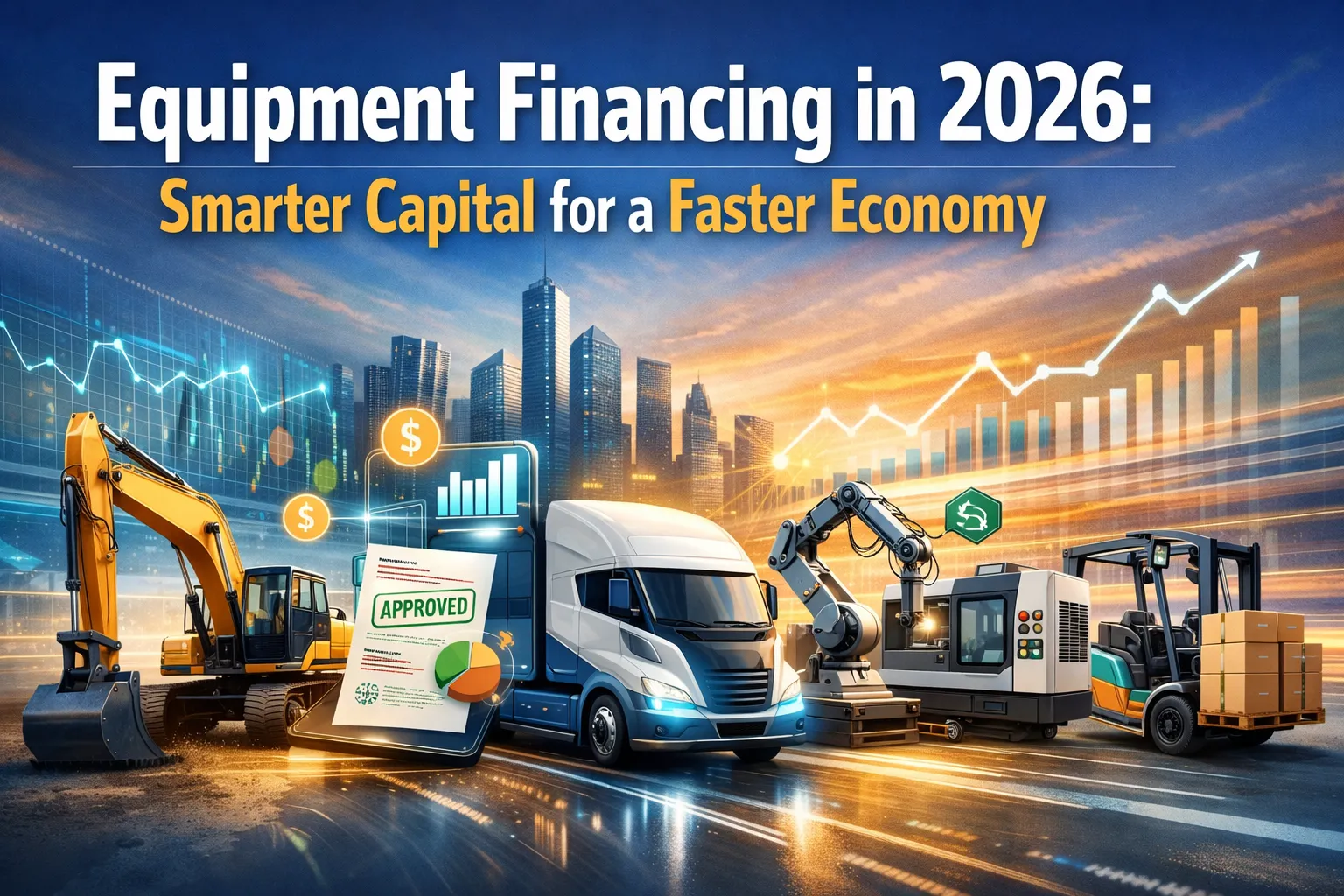
The economic landscape of 2026 demands speed, agility, and strategic capital deployment. Businesses across the United States face a common challenge: acquiring essential equipment and technology without depleting operational reserves or compromising growth initiatives. Consequently, equipment financing has evolved from a simple lending mechanism into a sophisticated capital strategy that aligns cash flow management with technological advancement.
Modern equipment financing addresses fundamental business concerns. Technology refreshment cycles have accelerated, while cybersecurity requirements demand continuous infrastructure updates. Moreover, competitive pressures require immediate access to cutting-edge tools. Traditional capital expenditure models increasingly fail to match the pace of business evolution, thereby creating opportunities for financing solutions that prioritize accessibility, flexibility, and strategic alignment.
The financing landscape in 2026 reflects broader economic transformations. Interest rate environments fluctuate based on Federal Reserve policies and inflation trends. Meanwhile, alternative lending platforms democratize access to capital previously reserved for large enterprises. Additionally, embedded financing solutions integrate directly into vendor relationships, and artificial intelligence streamlines approval processes that once required weeks of documentation review.
Understanding equipment financing options empowers business leaders to make informed decisions about capital allocation, technology adoption, and growth strategies. This comprehensive examination explores contemporary financing mechanisms, strategic considerations, vendor relationships, and practical implementation approaches that position businesses for sustained competitive advantage.
The Evolution of Equipment Financing Models
From Traditional Loans to Modern Flexible Solutions
Equipment financing has transformed significantly from conventional bank loans and basic leasing arrangements. Traditional models required substantial down payments, lengthy approval processes, and rigid repayment structures that often misaligned with business cash flow patterns. In contrast, contemporary financing solutions recognize that businesses require flexibility, speed, and customization to match diverse operational needs.
Several distinct financing models dominate the 2026 landscape. Equipment loans provide ownership pathways where businesses borrow capital to purchase assets outright, building equity while making fixed monthly payments. This approach suits organizations seeking long-term asset retention and potential tax advantages through depreciation schedules. Typically, loan terms range from three to seven years, with interest rates reflecting creditworthiness, collateral value, and market conditions.
Capital Leases and Operating Leases
Capital leases function similarly to conditional sales agreements, where businesses assume many ownership benefits including depreciation rights while making lease payments. At contract conclusion, organizations typically exercise purchase options at predetermined residual values. This structure appeals to companies wanting eventual ownership while managing initial capital requirements. Furthermore, capital leases appear on balance sheets as assets and liabilities, thereby impacting financial ratios that creditors and investors analyze.
Operating leases provide usage rights without ownership obligations, keeping assets off balance sheets in many accounting treatments. Monthly payments remain lower than equivalent loan scenarios since lessees pay for asset usage rather than full purchase value. At lease termination, businesses can return equipment, upgrade to newer models, or negotiate purchase options. Subsequently, this model suits rapidly evolving technologies where obsolescence risks outweigh ownership benefits.
Creative Financing Alternatives
Sale-leaseback arrangements enable businesses to monetize existing owned equipment by selling assets to financing companies then leasing them back. This creative financing unlocks capital trapped in depreciated assets while maintaining operational continuity. As a result, organizations convert fixed assets into working capital for expansion, debt reduction, or strategic initiatives while preserving essential equipment access through predictable lease terms.
Equipment-as-a-Service models represent emerging alternatives where manufacturers and vendors bundle financing, maintenance, and technology refreshment into subscription-based pricing. Organizations pay monthly fees covering equipment usage, service, upgrades, and eventual replacement. This comprehensive approach eliminates capital expenditure planning, simplifies budgeting, and ensures continuous access to current technology generations without financing negotiations or ownership burdens.
Technology-Specific Financing Considerations
IT Infrastructure and Hardware Financing
Different equipment categories present unique financing challenges and opportunities. Information technology infrastructure, medical equipment, manufacturing machinery, vehicles, and office systems each carry distinct depreciation curves, maintenance requirements, and operational lifespans that influence optimal financing strategies.
Technology equipment financing addresses rapid obsolescence concerns inherent in servers, networking hardware, endpoint devices, and specialized IT systems. Three-year refresh cycles dominate enterprise technology planning, aligning with manufacturer support lifecycles and security update availability. Consequently, financing terms matching these refresh intervals prevent businesses from making payments on obsolete equipment while facilitating seamless technology transitions through built-in upgrade provisions.
Server and Network Equipment
Server infrastructure financing requires careful consideration of scalability needs and cloud migration strategies. Companies transitioning from on-premises infrastructure to hybrid cloud environments need financing flexibility that accommodates changing equipment requirements. Shorter financing terms provide exit strategies if cloud adoption accelerates, whereas longer terms reduce monthly payments for organizations committed to maintaining substantial on-premises presence.
Cybersecurity equipment including firewalls, intrusion detection systems, endpoint protection appliances, and security information management platforms represent critical infrastructure investments. Financing these protective technologies aligns security investment with the continuous threat landscape evolution. Additionally, monthly payment structures enable businesses to implement comprehensive security architectures without depleting capital reserves needed for incident response or remediation activities.
Communications and Production Equipment
Telecommunications equipment such as VoIP phone systems, video conferencing platforms, and unified communications infrastructure benefits from financing approaches that accommodate rapid technology advancement. Cloud-based communication systems increasingly supplant premise-based equipment, yet some businesses require hybrid deployments combining on-premises hardware with cloud services. Therefore, financing arrangements should support these transitional architectures while providing upgrade pathways as organizational needs evolve.
Manufacturing and production equipment presents different considerations, with equipment lifespans often extending ten to fifteen years. Longer financing terms better match asset useful life, though technological improvements may render older equipment less competitive before physical obsolescence occurs. Furthermore, financing structures incorporating mid-term upgrade options balance long-term affordability with technological currency, enabling manufacturers to modernize production capabilities without complete system replacements.
Strategic Advantages of Equipment Financing
Preserving Cash Flow and Working Capital
Equipment financing delivers multiple strategic advantages beyond simple capital preservation. Understanding these benefits enables business leaders to leverage financing as a growth enabler rather than viewing it merely as a funding mechanism for asset acquisition.
Cash flow preservation ranks among the most significant advantages. Purchasing equipment outright creates substantial cash outflows that reduce working capital availability for payroll, inventory, marketing, or unexpected opportunities. In contrast, financing distributes acquisition costs across multiple periods, aligning payments with revenue generation from newly acquired assets. This cash flow alignment proves particularly valuable for growing businesses where liquidity constraints might otherwise delay essential equipment purchases.
Tax Benefits and Deductions
Tax optimization represents another compelling advantage. Financing structures may qualify for Section 179 deductions, bonus depreciation, or standard depreciation schedules that reduce taxable income. Businesses can deduct the full purchase price of qualifying equipment up to statutory limits through Section 179, providing immediate tax relief. Moreover, bonus depreciation enables additional first-year deductions for new equipment purchases. Consulting with tax professionals ensures financing structures maximize available deductions while complying with evolving tax regulations.
Balance Sheet and Financial Ratio Management
Balance sheet management benefits businesses monitoring debt-to-equity ratios, working capital metrics, or covenant requirements with existing lenders. Operating leases and certain financing structures keep equipment obligations off balance sheets, thereby improving financial ratios that investors and creditors evaluate. This accounting treatment preserves borrowing capacity for real estate acquisitions, business expansions, or strategic investments that require conventional financing.
Maintaining Technology Currency
Technology currency advantages allow businesses to maintain competitive technological capabilities without ownership burdens. Financing terms matching equipment useful life prevent businesses from operating obsolete technology while making payments on deprecated assets. Additionally, built-in refresh provisions enable seamless transitions to newer equipment generations, ensuring businesses access current capabilities, security features, and performance improvements that newer equipment delivers.
Risk mitigation occurs through various financing mechanisms. Maintenance agreements bundled with financing arrangements transfer equipment failure risks to service providers, preventing unexpected repair expenses from disrupting operations. Similarly, upgrade provisions protect against obsolescence risks by enabling mid-contract equipment exchanges as newer technologies emerge. These risk transfer mechanisms provide operational predictability that ownership models cannot match.
Qualifying for Equipment Financing
Credit Requirements and Business History
Understanding qualification criteria enables businesses to prepare effectively for financing applications and improve approval probabilities. Lenders evaluate multiple factors when assessing financing requests, with emphasis varying based on financing amount, equipment type, and lender risk tolerance.
Credit history remains fundamental to financing approvals. Lenders examine both business credit scores and personal credit profiles of business owners, particularly for smaller organizations or newer businesses with limited operating history. Generally, FICO scores above 680 improve approval odds and secure favorable interest rates, while scores below 600 may require additional collateral, higher down payments, or personal guarantees from business principals.
Time in business significantly influences lender confidence. Established businesses with three or more years of operating history demonstrate survival capability and market viability that startups cannot evidence. Conversely, newer businesses often face higher interest rates, larger down payment requirements, or more restrictive terms reflecting the higher statistical default risk associated with early-stage ventures. Some specialized lenders focus specifically on startup financing, offering programs tailored to businesses with compelling growth trajectories despite limited operating history.
Financial Statements and Documentation
Financial statement analysis provides lenders insight into business health and repayment capacity. Profit and loss statements reveal revenue trends, profitability patterns, and expense management. Meanwhile, balance sheets show asset bases, liability structures, and equity positions. Cash flow statements demonstrate actual cash generation capability and liquidity strength. Lenders calculate debt service coverage ratios comparing operating income to existing debt obligations plus proposed equipment payments, typically requiring minimum ratios of 1.25 to 1.35 to ensure adequate payment capacity.
Collateral value protects lenders against default scenarios. The equipment being financed serves as primary collateral, with lenders advancing percentages of appraised fair market value or cost. Equipment with established secondary markets and predictable depreciation curves supports higher advance rates than specialized equipment with limited resale potential. Furthermore, additional collateral such as real estate, inventory, or accounts receivable may strengthen applications for borrowers with limited credit history or requesting financing amounts exceeding equipment value.
Documentation requirements have standardized across most lenders, though specific requests vary by financing size and complexity. Typical requirements include completed applications with business and personal information, two to three years of business tax returns, current financial statements, bank statements demonstrating cash flow patterns, and equipment quotes or invoices specifying costs and vendor details. Well-organized documentation packages expedite approval processes and demonstrate the organizational competence that lenders value.
Interest Rates and Terms in 2026
Current Rate Environment
Interest rate environments directly impact equipment financing costs and optimal financing structures. The Federal Reserve’s monetary policy decisions, inflation trends, and broader economic conditions influence the rates that lenders charge for equipment financing across various structures.
Equipment financing rates in early 2026 reflect a moderating interest rate environment following the aggressive tightening cycles of previous years. Prime rates influence equipment loan pricing, with lenders adding margins based on borrower creditworthiness, equipment type, and loan-to-value ratios. Well-qualified borrowers with strong credit profiles may secure rates ranging from 6% to 10% for term loans. In contrast, businesses with credit challenges might encounter rates from 12% to 20% or higher depending on risk factors.
Understanding Lease Factors and Rate Structures
Lease rate factors provide alternative pricing mechanisms for lease structures. Rather than quoting annual percentage rates, lessors express pricing through lease factors or money factors that borrowers multiply by equipment costs to calculate monthly payments. For example, a lease factor of 0.025 applied to $100,000 equipment cost generates monthly payments of $2,500. Converting lease factors to approximate interest rates requires multiplying by 24, yielding roughly 60% APR in this example, though precise equivalent rates depend on specific lease structures and accounting treatments.
Fixed versus variable rate decisions influence payment predictability and total financing costs. Fixed rates lock payment amounts throughout financing terms, providing budget certainty and protecting against rate increases in rising interest environments. Conversely, variable rates tied to prime rate or SOFR indexes fluctuate based on market conditions, potentially offering lower initial costs but creating payment uncertainty as rates adjust. Most equipment financing utilizes fixed rates given the relatively short terms compared to commercial mortgages where variable rates appear more frequently.
Selecting Optimal Terms and Down Payments
Term length selection balances monthly payment affordability against total interest costs and equipment useful life. Shorter terms generate higher monthly payments but reduce total interest paid and align payment obligations with equipment productivity periods. Conversely, longer terms lower monthly burdens but increase cumulative interest costs and risk extending payments beyond equipment economic viability. Optimal terms typically match equipment useful life minus one to two years, providing payment completion before equipment replacement becomes necessary.
Down payment requirements vary based on lender policies, equipment types, and borrower qualifications. Traditional lenders often require 10% to 20% down payments on equipment purchases, reducing loan-to-value ratios and borrower default incentives. Strong credit borrowers may secure 100% financing on newer equipment with predictable resale values. However, specialized or older equipment typically requires larger down payments reflecting limited secondary market liquidity. Higher down payments generally secure lower interest rates by reducing lender risk exposure.
Vendor Financing Versus Traditional Lenders
Streamlined Vendor Programs
Businesses seeking equipment financing encounter choices between vendor-arranged financing through equipment suppliers and traditional lending relationships with banks, credit unions, or independent finance companies. Each approach presents distinct advantages and considerations that influence optimal financing source selection.
Vendor financing programs offer streamlined application processes integrated directly into equipment purchase transactions. Manufacturers and distributors partner with captive finance arms or third-party lenders to provide immediate financing options during sales discussions. This convenience eliminates separate financing applications and coordinates delivery timing with funding availability. Additionally, vendor programs often feature promotional rates, deferred payment periods, or special terms designed to stimulate equipment sales during specific periods or for certain product lines.
Traditional Banking Relationships
Traditional lenders provide potentially broader equipment coverage and relationship banking benefits. Established banking relationships may yield more favorable terms than vendor programs for creditworthy borrowers, particularly when financing multiple equipment types or coordinating equipment financing with other business credit needs. Furthermore, banks offering comprehensive commercial services can structure equipment financing alongside working capital lines, real estate loans, or treasury management services that vendor programs cannot provide.
Comparing Flexibility and Approval Speed
Flexibility differences distinguish these financing sources significantly. Vendor programs typically restrict financing to specific manufacturer equipment, thereby limiting competitive equipment comparisons and potentially constraining optimal equipment selection. In contrast, traditional lenders generally finance equipment from any vendor, empowering businesses to select equipment based purely on performance, features, and value rather than financing availability. This flexibility proves particularly valuable when businesses require multiple equipment types from various vendors within single financing transactions.
Approval speed varies considerably between sources. Vendor programs emphasizing sales support often feature accelerated approvals using automated underwriting systems that provide decisions within hours or days. Conversely, traditional bank approvals may require several weeks for larger transactions involving committee reviews and extensive documentation analysis. However, established banking relationships with pre-approved credit facilities can sometimes facilitate immediate funding that rivals vendor program speed.
Pricing competitiveness requires careful comparison. Vendor promotional rates occasionally beat traditional lending costs, particularly during end-of-quarter sales pushes or new product launches. Nevertheless, vendor programs may embed equipment price premiums that offset apparent financing savings. Therefore, businesses should compare total acquisition costs including equipment prices, financing rates, fees, and ancillary charges across vendor and traditional financing options to identify genuinely economical solutions.
The Role of AI in Equipment Financing
Automated Underwriting and Risk Assessment
Artificial intelligence has fundamentally transformed equipment financing processes, from initial applications through approval decisions and ongoing account management. These technological advances benefit both lenders seeking operational efficiency and borrowers requiring faster, more accessible financing solutions.
Automated underwriting systems analyze financing applications using machine learning algorithms trained on thousands of historical approval decisions. These systems evaluate credit scores, financial statement patterns, industry risk profiles, and equipment characteristics to generate preliminary approval decisions within minutes rather than the days or weeks traditional manual underwriting required. Subsequently, algorithms identify approval likelihood, suggest appropriate terms, and flag applications requiring human review, dramatically accelerating financing timelines for straightforward transactions.
Risk assessment models leverage vast data repositories to predict default probabilities more accurately than conventional credit scoring alone. AI systems incorporate alternative data sources including payment histories with vendors, social media business profiles, online review patterns, and industry performance trends. Consequently, these comprehensive risk evaluations enable lenders to approve marginal borrowers who traditional models would decline, expanding equipment financing access for businesses with limited credit history but strong operational indicators.
Fraud Detection and Customer Service
Fraud detection algorithms protect lenders from sophisticated application fraud schemes. AI systems identify suspicious patterns including fabricated financial statements, duplicate equipment serial numbers, falsified vendor quotes, or application information inconsistencies. Real-time verification processes cross-reference submitted information against public records, vendor databases, and previous application histories to detect fraudulent activity before funding occurs. These protections reduce lender losses while maintaining approval speed for legitimate applications.
Chatbot assistants provide instant responses to borrower questions throughout application and servicing lifecycles. Natural language processing enables these systems to interpret questions, access account information, and deliver helpful responses covering payment schedules, payoff quotes, lease-end options, and general financing questions. As a result, borrowers receive immediate assistance without waiting for representative availability, improving satisfaction while reducing lender service costs.
Predictive Analytics and Document Processing
Predictive analytics guide portfolio management decisions by identifying accounts at elevated default risk before payment delinquencies occur. Early warning systems monitor payment patterns, account activity, credit report changes, and industry conditions to flag potential problems. Proactive outreach to struggling borrowers enables workout arrangements that prevent defaults, thereby preserving lender returns while helping businesses through temporary difficulties.
Document processing automation extracts relevant information from uploaded financial statements, bank statements, and tax returns using optical character recognition and intelligent data capture. Systems populate application fields automatically, reducing manual data entry errors and accelerating review processes. Moreover, advanced systems even verify financial statement accuracy by comparing reported figures against typical industry patterns, flagging discrepancies that merit additional scrutiny.
Equipment Financing for Technology Upgrades
Server and Data Center Financing
Technology infrastructure represents one of the most common equipment financing applications for businesses nationwide. The unique characteristics of IT equipment financing require specialized approaches that account for rapid obsolescence, security requirements, and evolving technology strategies.
Server replacement financing enables businesses to maintain current data center capabilities without large capital expenditures that strain budgets during already expensive refresh cycles. Three to five-year financing terms align with typical server useful life, ensuring payment obligations conclude before next refresh requirements. Additionally, financing arrangements can include trade-in provisions where existing equipment offsets partial costs of new deployments, reducing net financing amounts and monthly payment burdens.
Network Infrastructure and Endpoint Devices
Network infrastructure upgrades encompass switches, routers, wireless access points, and cabling systems that form business connectivity foundations. Financing these comprehensive projects allows phased deployments where businesses implement improvements across multiple locations or departments without depleting capital reserves in single periods. Furthermore, milestone-based funding releases coordinate equipment purchases with installation progress, preventing excess inventory holding costs and financing charges on undeployed equipment.
Endpoint device financing addresses the continuous need for workstation, laptop, and mobile device refreshment. Many businesses establish perpetual refresh programs where specific device percentages receive replacement annually, distributing upgrade costs across multiple budget periods. Master lease agreements facilitate these programs by establishing financing frameworks that accommodate equipment additions throughout agreement terms without renegotiating complete arrangements for each procurement cycle.
Cybersecurity and Cloud Migration Equipment
Cybersecurity equipment financing recognizes that protective technologies represent essential rather than discretionary investments. Financing next-generation firewalls, endpoint detection systems, security information management platforms, and backup infrastructure enables businesses to implement comprehensive security architectures despite competing capital priorities. Importantly, the immediate protection that financed security equipment provides often prevents breach costs that dwarf financing interest expenses, making security financing particularly economically sound.
Cloud migration transitional financing supports hybrid infrastructure strategies where businesses maintain some on-premises equipment while migrating specific workloads to cloud platforms. Shorter financing terms provide flexibility for businesses uncertain about ultimate cloud adoption scope. Additionally, structured early termination provisions enable financing exits if cloud migration accelerates beyond initial projections. This financing flexibility reduces cloud adoption barriers by managing the transitional period financial complexity.
Financial Planning and Equipment Financing Strategy
Integrating Financing into Capital Budgeting
Integrating equipment financing into comprehensive financial planning ensures that acquisition strategies support rather than compromise broader business objectives. Strategic financing approaches align equipment investments with growth plans, cash flow patterns, and capital allocation priorities.
Capital budgeting processes should incorporate equipment financing availability when evaluating technology investments and operational improvements. Rather than viewing equipment decisions purely through cash purchase lenses, financial planning models should compare ownership costs against financing alternatives including total interest charges, tax implications, and opportunity costs of capital deployment. Net present value analyses accounting for financing structures often reveal that preserving capital for higher-return opportunities justifies financing costs even when businesses possess purchase cash.
Cash Flow Forecasting and Debt Management
Cash flow forecasting incorporating equipment financing commitments provides realistic liquidity projections that inform working capital management. Monthly financing payments represent fixed obligations that require cash availability regardless of revenue fluctuations. Maintaining conservative forecasting ensures that businesses have adequate liquidity cushions beyond financing requirements, thereby preventing situations where equipment obligations crowd out payroll, vendor payments, or other critical expenses during slower business periods.
Debt capacity management recognizes that equipment financing consumes borrowing capability that might otherwise support real estate purchases, business acquisitions, or emergency credit lines. Organizations should maintain awareness of total debt obligations relative to cash flow generation and lender covenant requirements. Strategic equipment financing timing coordinates major acquisitions to avoid exceeding debt service coverage thresholds or debt-to-equity ratios that trigger covenant violations or limit additional borrowing capacity.
Technology Refresh Planning and Vendor Relationships
Technology refresh planning establishes systematic equipment replacement schedules that prevent urgent acquisitions during inopportune financial periods. Multi-year refresh calendars coordinate financing origination timing to smooth monthly payment obligations rather than concentrating renewal obligations in single periods. Staggered financing maturities prevent balloon payment concentrations that create liquidity challenges, thereby distributing refinancing risks across multiple periods.
Vendor relationship management enhances financing negotiation leverage. Strong vendor relationships built through consistent purchasing patterns often unlock preferential financing terms, extended payment provisions, or bundled service agreements that improve total acquisition economics. Organizations should cultivate relationships with multiple vendors to maintain competitive tension while ensuring backup supply sources if primary vendor relationships deteriorate or preferred vendors cannot accommodate specific requirements.
Common Equipment Financing Mistakes to Avoid
Underestimating Total Ownership Costs
Understanding frequent financing mistakes enables businesses to avoid costly errors that compromise financial flexibility or result in suboptimal equipment investments. Learning from common pitfalls improves financing decision quality and execution.
Underestimating total ownership costs represents a prevalent mistake where businesses focus exclusively on monthly financing payments while overlooking maintenance, insurance, training, and operational expenses. Comprehensive cost analysis should incorporate all ownership expenses to ensure that businesses can afford not just equipment acquisition but ongoing operation and support. Failure to account for these ancillary costs sometimes forces premature equipment disposal or curtailed utilization that negates intended productivity benefits.
Overextending Terms and Ignoring Exit Clauses
Overextending financing terms to minimize monthly payments creates situations where businesses make payments on obsolete equipment or continue obligations after equipment utility expires. While longer terms reduce monthly burdens, they increase total interest costs and risk leaving businesses locked into outdated technology. Optimal terms balance affordability with equipment useful life, thereby preventing payment obligations from extending beyond productive equipment operation periods.
Neglecting early termination provisions leaves businesses trapped in financing obligations for equipment that changing strategies render unnecessary. Restructuring, acquisitions, technology pivots, or operational changes sometimes eliminate equipment needs before financing concludes. Financing agreements lacking early termination options or including prohibitive prepayment penalties can force businesses to continue paying for unused equipment or accept substantial financial penalties to exit agreements. Including reasonable termination provisions provides flexibility to adapt to unforeseen circumstances.
Tax Planning and Negotiation Oversights
Ignoring tax implications results in suboptimal deduction timing or missed opportunities for advantageous tax treatments. Different financing structures carry varying tax consequences regarding deduction availability, timing, and limitations. Consulting with tax advisors when structuring significant equipment financing helps maximize tax benefits while ensuring compliance with complex depreciation rules, deduction limitations, and evolving tax regulations.
Failing to negotiate terms represents another common oversight. Many businesses accept initial financing proposals without exploring alternative structures, rate reductions, or improved terms. Lenders typically price initial proposals conservatively, expecting negotiation. Organizations with strong credit profiles, existing banking relationships, or competitive quotes often secure meaningful improvements through professional negotiation. Consequently, fee reductions, rate decreases, or enhanced terms can generate thousands in savings on significant financing transactions.
Rushing equipment selection to meet financing deadlines sometimes results in suboptimal equipment choices. While financing approvals typically include time limitations before expiration, businesses should resist pressure to select equipment hastily. Thoroughly evaluating equipment performance, features, vendor support quality, and long-term suitability prevents expensive mistakes where financed equipment fails to meet operational requirements. Extended evaluation periods typically prove more economical than premature commitments to inappropriate equipment.
Industry-Specific Equipment Financing Applications
Healthcare and Medical Equipment
Different industries present unique equipment financing scenarios that reflect sector-specific equipment types, depreciation patterns, and operational considerations. Understanding industry dynamics informs appropriate financing strategies for businesses across various sectors.
Healthcare equipment financing addresses expensive medical technology including diagnostic equipment, patient monitoring systems, therapeutic devices, and electronic health record systems. Medical equipment often carries regulatory certification requirements and specialized maintenance needs that influence financing structures. Longer equipment useful lives in medical settings sometimes justify extended financing terms, particularly for durable diagnostic equipment with ten to fifteen-year service expectations. Additionally, technology components within medical systems may require modular financing enabling subsystem upgrades without replacing entire platforms.
Professional Services and Construction
Professional services firms financing conference systems, presentation equipment, specialized software licenses, and office infrastructure benefit from financing structures accommodating variable utilization patterns. Organizations experiencing seasonal volume fluctuations might prefer seasonal payment schedules aligning higher payments with busy periods and reduced payments during slower months. This payment flexibility improves cash flow alignment and prevents financing obligations from straining liquidity during predictable low-revenue periods.
Construction businesses financing heavy equipment face unique depreciation and utilization considerations. Construction equipment endures harsh operating conditions that accelerate wear and require intensive maintenance. Financing terms should account for faster depreciation by aligning payment periods with realistic equipment service lives in demanding construction applications. Furthermore, usage-based financing where payments adjust based on equipment hours sometimes better matches payment obligations to actual equipment productivity and corresponding revenue generation.
Hospitality and Manufacturing Operations
Hospitality businesses financing kitchen equipment, point-of-sale systems, property management platforms, and guest service technology require financing flexibility accommodating renovation cycles and franchise system requirements. Franchise agreements often specify mandatory equipment standards and refresh schedules that drive financing needs on timelines outside business control. Therefore, financing structures aligned with franchise requirements prevent compliance issues while managing the significant capital demands that franchise system participation imposes.
Manufacturing operations financing production equipment, automation systems, quality control instrumentation, and inventory management platforms benefit from financing structures recognizing long equipment useful lives and major capital improvement project timing. Manufacturers frequently implement equipment upgrades during planned facility shutdowns or expansion projects. Coordinating financing closings with project schedules ensures funding availability when needed while avoiding carrying costs on idle equipment awaiting installation.
Equipment Financing and Business Growth
Capacity Expansion and Market Entry
Equipment financing frequently serves as a growth enabler that removes capital constraints limiting expansion opportunities. Understanding how to leverage financing strategically accelerates business development while managing financial risks inherent in growth initiatives.
Capacity expansion projects requiring additional production equipment, vehicles, or facility infrastructure consume substantial capital that growing businesses often lack. Financing these growth investments enables businesses to capture market opportunities without delaying expansion until internal cash generation provides purchase capital. The revenue growth that additional capacity enables typically generates sufficient cash flow to service financing obligations while funding continued operations and development.
Market entry initiatives requiring specialized equipment for new product lines or service offerings represent significant capital commitments with uncertain return timelines. Financing these exploratory investments limits downside exposure by capping initial capital commitments while preserving working capital reserves for sustained market development efforts. If market entry succeeds, equipment financing costs represent modest portions of resulting revenue streams. Conversely, if market reception disappoints, limited initial capital deployment minimizes sunk costs compared to outright equipment purchases.
Competitive Response and Acquisition Integration
Competitive response scenarios where competitors deploy new technologies or capabilities force reactive equipment investments to maintain market position. Organizations cannot always postpone these defensive investments until convenient financial timing permits. Equipment financing provides immediate response capability without exhausting capital reserves or compromising existing operations. The business preservation value of matching competitive capabilities often justifies financing costs that maintaining market position requires.
Acquisition integration frequently requires equipment harmonization where acquired businesses operate incompatible systems or outdated equipment. Post-acquisition equipment upgrades standardize operations, eliminate redundant systems, and capture synergies that acquisition strategies project. Financing these integration investments spreads acquisition total costs across extended periods, thereby preventing working capital drains during already complex integration processes requiring substantial management attention and organizational resources.
Geographic expansion into new markets demands equipment duplication across multiple locations. Financing enables simultaneous multi-location deployments that accelerate market penetration and competitive positioning. Staggered outright purchases might require sequential market entry that allows competitors to establish presence in planned expansion markets before businesses complete funding cycles for subsequent locations. Coordinated financing across multiple locations facilitates synchronized expansion that captures first-mover advantages.
Frequently Asked Questions
What types of equipment qualify for financing in 2026?
Most business equipment qualifies for financing including IT infrastructure, telecommunications systems, manufacturing machinery, medical equipment, vehicles, office equipment, restaurant equipment, and construction machinery. Lenders prefer equipment with predictable useful lives and established resale markets. Even software licenses and highly specialized equipment can qualify through specialized lenders focusing on niche categories.
How long does equipment financing approval typically take?
Approval times vary by amount and lender. Applications under $100,000 with online lenders often receive decisions within hours to two days. Traditional bank financing for $100,000-$500,000 takes three to ten business days. Large transactions exceeding $500,000 may require two to four weeks. Complete documentation significantly accelerates approval timelines.
Can startups or new businesses qualify for equipment financing?
Yes, though startups face higher rates, larger down payments (20-30%), and often require personal guarantees. Lenders emphasize owner credit scores, industry experience, and business plan quality. Startups with strong owner credit above 700, substantial down payments, and equipment with reliable resale value have the best approval prospects.
What credit score is needed for equipment financing approval?
Scores above 680 typically qualify for competitive rates with most lenders. Scores between 600-680 still qualify but at higher rates with additional requirements. Scores below 600 significantly restrict options and require specialized subprime lenders. Some alternative lenders emphasize business performance over credit scores.
Should I choose an equipment loan or lease?
Loans suit businesses wanting ownership, long-term use, and depreciation tax benefits. Leases work better for rapidly obsolescent equipment, off-balance-sheet treatment preference, and lower monthly payments. Model total costs including taxes and disposition expenses. Consult tax advisors to optimize deduction timing.
What happens if I can’t make equipment financing payments?
Contact your lender immediately before missing payments. Many offer workout programs including payment reductions, interest-only periods, or deferrals. Missed payments trigger late fees, negative credit reporting, and potential equipment repossession. Early communication demonstrates good faith and enables collaborative solutions protecting both parties.
Can equipment financing help build business credit?
Yes. Timely payments report to business credit bureaus including Dun & Bradstreet, Experian Business, and Equifax Business, establishing positive payment history. Successful equipment financing demonstrates creditworthiness to future lenders, securing better terms on subsequent needs and eventually enabling financing based on business rather than personal credit.
Are there tax benefits to equipment financing?
Several benefits exist depending on structure. Section 179 allows deducting full equipment purchase prices up to $1,220,000 in 2026. Bonus depreciation permits additional first-year deductions. Loan interest generates business expense deductions. Lease payments may qualify for immediate expense deduction. Consult tax professionals to maximize available deductions.
What documents do I need to apply for equipment financing?
Typical requirements include completed application, two to three years of business tax returns, current profit/loss statements and balance sheets, three to six months of bank statements, equipment quotes or invoices, and business entity documents. Startups may need personal financial statements, business plans, and owner resumes. Well-organized packages accelerate approvals.
Can I refinance existing equipment to free up capital?
Yes. Equipment refinancing provides capital access for businesses owning equipment outright or with substantial equity. Lenders advance 60-80% of current fair market value, generating proceeds for working capital, debt consolidation, or expansion. Refinancing works best for newer equipment maintaining significant value. Sale-leaseback arrangements represent alternatives maximizing proceeds while maintaining equipment access.

No comment