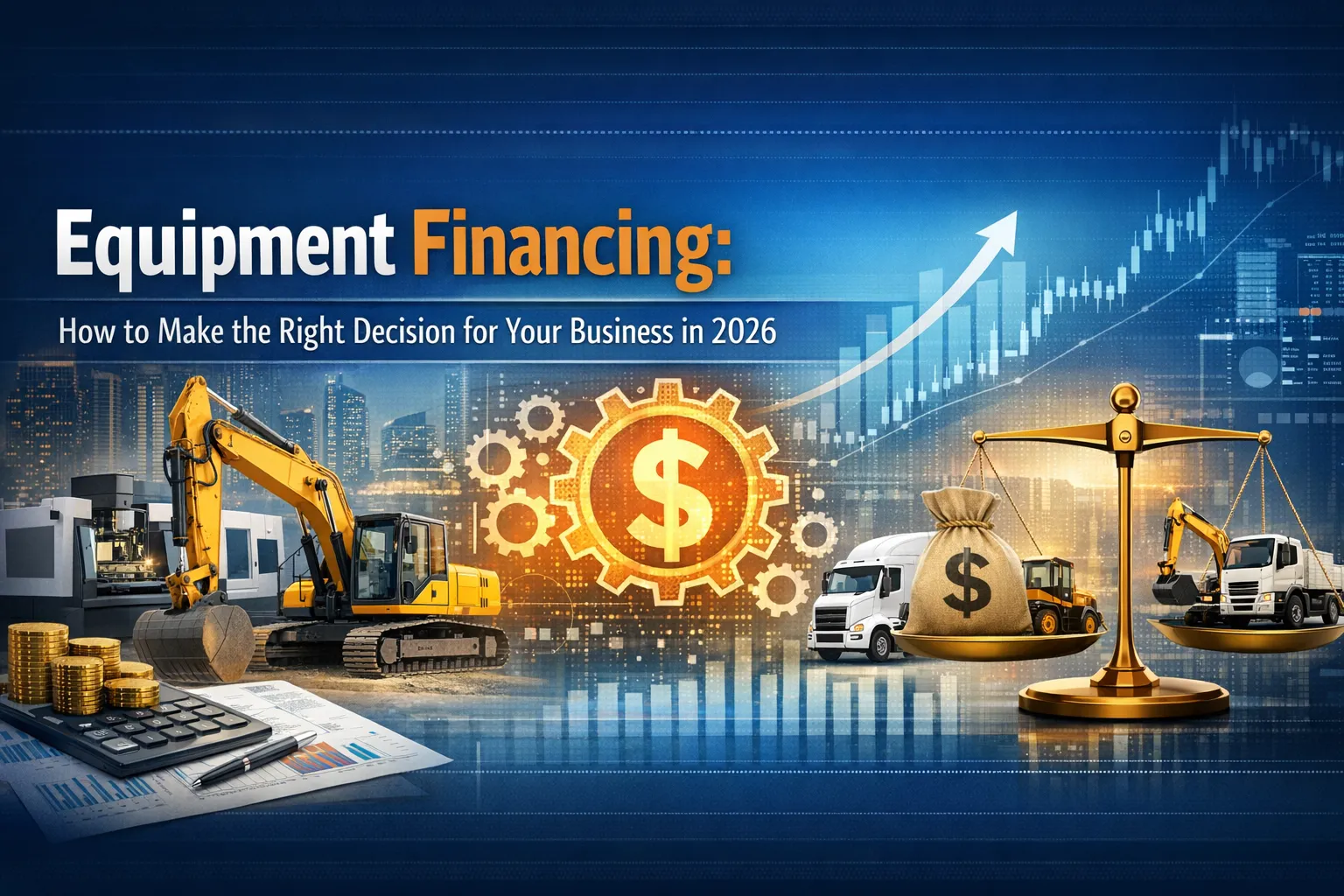
Equipment Financing: How to Make the Right Decision for Your Business in 2026
Every business owner eventually faces the equipment financing decision. The manufacturing company needs a CNC machine. The construction contractor requires an excavator. The restaurant needs a commercial kitchen upgrade. The question is never whether to acquire essential equipment but how to acquire it wisely.
The equipment financing industry has grown to $1.4 trillion, with businesses financing more than three-quarters of their equipment and software purchases rather than buying outright. Credit approval rates hover near historic highs at 78%, while delinquency rates remain stable at just 2%. These favorable conditions create opportunities but also require careful decision-making to capture the best available terms.
Making the right equipment financing decision involves more than comparing interest rates. You need to evaluate whether financing makes sense at all, choose between new and used equipment, select the right financing structure, and identify the lender type that best serves your situation. Getting these decisions right can save thousands of dollars and position your business for sustainable growth.
This guide walks through the equipment financing decisions facing business owners in 2026 and provides frameworks for making choices that align with your business objectives.
The First Decision: Should You Finance at All
Before exploring financing options, determine whether financing actually makes sense for your situation. While most businesses benefit from preserving cash through equipment financing, certain circumstances favor outright purchase.
When Financing Makes Strategic Sense
Financing becomes the right choice when preserving working capital serves your business better than avoiding interest costs. This applies in several common situations.
Businesses experiencing growth opportunities benefit from keeping cash available for hiring, inventory, marketing, and other investments that fuel expansion. Tying up capital in equipment purchases limits flexibility precisely when flexibility matters most. The interest cost on equipment financing often pales compared to the opportunity cost of missing growth windows.
Companies with unpredictable cash flow patterns find financing valuable for maintaining stability. Fixed monthly payments spread over years prove easier to manage than large one-time expenditures that create temporary cash crunches. Seasonal businesses particularly benefit from matching equipment costs to revenue patterns through structured payment plans.
Organizations acquiring equipment that generates immediate revenue should consider financing to accelerate returns. Equipment that sits waiting while you save for outright purchase represents lost production. Financing allows the equipment to start generating revenue immediately, often exceeding the financing cost within months.
Businesses building credit history benefit from equipment financing as a relationship-building tool with lenders. Successfully completing an equipment loan establishes track record for future financing needs when expansion opportunities arise.
When Paying Cash Makes More Sense
Despite financing advantages, certain situations favor outright purchase.
Businesses sitting on excess cash with limited investment opportunities may prefer purchasing equipment directly. If cash generates minimal returns while sitting in bank accounts, using it to avoid interest charges makes financial sense. However, consider whether that cash might serve better purposes before committing it to equipment.
Companies acquiring inexpensive equipment may find financing transaction costs outweigh benefits. Equipment costing a few thousand dollars rarely justifies the paperwork and fees associated with formal financing arrangements. Credit cards or operating cash handle these smaller purchases more efficiently.
Organizations nearing debt capacity limits may need to conserve borrowing capacity for higher-priority needs. If you anticipate needing credit lines for working capital or face lending covenants that restrict additional debt, paying cash for equipment preserves flexibility for more critical financing needs.
Equipment with uncertain useful life or rapidly changing technology sometimes argues against long-term financing commitments. If equipment may become obsolete before the loan term ends, ownership flexibility becomes valuable.
The Hybrid Approach
Many businesses find optimal results through hybrid approaches combining cash and financing. Making larger down payments reduces interest costs while still preserving most working capital. This middle path captures benefits from both strategies.
Consider equipment value and useful life when determining down payment amounts. Equipment holding value well supports lower down payments since collateral protects lender interests regardless. Equipment depreciating rapidly may require larger down payments to maintain favorable loan-to-value ratios throughout the financing term.
New Versus Used Equipment: The Cost-Value Calculation
After deciding to finance, the next choice involves new versus used equipment. This decision significantly impacts both financing terms and total ownership costs.
Advantages of Financing New Equipment
New equipment offers several financing advantages that used equipment cannot match.
Lenders offer the most favorable terms for new equipment from established manufacturers. Interest rates run lower, term lengths extend longer, and down payment requirements shrink compared to used equipment financing. The combination of manufacturer warranties, predictable depreciation curves, and established resale markets reduces lender risk, savings passed to borrowers through better terms.
Manufacturer financing programs sometimes offer below-market rates or promotional terms unavailable through independent lenders. These captive finance companies use attractive financing as a sales tool, creating opportunities for borrowers willing to accept brand-specific equipment.
New equipment includes warranties covering repairs and maintenance during initial years of operation. These warranties reduce total ownership costs and eliminate the uncertainty of surprise repair expenses that plague used equipment purchases.
Technology advantages in new equipment can translate to productivity gains, energy efficiency, and competitive advantages. The latest models often incorporate improvements learned from previous generations, addressing known weaknesses and adding capabilities.
Advantages of Financing Used Equipment
Used equipment provides compelling advantages for cost-conscious businesses.
Initial purchase prices for used equipment run 30 to 70 percent below new equipment costs, depending on age and condition. These savings translate directly to lower financing amounts, reduced monthly payments, and less total interest paid over the loan term.
Depreciation already absorbed by previous owners eliminates the steepest value decline. New equipment loses 20 to 40 percent of value immediately after purchase. Buying used means paying prices reflecting actual production value rather than new-equipment premiums.
Used equipment with documented maintenance history represents known quantities. Service records reveal how equipment was treated, what components were replaced, and potential remaining issues. This transparency sometimes exceeds what new equipment provides since performance remains theoretical until proven in actual use.
Faster availability often accompanies used equipment purchases. New equipment may require months of lead time for manufacturing and delivery. Used equipment sitting on dealer lots or available from other businesses can be operational within days or weeks.
Lender Perspectives on New Versus Used
Understanding how lenders view new and used equipment helps set realistic expectations.
Most lenders readily finance new equipment with favorable terms. The combination of manufacturer support, warranty coverage, and predictable value retention minimizes lender concerns.
Used equipment financing requires more careful evaluation. Lenders consider equipment age, with most preferring equipment no more than 10 years old and many limiting financing to equipment with substantial remaining useful life. Condition documentation, maintenance records, and professional inspections may be required to establish equipment value accurately.
Equipment with strong secondary markets finances more easily than specialized machinery with limited resale potential. Common equipment types like trucks, trailers, and standard manufacturing machinery enjoy broader lender acceptance than niche equipment with few potential buyers if repossession becomes necessary.
Interest rates for used equipment typically run somewhat higher than comparable new equipment financing. However, the lower purchase price often more than compensates, keeping total acquisition costs below new equipment alternatives.
Choosing the Right Financing Structure
Equipment financing comes in several structures, each with distinct characteristics suited to different situations.
Equipment Loans: The Ownership Path
Equipment loans provide capital to purchase equipment outright, with the equipment serving as collateral. You own the equipment from day one and build equity with each payment until the loan concludes.
Loans make sense when you intend to use equipment for its full useful life. Equipment matching your long-term operational needs justifies the ownership commitment. Loans also provide potential tax advantages through depreciation deductions and Section 179 expensing that allows deducting full equipment cost in the purchase year.
Typical loan terms range from two to seven years depending on equipment type and useful life. Interest rates in early 2026 range from 4 to 20 percent based on borrower creditworthiness, equipment type, and market conditions. Well-qualified borrowers with strong credit profiles secure rates toward the lower end while challenged credit situations command premium rates.
Down payments commonly range from 10 to 20 percent of equipment cost, though some lenders offer zero-down options for strong applicants. Larger down payments reduce interest costs but require more upfront capital.
Equipment Leases: Flexibility and Predictability
Equipment leases provide use of equipment without ownership commitment. Monthly payments rent the equipment for a defined term, with various options at lease conclusion.
Capital leases function similarly to conditional sales agreements where you assume most ownership benefits including depreciation rights. At term end, you exercise purchase options at predetermined residual values, typically $1 or fair market value. Capital leases suit businesses wanting eventual ownership while spreading costs over time.
Operating leases function as true rental arrangements where you return equipment at lease end without ownership obligations. These work well for equipment becoming obsolete quickly, allowing transitions to newer models without selling outdated assets. Technology equipment, medical imaging systems, and rapidly evolving manufacturing tools often suit operating lease structures.
Leases typically require no down payment and may offer lower monthly payments than loans for equivalent equipment. However, total payments over the lease term often exceed equipment purchase price since you’re essentially paying for use rather than ownership.
Equipment-as-a-Service: The Subscription Model
Equipment-as-a-Service represents one of the most significant financing trends in 2026. Instead of buying or leasing equipment outright, businesses pay monthly subscription fees typically covering equipment, maintenance, repairs, and future upgrades.
This model converts large capital expenses into predictable monthly operating costs. Working capital remains available for other priorities. When equipment becomes outdated, upgrading to newer models often comes included rather than requiring additional capital expenditure.
Healthcare practices, technology companies, and manufacturers in fast-moving industries particularly benefit from Equipment-as-a-Service arrangements. The model eliminates equipment obsolescence risk while ensuring access to current technology.
Monthly costs may exceed traditional financing payments, but comprehensive service coverage often makes total cost of ownership competitive. Evaluate specific offerings carefully since service levels and upgrade provisions vary significantly across providers.
Selecting the Right Lender Type
Multiple lender types compete for equipment financing business, each offering distinct advantages and limitations.
Traditional Banks
Banks offer equipment financing with competitive interest rates, especially for established businesses with strong credit profiles and existing banking relationships. Rates through primary banking relationships often beat alternative lenders.
Banks conduct thorough underwriting considering overall financial position beyond just the equipment transaction. This comprehensive evaluation benefits strong applicants but can slow approval timelines and exclude businesses with limited operating history or credit challenges.
Documentation requirements tend toward the extensive end with banks. Expect requests for multiple years of tax returns, detailed financial statements, and comprehensive business information. Approval timelines of one to four weeks are common for meaningful loan amounts.
Relationship benefits extend beyond individual transactions. Equipment financing through your bank strengthens overall relationships that may benefit future credit needs, though this cuts both ways since equipment financing problems could affect other banking relationships.
Online and Alternative Lenders
Online lending platforms have democratized equipment financing access, offering faster approvals and more flexible qualification criteria than traditional banks.
These lenders leverage technology to evaluate applications rapidly, often delivering decisions within hours rather than weeks. AI-powered underwriting analyzes hundreds of data points beyond conventional credit scores, including real-time cash flow patterns and industry performance benchmarks.
Qualification requirements accommodate businesses that might struggle with traditional bank standards. Minimum credit score thresholds run lower, time-in-business requirements may start at one year rather than two or three, and revenue thresholds prove more accessible for smaller operations.
Interest rates from alternative lenders typically exceed bank rates, reflecting the higher risk profiles many borrowers present. However, for businesses unable to qualify through traditional channels, these lenders provide access that didn’t previously exist.
Vendor and Manufacturer Financing
Equipment vendors and manufacturers frequently offer financing through captive finance companies or lending partnerships. This creates single-source convenience for equipment acquisition and financing.
Promotional rates and terms sometimes provide below-market financing as sales incentives. Zero-interest offers, reduced down payments, and extended terms can make vendor financing attractive for specific equipment purchases.
Process simplicity appeals to many buyers. The sales representative handles financing paperwork alongside equipment documentation, eliminating separate lender interactions. Approvals may come faster since vendor financing programs specialize in their specific equipment types.
Limitations include restriction to specific equipment brands and potential for higher rates on non-promotional offerings. Vendor finance companies may charge premium rates once promotional periods end, and you lose comparison shopping benefits that come from evaluating multiple lenders.
Specialized Equipment Finance Companies
Independent equipment finance companies focus exclusively on equipment financing, developing deep expertise in specific industries and equipment categories.
These specialists understand equipment values, useful lives, and secondary markets better than generalist lenders. This expertise can translate to better terms for unique equipment types that generalist lenders view skeptically.
Industry specialization means finance company representatives understand your business context. A company specializing in construction equipment financing knows excavator values and contractor cash flow patterns differently than a bank lending across all industries.
Flexibility often exceeds traditional banks since specialized companies compete specifically on equipment financing rather than bundling it with broader banking relationships. Creative structures like seasonal payments, step-up plans, and deferred first payments may be more readily available.
Questions to Ask Before Financing
Smart equipment financing decisions require asking the right questions before committing.
Questions About Your Business Situation
How does this equipment fit your growth strategy? Equipment supporting clear strategic objectives justifies financing more readily than equipment acquired without defined purpose. Understanding how equipment contributes to revenue generation or cost reduction helps evaluate whether financing costs make sense.
What is your current cash position and near-term outlook? Businesses with healthy cash reserves but uncertain futures may prefer preserving capital through financing. Those with tight cash but stable predictable income may find financing payments manageable even with limited reserves.
How does additional debt affect other aspects of your financial position? Consider existing loan covenants, credit utilization impacts, and potential effects on future borrowing capacity. Equipment financing appearing attractive in isolation may create problems when viewed within broader financial context.
Questions About the Equipment
What is the realistic useful life of this equipment? Financing terms should align with useful life. Equipment becoming obsolete in three years shouldn’t carry seven-year loans that leave you paying for equipment you’ve already replaced.
How critical is this specific equipment versus alternatives? Sometimes comparable equipment from different manufacturers carries significantly different financing terms based on brand reputation and resale markets. Flexibility on brand preferences can yield meaningful savings.
What are the total ownership costs beyond purchase price? Maintenance, insurance, training, and operational costs add up. Focusing solely on acquisition financing while ignoring ongoing expenses leads to unpleasant surprises.
Questions About Financing Terms
What is the true total cost of financing? Compare total payments across different options rather than focusing solely on monthly amounts or interest rates. Lower monthly payments over longer terms often cost more than higher payments over shorter periods.
Are there prepayment penalties or restrictions? Flexibility to pay off early if cash flow improves has value. Some financing arrangements include meaningful penalties for early payoff while others allow prepayment without restriction.
What happens if business conditions change? Understand options if equipment becomes unnecessary, business struggles to make payments, or circumstances require different arrangements. Flexibility has value even if you never exercise it.
Common Equipment Financing Decision Mistakes
Avoiding common mistakes saves money and frustration.
Rushing Decisions Under Pressure
Businesses needing equipment urgently lose negotiating leverage. Applying under time pressure limits options, prevents thorough comparison shopping, and often results in accepting unfavorable terms that better planning would have avoided.
Equipment needs rarely emerge without warning. Equipment ages predictably. Growth creates capacity constraints progressively. Planning financing before equipment becomes urgently needed preserves options and leverage.
Focusing Exclusively on Interest Rates
Interest rates matter but represent only one component of financing cost. Origination fees, documentation charges, and required insurance add costs beyond headline rates. Term lengths affect total interest paid regardless of rate.
A low rate means little if approval takes weeks or never comes. Speed, certainty, and flexibility often prove more valuable than small rate differences for businesses with time-sensitive equipment needs.
Defaulting to Familiar Options
Many business owners approach only their primary bank for equipment financing without exploring alternatives. While existing banking relationships have value, they don’t guarantee optimal terms for equipment financing.
Spending an hour comparing options across different lender types often reveals meaningful differences in rates, terms, and flexibility. The comfort of familiar relationships shouldn’t substitute for due diligence on significant financial commitments.
Ignoring Total Cost of Ownership
Purchase price and financing costs represent acquisition expense, not total ownership cost. Maintenance, repairs, insurance, training, and operational expenses accumulate throughout equipment life.
New equipment with higher acquisition cost but lower maintenance requirements may prove less expensive than used equipment with lower purchase price but frequent repair needs. Evaluate total ownership economics rather than acquisition costs alone.
Mismatching Term Length to Equipment Life
Financing terms should align with how long you’ll actually use the equipment. Long terms reduce monthly payments but leave you paying for equipment after it’s been replaced or retired. Short terms increase payments but build equity faster and eliminate financing costs sooner.
Technology equipment with short useful lives benefits from shorter terms or lease structures allowing upgrades. Long-lived industrial equipment can reasonably carry extended terms matching decades of productive use.
FAQs About Equipment Financing Decisions
What credit score do I need for equipment financing in 2026?
Credit requirements vary significantly across lenders. Traditional banks typically prefer scores above 650, while alternative lenders may approve applicants with scores as low as 550 depending on other business health indicators. Because equipment serves as collateral, qualifications prove more flexible than unsecured lending. Revenue stability, time in business, and equipment value matter alongside credit scores.
Should I choose a loan or a lease for equipment financing?
The choice depends on your objectives and equipment characteristics. Loans build equity and ownership, providing potential tax advantages through depreciation. Leases offer flexibility, lower upfront costs, and easier technology upgrades. Equipment used for its full useful life typically suits loans while rapidly obsoleting equipment often benefits from lease structures.
How quickly can I get equipment financing approved?
Approval speed ranges from same-day for streamlined online applications to several weeks for complex transactions through traditional banks. Applications under $100,000 with online lenders often receive decisions within hours to two days. Larger transactions or those requiring extensive documentation take longer. Complete application packages expedite approval regardless of lender type.
Is financing new or used equipment better for my business?
Neither option is universally superior. New equipment offers better financing terms, warranties, and latest technology but costs more. Used equipment provides significant cost savings but may carry higher interest rates and uncertainty about condition. Your budget constraints, equipment requirements, and risk tolerance determine which approach serves your situation better.
What documentation do I need for equipment financing applications?
Typical requirements include completed applications with business and personal information, two to three years of business tax returns, recent financial statements, bank statements demonstrating cash flow patterns, and equipment quotes specifying costs and vendor details. Organized documentation packages expedite approvals and demonstrate the organizational competence lenders value.
Can startups get equipment financing?
Yes, though with more limitations than established businesses. Some lenders specialize in startup financing, evaluating personal credit, business plans, and industry experience rather than operating history. Equipment serving as collateral provides security that enables lending even to newer businesses. Expect higher rates, larger down payment requirements, or personal guarantees for startup equipment financing.
Conclusion
Equipment financing decisions shape business capabilities for years. The right choices enable growth, preserve flexibility, and position businesses for competitive success. Wrong choices drain cash flow, create burdensome obligations, and limit strategic options.
The equipment financing landscape in 2026 offers unprecedented options. Credit approval rates near historic highs mean most businesses can access financing. Alternative lenders provide access to businesses previously excluded from traditional channels. Flexible structures from seasonal payments to Equipment-as-a-Service accommodate diverse business models and preferences.
These options require thoughtful evaluation rather than accepting whatever appears first. Start by questioning whether financing makes sense at all for your situation. Evaluate new versus used equipment based on total ownership economics rather than just purchase price. Choose financing structures matching your ownership intentions and equipment useful life. Compare lender types to find the best fit for your specific circumstances.
Asking the right questions before committing prevents expensive mistakes. Understanding your strategic objectives, cash position, and future needs informs choices that serve long-term interests rather than immediate convenience. Taking time for proper evaluation pays dividends throughout the financing term.
Equipment financing done right accelerates business growth while preserving the financial flexibility that enables responding to future opportunities. Done wrong, it creates burdens that constrain operations and limit possibilities. The difference lies not in luck but in making informed decisions based on clear understanding of available options and your specific business needs.
Your equipment needs are unique. Your financing decisions should be equally thoughtful and tailored to your situation.

No comment