
Equipment Financing by Industry: Tailored Strategies for Every Business Sector in 2026
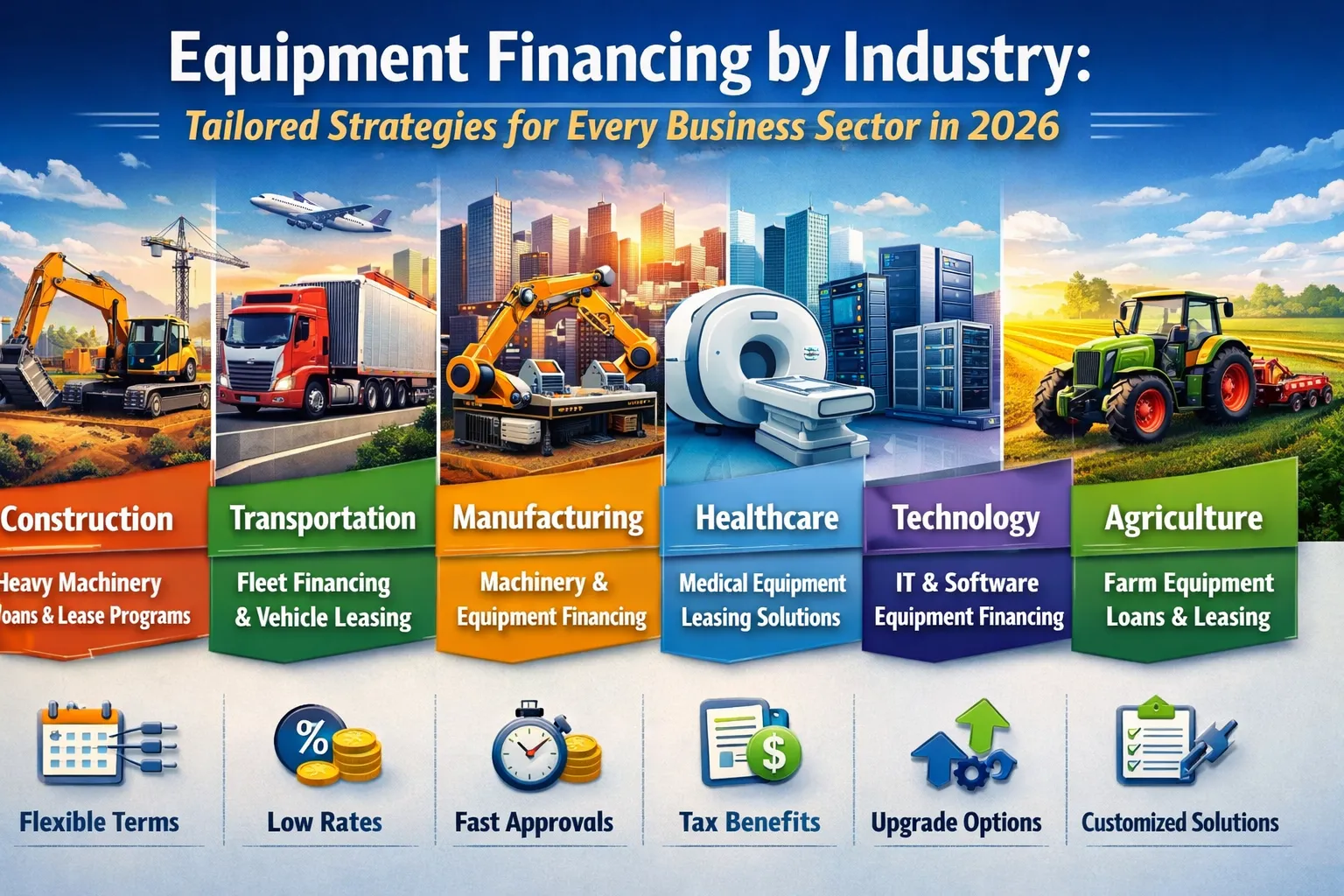
The construction company needs an excavator that costs $350,000. The medical practice needs a digital imaging system priced at $275,000. The restaurant needs commercial kitchen equipment totaling $85,000. Each business requires equipment financing, yet their paths to approval, optimal financing structures, and strategic considerations differ dramatically.
Equipment financing has grown into a $1.3 trillion industry that touches virtually every business sector. January 2026 saw new business volume reach its highest monthly dollar amount in two decades, with year-over-year growth exceeding 30 percent. This growth reflects businesses across all industries recognizing that financing equipment preserves capital while enabling operational expansion.
However, approaching equipment financing without understanding industry-specific dynamics leaves money on the table and opportunities unrealized. Lenders evaluate different equipment types differently. Approval rates vary by sector. Tax advantages apply differently across industries. The financing structure that works perfectly for one business may create problems for another.
This guide explores how major industries approach equipment financing in 2026, examining the unique equipment needs, lender perspectives, approval dynamics, and strategic considerations that shape financing decisions in each sector.
The Industry Matters More Than You Think
Equipment financing is not one-size-fits-all. Lenders specialize in certain industries because understanding equipment types, useful lives, resale values, and cash flow patterns requires deep sector knowledge. A lender experienced with medical equipment may not understand construction machinery well enough to offer competitive terms.
Industry expertise affects every aspect of financing. Lenders familiar with your sector understand typical equipment costs, expected useful life, depreciation patterns, and secondary market values. This knowledge translates into better approval rates, more appropriate terms, and financing structures that align with how your industry operates.
Current data reveals significant variation in approval rates across equipment categories. Transportation equipment leads with 86 percent approval rates, driven by strong resale markets and essential business nature. Medical and healthcare equipment follows at 81 percent. Construction equipment achieves 77 percent approval rates. These differences reflect lender confidence in collateral values and industry stability.
Understanding your industry’s position in the financing landscape helps set realistic expectations and identify the most receptive lenders for your equipment needs.
Healthcare and Medical Equipment Financing
Healthcare represents one of the most active sectors for equipment financing in 2026. Medical practices, hospitals, dental offices, surgery centers, and diagnostic facilities all depend on sophisticated equipment that advances rapidly and costs significantly.
The Healthcare Equipment Landscape
Medical equipment ranges from relatively modest investments like examination tables and basic diagnostic tools to major capital expenditures including MRI machines, CT scanners, robotic surgery systems, and complete laboratory setups. A single piece of advanced imaging equipment can cost several hundred thousand dollars, while equipping an entire practice may require millions.
Technology advancement drives constant pressure to upgrade. Equipment that represented cutting-edge capability five years ago may now seem outdated as AI-powered diagnostics, advanced imaging, and precision treatment systems become standard expectations. Patients and referring physicians expect modern equipment that delivers better outcomes.
Why Lenders Like Healthcare
Medical equipment enjoys strong approval rates because lenders understand several favorable characteristics. Healthcare equipment generates measurable revenue through billable procedures. Practices have predictable cash flows from insurance reimbursements. The equipment itself often retains significant resale value due to robust secondary markets for refurbished medical devices.
Lenders also recognize that healthcare providers typically demonstrate strong business stability. Established practices have patient bases that generate ongoing revenue. The essential nature of healthcare services provides some recession resistance that other industries lack.
Healthcare-Specific Considerations
Insurance reimbursement cycles create cash flow patterns that smart financing structures accommodate. Payments from insurance companies may arrive 30 to 90 days after services are rendered. Financing arrangements that align payment schedules with these reimbursement cycles reduce cash flow strain.
Regulatory compliance adds complexity to healthcare equipment decisions. Equipment must meet FDA requirements, HIPAA standards, and various state regulations. Lenders familiar with healthcare understand that compliance requirements affect equipment selection and may influence approval decisions.
Technology obsolescence risk runs particularly high in healthcare. Financing structures that allow equipment upgrades or include buyout provisions provide flexibility as technology advances. Many healthcare providers prefer shorter terms that enable upgrading to newer technology before equipment becomes outdated.
Strategic Approaches for Healthcare
Consider lease structures that include technology refresh provisions for rapidly advancing equipment categories. Operating leases may provide advantages when equipment is likely to be replaced within a few years.
Manufacturer financing programs often offer attractive terms for major medical equipment brands. Companies like GE, Siemens, and Philips provide financing options that may include maintenance bundling and upgrade paths.
Section 179 deductions apply to medical equipment purchases, potentially allowing deduction of up to $1.22 million in qualifying equipment. Combined with financing, this creates powerful tax advantages where the full deduction applies in year one while payments spread across multiple years.
Construction Equipment Financing
Construction remains one of the largest sectors for equipment financing, driven by the capital-intensive nature of the industry and the high cost of heavy machinery. Federal infrastructure spending, renewable energy projects, and manufacturing reshoring continue fueling strong demand for construction equipment in 2026.
The Construction Equipment Landscape
Construction equipment spans an enormous range from hand tools to massive earthmoving machinery. Excavators, loaders, cranes, bulldozers, concrete equipment, and specialized machinery can individually cost from tens of thousands to several million dollars. A single large excavator may cost $300,000 to $500,000, while crane systems can exceed $1 million.
Project-based work creates equipment needs that fluctuate with contract portfolios. Winning a major project may require equipment the company does not currently own. Losing anticipated work may leave equipment underutilized. This variability makes equipment financing decisions particularly strategic in construction.
Lender Perspectives on Construction
Construction equipment achieves solid approval rates around 77 percent, reflecting strong secondary markets and clear collateral value. Heavy equipment holds value well, with established markets for used machinery that give lenders confidence in recovery if needed.
However, lenders also recognize construction industry volatility. Economic cycles affect construction spending significantly. Regional variations in construction activity can leave equipment stranded in slow markets. Lenders typically want to see established project pipelines and demonstrated business stability.
Startups and newer construction companies face more scrutiny. Lenders may require higher down payments, personal guarantees, or proof of signed contracts demonstrating revenue certainty. Industry experience and contractor licensing documentation strengthen applications.
Construction-Specific Considerations
Seasonal patterns affect many construction businesses. Work may concentrate in certain months with reduced activity during winter or rainy seasons. Seasonal payment structures that reduce or skip payments during slow periods can dramatically improve cash flow management.
Project-based revenue creates timing mismatches between equipment needs and cash availability. A company may need equipment immediately to start a project but not receive significant payment until project milestones are reached. Financing bridges this gap, but payment structures should account for project payment timing.
Equipment utilization varies significantly in construction. Some equipment runs constantly across multiple projects. Other specialized machinery may sit idle between specific project types. Understanding utilization patterns helps determine whether ownership or rental makes more sense for particular equipment categories.
Strategic Approaches for Construction
Negotiate seasonal payment structures that align with your business cycle. Lenders experienced with construction understand seasonal patterns and often accommodate payment variations.
Consider equipment lines of credit for businesses with ongoing equipment needs. Rather than applying separately for each piece of equipment, a credit line allows drawing funds as needed within pre-approved limits. ELFA data shows equipment line of credit usage grew 24 percent in 2025.
For specialized equipment used infrequently, compare financing costs against rental options. Equipment that sits idle between projects may cost more to own than to rent when needed.
Leverage strong resale values when negotiating. Construction equipment with established secondary markets represents lower risk for lenders, which should translate into better terms for borrowers.
Manufacturing Equipment Financing
Manufacturing businesses depend on machinery and equipment that directly determines production capacity, efficiency, and product quality. Equipment investments in manufacturing typically tie directly to revenue-generating capability, making financing decisions particularly strategic.
The Manufacturing Equipment Landscape
Manufacturing equipment varies enormously across subsectors. CNC machines, injection molding equipment, assembly line automation, welding systems, quality control instrumentation, and material handling equipment represent just a fraction of categories. A single advanced CNC machining center may cost $200,000 to $500,000, while complete production line installations can reach millions.
Automation and robotics are transforming manufacturing equipment needs. AI-assisted machinery, collaborative robots, and smart factory technology command premium prices but offer productivity gains that justify investment. Lenders increasingly finance AI-driven and smart equipment as data demonstrating ROI reduces perceived risk.
Lender Perspectives on Manufacturing
Lenders evaluate manufacturing equipment based on productivity impact and useful life. Equipment that demonstrably increases output or reduces costs represents clear business value. Production machinery with established useful lives and predictable depreciation patterns fits well into standard financing models.
However, highly specialized equipment designed for specific products may concern lenders. If equipment has limited applications beyond the borrower’s particular manufacturing needs, resale options narrow significantly. General-purpose machinery with broader applications typically achieves better terms than ultra-specialized equipment.
Manufacturing business stability matters significantly. Lenders want to see consistent revenue, manageable customer concentration, and evidence that production capacity aligns with market demand. Companies overly dependent on single customers or volatile markets face more scrutiny.
Manufacturing-Specific Considerations
Production scheduling affects equipment financing strategy. Equipment that enables faster production or higher capacity should generate additional revenue that covers financing costs. Analyzing the relationship between equipment investment and production improvement helps determine appropriate financing levels.
Technology integration requirements can add costs beyond the equipment itself. New machinery may require facility modifications, training investments, software systems, or supporting equipment. Comprehensive budgeting should account for total implementation costs, not just equipment price.
Supply chain relationships may offer financing advantages. Equipment manufacturers sometimes provide favorable financing to strengthen relationships with production customers. These captive financing programs may offer better terms than third-party lenders, particularly when combined with service agreements.
Strategic Approaches for Manufacturing
Document productivity improvements that equipment will enable. Lenders respond well to clear ROI projections showing how equipment investment translates into revenue growth or cost reduction.
Explore manufacturer financing programs before assuming third-party lending is necessary. Equipment manufacturers often have financing subsidiaries offering competitive terms to support equipment sales.
Consider Equipment-as-a-Service models for technology that evolves rapidly. Subscription-based arrangements that include maintenance and upgrades may prove more cost-effective than ownership for equipment likely to require replacement within a few years.
Time equipment purchases to maximize Section 179 benefits. Manufacturing equipment typically qualifies for immediate deduction, creating tax advantages when purchases align with profitable years.
Transportation and Logistics Equipment Financing
Transportation equipment consistently leads approval rates across all equipment categories, making financing particularly accessible for trucking companies, logistics businesses, and fleet operators.
The Transportation Equipment Landscape
Commercial trucks, trailers, delivery vehicles, and fleet support equipment form the backbone of transportation businesses. A single heavy-duty commercial truck can cost $150,000 to $200,000, while building or expanding a fleet requires significant capital investment. Specialized vehicles like refrigerated trucks or tankers command premium prices.
Transportation equipment growth led all categories in recent periods, with 18 percent volume growth driven by e-commerce expansion and logistics demand. Fleet operators continuously balance equipment age against maintenance costs and fuel efficiency of newer vehicles.
Why Transportation Leads Approval Rates
Transportation equipment achieves 86 percent approval rates for several reasons. Vehicles have clear, verifiable values through established pricing guides. Active secondary markets provide confidence that equipment can be resold if necessary. The essential nature of transportation assets for business operations demonstrates clear utility.
Manufacturer captive finance programs are particularly strong in transportation. Truck manufacturers operate sophisticated financing operations designed to support equipment sales. These programs often provide competitive terms while simplifying the purchasing process.
Telematics and GPS tracking provide lenders with visibility into equipment utilization and location. This transparency reduces risk and may enable better terms for operators willing to allow equipment monitoring.
Transportation-Specific Considerations
Operating cost calculations should factor into financing decisions. Newer trucks offer better fuel efficiency and lower maintenance costs that offset higher acquisition prices. Analyzing total cost of ownership rather than just purchase price reveals true economic comparisons.
Regulatory requirements affect equipment decisions. Emissions standards, electronic logging mandates, and safety requirements influence which equipment makes sense to acquire versus retire. Financing should account for useful life considering regulatory evolution.
Seasonal variations affect some transportation businesses. Agricultural haulers, holiday shipping support, and seasonal freight patterns create utilization fluctuations. Seasonal payment structures may align better with actual business cash flows.
Strategic Approaches for Transportation
Leverage the favorable approval environment to negotiate competitive terms. Transportation equipment’s strong approval rates and clear collateral values should translate into better pricing for well-qualified borrowers.
Consider manufacturer financing programs as primary options. The combination of financing convenience and potential service bundling often provides value beyond rate comparison alone.
Evaluate fleet financing arrangements if acquiring multiple vehicles. Volume commitments may unlock better terms than individual unit financing.
Plan equipment replacement cycles strategically. Financing terms should align with intended useful life, avoiding situations where payments continue on equipment ready for replacement.
Agricultural Equipment Financing
Agriculture represents a unique equipment financing environment shaped by seasonal revenue patterns, weather dependence, and the essential role equipment plays in farm operations.
The Agricultural Equipment Landscape
Farm equipment ranges from tractors and harvesters to specialized implements for specific crop operations. A modern combine harvester can cost $500,000 to $800,000, while precision farming technology adds significant additional investment. Irrigation systems, storage facilities, and processing equipment expand the scope of agricultural financing needs.
Precision agriculture technology is transforming farming operations. GPS-guided equipment, sensor systems, drone monitoring, and data analytics platforms represent growing investment categories. Lenders are increasingly comfortable financing technology-integrated agricultural systems.
Agricultural Financing Dynamics
Agricultural equipment financing grew 15 percent in recent periods, driven partly by precision farming technology adoption. Lenders experienced with agriculture understand the seasonal nature of farm revenue and typically accommodate payment structures aligned with harvest cycles.
Farm Credit System institutions specialize in agricultural lending and often provide terms unavailable from conventional equipment lenders. These specialized lenders understand crop cycles, commodity price impacts, and the unique characteristics of farm operations.
Weather and commodity price volatility introduce risk factors that affect both farm operations and lender evaluations. Strong years may warrant aggressive equipment investment, while challenging periods require careful financial management.
Agricultural-Specific Considerations
Seasonal payment structures are standard in agricultural equipment financing. Payments concentrated after harvest when cash is available align with farm revenue patterns. Skip-payment periods during planting or growing seasons reduce cash flow pressure during income-light months.
Multi-year commodity price trends affect equipment investment decisions. Strong commodity prices support equipment investment, while price weakness may warrant caution. Financing decisions should consider price cycle positions rather than just current conditions.
Government programs may interact with equipment financing. Conservation programs, disaster assistance, and commodity support payments affect farm cash flows in ways that influence financing capacity and timing.
Strategic Approaches for Agriculture
Work with lenders experienced in agricultural equipment. Farm Credit institutions and agricultural equipment manufacturers often provide terms better suited to farm operations than general commercial lenders.
Structure payments around harvest timing. The ability to make larger payments when cash is available while minimizing obligations during capital-intensive planting seasons improves financial management.
Consider precision farming technology investments carefully. While technology offers productivity improvements, the pace of advancement means equipment may become outdated relatively quickly. Financing structures should account for technology refresh needs.
Evaluate used equipment markets. Agricultural equipment often has long useful lives, and well-maintained used equipment may provide excellent value compared to new purchases.
Technology and IT Equipment Financing
Technology equipment financing presents unique challenges and opportunities driven by rapid obsolescence and the critical role technology plays in business operations.
The Technology Equipment Landscape
Business technology encompasses computing hardware, networking infrastructure, data center equipment, and specialized industry systems. While individual workstations may cost a few thousand dollars, enterprise server installations, AI computing infrastructure, and specialized systems can reach hundreds of thousands or millions.
AI hardware represents the fastest-growing technology equipment category. The buildout of AI capabilities is creating unprecedented demand for high-performance computing infrastructure. Enterprise AI investments drove much of the equipment finance industry’s growth in 2025.
Technology Financing Dynamics
Technology equipment shows modest unit volume growth but accounts for the largest aggregate dollar value due to increasing costs of enterprise technology. Rapid obsolescence creates particular financing considerations, as equipment may become outdated before financing terms conclude.
Lenders recognize technology obsolescence risk and may offer shorter terms or require larger down payments on rapidly evolving equipment categories. However, lenders are also becoming more comfortable with technology as data demonstrating productivity returns reduces perceived risk.
Technology-Specific Considerations
Obsolescence timeline should drive financing term decisions. Equipment likely to require replacement within three years may not suit five-year financing terms. Matching terms to realistic useful life prevents paying for outdated equipment.
Software integration adds complexity to technology equipment decisions. Hardware often requires associated software that may have separate licensing costs and upgrade requirements. Total technology investment includes both hardware and ongoing software expenses.
Connectivity requirements are increasingly expected by lenders. Technology equipment that provides monitoring and reporting data may qualify for better terms as lenders can track utilization and performance.
Strategic Approaches for Technology
Consider Equipment-as-a-Service models for rapidly evolving technology. Subscription arrangements that include upgrades may prove more cost-effective than ownership for equipment likely to become obsolete quickly.
Evaluate total cost including software, integration, training, and support. Equipment financing represents only part of technology investment; comprehensive planning accounts for all implementation costs.
Negotiate short terms or buyout provisions for equipment with uncertain useful life. Flexibility to exit financing arrangements when equipment requires replacement prevents overpaying for outdated technology.
Restaurant and Hospitality Equipment Financing
Restaurants, hotels, and hospitality businesses require specialized equipment that directly affects customer experience and operational efficiency.
The Hospitality Equipment Landscape
Commercial kitchen equipment, food service systems, point-of-sale technology, furniture, fixtures, and specialty equipment serve hospitality operations. A complete restaurant kitchen buildout may cost $100,000 to $300,000 depending on concept and scale. Hotel property improvements can require millions in equipment and furnishing investments.
Equipment directly visible to customers affects brand perception and revenue. Outdated or poorly maintained equipment can damage customer experience, while modern equipment may enable menu expansion or operational improvements.
Hospitality Financing Dynamics
Hospitality equipment financing is accessible but requires attention to business fundamentals. Restaurants in particular have high failure rates that make lenders cautious. Established operations with demonstrated profitability achieve easier approval than new concepts or struggling businesses.
Equipment with clear resale markets achieves better terms. Commercial kitchen equipment, particularly from major manufacturers, has established secondary markets. Highly customized or specialized equipment may face more scrutiny.
Strategic Approaches for Hospitality
Demonstrate business stability and profitability when possible. Financial documentation showing consistent revenue and positive cash flow significantly improves approval likelihood and terms.
Consider vendor financing from equipment suppliers. Restaurant equipment dealers often provide financing options that may offer convenience and competitive terms.
Plan equipment investments around business cycles. Seasonal businesses may benefit from timing equipment purchases and financing to align with cash flow patterns.
FAQs About Industry-Specific Equipment Financing
Why do approval rates vary so much between industries?
Approval rates reflect lender confidence in collateral value and borrower stability. Transportation equipment achieves 86 percent approval because vehicles have clear values, active resale markets, and essential business functions. Other equipment categories may have less established secondary markets or higher obsolescence risk, leading to more selective approval. Lenders also develop expertise in specific industries, making them more confident evaluating familiar equipment types.
Should I work with lenders who specialize in my industry?
Industry-specialized lenders often provide significant advantages including better understanding of equipment types and values, familiarity with industry cash flow patterns, ability to structure payments around seasonal variations, and relationships with equipment vendors. General commercial lenders may offer competitive rates but lack the industry knowledge that enables optimal financing structures.
How does equipment obsolescence affect financing decisions?
Equipment with short useful lives due to technology advancement or industry changes requires careful financing term selection. Matching financing terms to realistic useful life prevents paying for equipment you no longer want or need. For rapidly evolving equipment, shorter terms, lease arrangements with upgrade provisions, or Equipment-as-a-Service models may prove more appropriate than long-term financing.
Do seasonal businesses face disadvantages in equipment financing?
Seasonal businesses can access equipment financing but benefit from lenders experienced with their patterns. Seasonal payment structures that reduce or skip payments during slow periods while concentrating payments during high-revenue seasons align financing with cash flow reality. Construction, agriculture, and certain hospitality businesses commonly use seasonal payment arrangements.
How do I find lenders experienced with my industry?
Industry associations often provide lender referrals or partnerships. Equipment manufacturers typically work with financing partners familiar with their products and industries. Online lending platforms allow comparison shopping across multiple lenders. Asking peers in your industry about financing experiences can identify lenders with relevant expertise.
Does equipment type affect financing terms within the same industry?
Yes. Within any industry, different equipment categories may receive different treatment. Equipment with strong resale values, established useful lives, and broad applications typically achieves better terms than specialized equipment with limited secondary markets. Essential equipment that directly generates revenue often qualifies more easily than support equipment.
Conclusion
Equipment financing serves every industry, but understanding how your specific sector approaches financing creates meaningful advantages. Industry dynamics affect approval rates, available terms, optimal structures, and strategic considerations in ways that generic financing guidance cannot capture.
The equipment finance industry reached record levels in early 2026, with January new business volume hitting its highest monthly amount in two decades. This growth reflects businesses across all sectors recognizing that strategic equipment financing preserves capital while enabling operational investment. Whether you operate in healthcare, construction, manufacturing, transportation, agriculture, technology, or hospitality, equipment financing options exist that align with your industry’s characteristics.
Success requires matching financing approaches to industry realities. Healthcare providers benefit from structures that accommodate reimbursement timing. Construction companies leverage seasonal payment arrangements. Manufacturers document productivity improvements that justify equipment investment. Transportation operators capitalize on favorable approval environments. Agricultural businesses align payments with harvest cycles. Technology purchasers account for obsolescence in term decisions.
The lenders who understand your industry can provide financing structures that work with rather than against your business patterns. Seeking industry-specialized lenders, exploring manufacturer financing programs, and negotiating terms that reflect your sector’s characteristics transforms equipment financing from generic transaction into strategic advantage.
Your industry has specific equipment needs, cash flow patterns, and financing considerations. Approaching equipment financing with industry awareness positions your business for approval success and optimal terms. Equipment drives business capability. Industry-informed financing helps you acquire it strategically.
Competitive service checklist
Before choosing a it equipment financing option, compare scope, response ownership, security duties, recovery testing, reporting, implementation effort, and exit terms. Ask what evidence the provider will return each month and which decisions remain with the customer. Comparing only the monthly payment while ignoring lifecycle and support obligations.
Measure the outcome
Set a baseline for the problem in this article, choose an owner, and review a small set of measures such as response time, repeat incidents, coverage, recovery tests, or time lost to workarounds. Review exceptions rather than assuming that a new tool fixed the operating cause.
How ECASYS can help
ECASYS can help business owners planning equipment purchases and replacements review it equipment financing. See it equipment financing services from ECASYS or request an ECASYS consultation.
Frequently Asked Questions
What should business owners planning equipment purchases and replacements review first for it equipment financing?
Start with the business activity affected, current evidence, dependencies, ownership, and the recovery or follow-up step. Tie the decision to the operating problem described in Equipment Financing by Industry: Tailored Strategies for Every Business Sector in 2026 rather than selecting a tool first.
How should a team compare it equipment financing providers?
Compare scope, response and escalation, security responsibilities, reporting, implementation ownership, exit terms, and the evidence each provider will supply. A lower price is not useful if important operating work remains unassigned.
How can success be checked after a it equipment financing change?
Record a baseline, choose a small set of measurable outcomes, review exceptions, and test the recovery path. Check user impact, security, documentation, and unresolved dependencies before calling the work complete.

No comment