
Equipment Financing for Startups: How New Businesses Access Essential Equipment in 2026
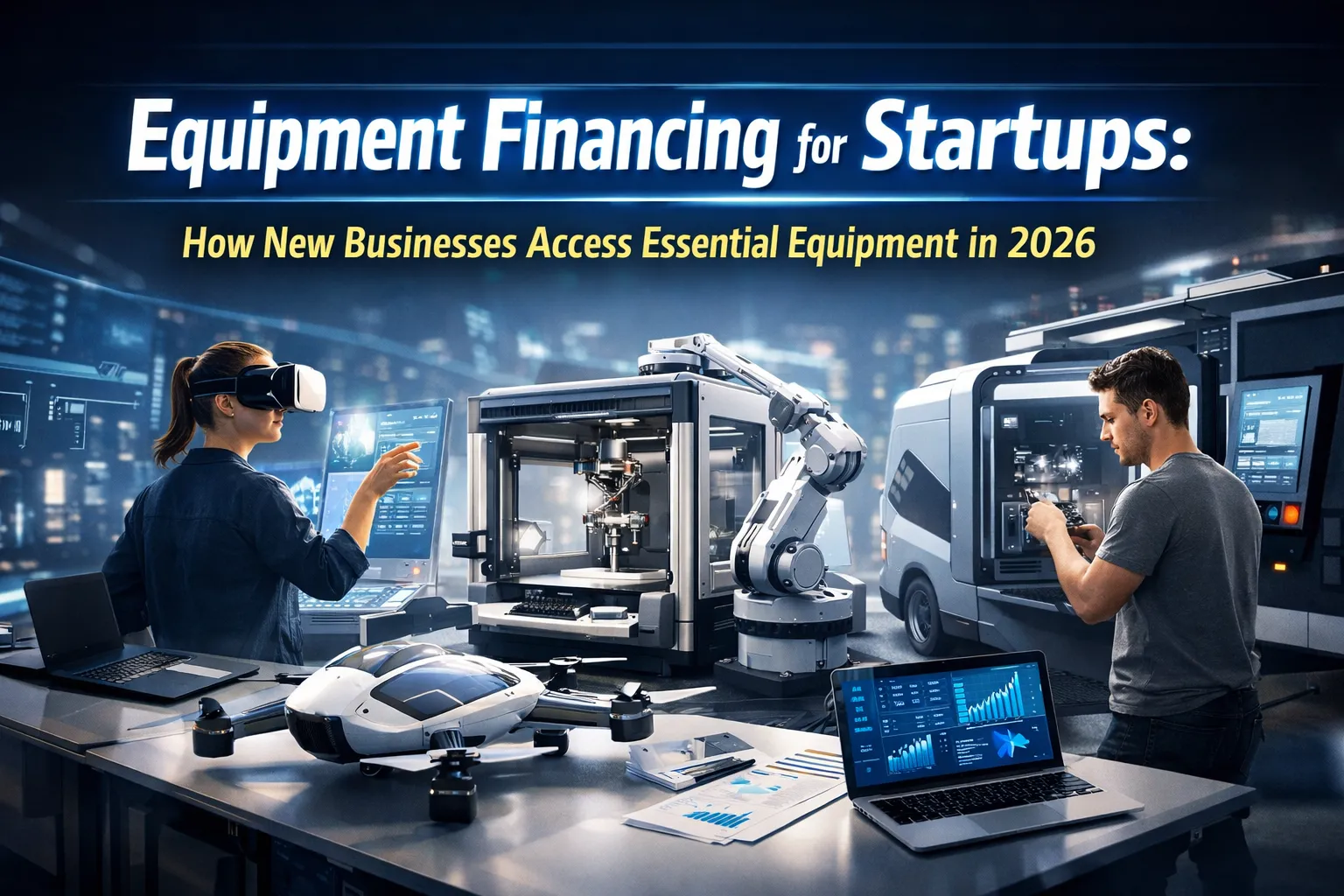
The machinery sits on the dealer’s floor, exactly what your new business needs to fulfill the contracts already signed. The problem is that your business opened six months ago, and the bank wants two years of financial statements you do not have. Traditional lenders see a startup. You see a business with paying customers and nowhere to put their orders.
This gap between opportunity and access frustrates new business owners daily. Equipment financing offers a path forward, but startups face different challenges than established businesses. Without operational history, conventional qualification criteria simply do not apply. The good news is that the equipment financing industry has evolved to serve new businesses, creating pathways that did not exist a few years ago.
In 2026, approximately 78% of businesses finance equipment rather than purchasing outright, and this includes startups leveraging creative financing solutions to acquire essential assets. The equipment financing industry reached record activity levels in early 2026, with new business volumes hitting all-time highs. Startup-friendly lenders, AI-powered underwriting, and flexible qualification approaches have expanded access for businesses that lack the operational history traditional lenders require.
This guide explains how equipment financing works for startups, what qualifications you actually need, which lenders serve new businesses, and how to position your startup for approval.
Why Traditional Financing Fails Startups
Understanding why conventional approaches fall short reveals where equipment financing provides advantages. The disconnect between startup realities and traditional lending requirements creates barriers that equipment financing can overcome.
The Operating History Problem
Most traditional lenders want to see two to three years of financial statements before considering commercial loans. They rely on historical performance to predict future repayment ability. Tax returns, income statements, and balance sheets demonstrate stability, consistency, and long-term viability in their evaluation models.
Startups, by definition, lack this track record. A business operating for six months cannot provide three years of financials regardless of how strong current performance might be. Even profitable startups with signed contracts and consistent revenue face rejection based solely on insufficient operating history.
This creates a frustrating paradox. Businesses need equipment to generate the revenue that would eventually satisfy lender requirements, but they cannot access that equipment without already having years of demonstrated performance. The chicken-and-egg problem stalls growth for viable businesses.
Credit Profile Challenges
New business owners often have personal credit that would qualify for consumer loans but lack established business credit entirely. Business credit scores require time to develop through vendor relationships, trade accounts, and financial activity in the company name.
Traditional lenders evaluating commercial loans want business credit history alongside personal credit. When the business itself has no credit file, evaluation relies entirely on personal factors that may not reflect business viability. Strong personal credit helps but may not overcome the missing business profile.
Any recent financial activity, even normal business startup activity, can appear negative in traditional evaluation. Credit inquiries from business formation, new account openings, and initial capital deployment may temporarily reduce scores even when representing healthy business development.
Timing Constraints
Traditional commercial loans involve lengthy underwriting, documentation requirements, and committee review processes. Weeks or months may pass between application and funding decision. For established businesses planning capital investments well in advance, this timeline works acceptably.
Startups frequently need equipment quickly to fulfill contracts, begin operations, or capture time-sensitive opportunities. Waiting extended periods for funding decisions can delay launch timelines and revenue generation. The customer who needs your services today may not wait while your financing application works through committee review.
Equipment financing addresses these timing constraints with streamlined approval processes. AI-powered platforms deliver decisions in hours rather than weeks. Same-day funding options exist for qualifying businesses and certain transaction amounts.
How Equipment Financing Differs for Startups
Equipment financing evaluates applications differently than traditional commercial lending, creating opportunities for new businesses that would fail conventional qualification.
Asset-Based Evaluation
The fundamental difference is that equipment financing is secured by the equipment itself. The machinery, vehicle, or technology being financed serves as collateral, reducing lender risk compared to unsecured loans. This collateralized structure shifts evaluation focus.
Lenders assess the equipment’s value and resale potential alongside borrower characteristics. Equipment with strong secondary markets and long useful lives is easier to finance because the lender can recover investment through asset liquidation if repayment fails. Brand reliability, durability, and market demand for the specific equipment influence approval decisions.
For startups, this asset focus provides significant advantage. When the equipment holds substantial value regardless of business outcome, lenders can extend financing they might refuse on an unsecured basis. The equipment itself partially answers the question traditional lenders ask through financial history.
Forward-Looking Evaluation
Because historical financials are limited or nonexistent, equipment lenders evaluate forward-looking projections when assessing startups. A clear business plan outlining target market, pricing strategy, cost structure, and expected revenue streams strengthens applications.
Lenders want to understand how the equipment directly contributes to income generation and how realistic projections appear. The connection between financed assets and projected income matters significantly. Equipment that enables revenue generation presents differently than equipment with indirect business impact.
Startups that present detailed cash flow forecasts, document contracts with early customers, and demonstrate realistic depreciation schedules tend to receive faster approvals and more favorable terms. The quality of forward-looking documentation partially substitutes for missing historical data.
Personal Credit Emphasis
In early-stage businesses, the founder’s personal credit carries significant weight because the company may not have established business credit. Lenders review personal credit scores, repayment history, outstanding obligations, and overall financial responsibility.
This reliance on personal credit works both directions. Strong personal credit significantly improves startup qualification chances even without business history. Conversely, personal credit problems present larger obstacles for startups than established businesses where business performance can offset individual credit concerns.
Understanding this emphasis helps founders prepare. Addressing personal credit issues before seeking equipment financing improves approval odds. Maintaining clean personal credit during business launch supports eventual financing needs.
Qualification Strategies for New Businesses
Startups can improve financing outcomes through strategic preparation and application positioning. These approaches help overcome limited operating history.
Building the Documentation Package
Comprehensive documentation substitutes partially for operating history. Lenders need confidence in business viability, and documentation provides evidence supporting that confidence.
Business plans with realistic financial projections demonstrate thoughtful planning. Revenue forecasts should connect logically to market opportunity and operational capacity. Expense projections should reflect actual cost research rather than arbitrary assumptions. Lenders review these documents critically, so realistic projections outperform optimistic ones that lack credible foundation.
Customer documentation provides powerful support. Signed contracts, letters of intent, or even detailed correspondence with potential customers demonstrate market demand. Equipment financing that enables fulfillment of existing commitments presents lower risk than equipment for speculative purposes.
Industry credentials strengthen applications. Relevant experience, professional certifications, licenses, and training demonstrate capability to execute the business plan. A contractor financing construction equipment presents better with licensing and industry background than without.
Optimizing Down Payment Position
Startups often need to contribute down payments, typically ranging from 5% to 20% of equipment cost. This upfront investment demonstrates commitment and reduces lender exposure. Larger down payments improve terms and increase approval likelihood.
The capital founders invest signals alignment of interests. When business owners have meaningful financial stake in equipment success, lenders feel more confident about repayment motivation. Down payment capacity also indicates financial resources supporting business operations generally.
Preparing down payment capital before seeking financing streamlines the process. Knowing available capital helps identify appropriate equipment price ranges and lender options. Scrambling for down payment after approval wastes time and may lose favorable terms.
Selecting the Right Equipment
Equipment characteristics affect financing availability. Some equipment finances more readily than others based on collateral value, useful life, and market liquidity.
Equipment with strong resale markets presents lower lender risk. If repayment fails, equipment that sells quickly for fair value limits lender losses. Standardized equipment from major manufacturers typically finances more readily than specialized or obscure alternatives.
Useful life should align with financing terms. Equipment that remains productive and valuable throughout the financing period provides better collateral than equipment approaching obsolescence. Lenders assess how equipment value will compare to remaining loan balance over time.
New equipment generally finances more easily than used equipment for startups specifically. New equipment from authorized dealers includes warranties, known condition, and clear title. Used equipment may offer cost savings but introduces condition uncertainties that some lenders avoid with startup borrowers.
Startup-Friendly Lenders and Options
Different lender types serve startup needs with varying requirements and approaches. Understanding options helps identify appropriate matches for specific situations.
Online and Alternative Lenders
Online lending platforms have transformed equipment financing accessibility for startups. These lenders use AI-powered underwriting that evaluates hundreds of data points beyond conventional credit scores, including real-time cash flow patterns, bank transaction analysis, and industry performance benchmarks.
Technology enables approval decisions in hours rather than weeks. Some platforms offer same-day funding for qualifying transactions. The speed advantage proves particularly valuable for startups needing quick equipment access.
Alternative lenders often accept applications from businesses with less than six months operating history. Some have no minimum time-in-business requirements at all. Revenue requirements also tend lower than traditional lenders, with some accepting businesses generating as little as $50,000 annually.
The tradeoff typically involves higher interest rates than traditional bank financing. Lenders accepting higher risk charge accordingly. For startups without other options, this premium may prove worthwhile to access needed equipment. As businesses establish track records, refinancing into lower-rate products becomes possible.
Manufacturer and Vendor Financing
Equipment manufacturers increasingly offer financing programs designed to facilitate sales. These captive finance programs often feature terms that independent lenders cannot match, including deferred interest periods, bundled maintenance agreements, and upgrade options.
Manufacturer financing may apply different qualification standards than independent lenders. Selling equipment serves their primary business objective, creating motivation to approve financing that enables sales. Startups sometimes find manufacturer programs more accessible than third-party alternatives.
These programs understand specific equipment deeply because the manufacturer knows exact specifications, expected useful life, and secondary market values. This expertise enables confident lending decisions without extensive borrower evaluation.
Vendor financing arrangements through equipment dealers work similarly. Dealers want to complete sales and may offer financing assistance or partner with lenders who specialize in their equipment categories.
SBA Loan Programs
Small Business Administration loan programs provide equipment financing options with attractive terms, though qualification requirements and processes differ from private lenders.
SBA 7(a) loans can finance equipment purchases with competitive interest rates and longer repayment terms. These loans work for startups meeting SBA eligibility requirements, though the application process involves more documentation than private alternatives. The government guarantee enables lower rates but requires thorough vetting.
SBA 504 loans specifically target major fixed asset purchases including equipment. These loans offer particularly favorable rates for qualifying purposes but involve additional requirements and longer processing times.
Startups considering SBA options should understand that processing takes longer than private alternatives. Planning equipment acquisitions in advance allows time for SBA processes to complete. Emergency equipment needs typically require faster private financing options.
Equipment Leasing Options
Leasing provides alternative access to equipment without purchasing. Operating leases allow equipment use for defined periods, with equipment returning to the lessor at lease end. Capital leases function similarly to financing with ownership transfer options.
Leasing sometimes requires less extensive qualification than purchase financing. Monthly payments may be lower than equivalent purchase financing. For startups uncertain about long-term equipment needs, leasing provides flexibility to return or upgrade equipment without carrying residual value risk.
Equipment obsolescence risk falls to the lessor in lease arrangements. Technology equipment that depreciates rapidly may suit leasing better than purchase financing. At lease end, startups can access updated equipment through new lease arrangements.
Building Business Credit Through Equipment Financing
Equipment financing provides opportunity to establish business credit that supports future financing needs. Strategic use of equipment financing builds credit history benefiting long-term business development.
Establishing Business Credit Files
Business credit bureaus track commercial credit activity separately from personal credit. New businesses begin without business credit files. Building files requires establishing credit relationships reported to business bureaus.
Many equipment lenders report payment activity to business credit bureaus. On-time payments build positive credit history that appears on business credit reports. This history demonstrates creditworthiness to future lenders evaluating the business.
Starting with accessible equipment financing and managing payments responsibly creates foundation for larger future financing. Early equipment loans build credit enabling later access to working capital, lines of credit, and expansion financing.
Separating Business and Personal Credit
Equipment financing in the business name helps establish business identity separate from personal finances. While personal guarantees may be required initially, equipment financing creates business credit activity distinct from personal credit history.
Over time, strong business credit may reduce reliance on personal guarantees. Some lenders offer non-personal-guarantee options for businesses with established credit. Building business credit through early equipment financing supports eventual separation.
Business credit also protects personal credit from business financial activity. Business accounts and financing in the company name build business credit without directly affecting personal credit scores. This separation protects personal finances while enabling business growth.
Progressing to Better Terms
Successful equipment financing creates track record supporting future applications. Demonstrating repayment reliability on initial financing improves subsequent application strength.
Startups often begin with higher-rate financing from alternative lenders due to limited history. After establishing payment track record, refinancing into better terms becomes possible. The equipment financing journey may start with accessible but expensive options and progress toward more favorable alternatives.
Relationships matter alongside credit data. Working successfully with a lender creates relationship value supporting future financing. Lenders who know your business through prior successful transactions approach subsequent applications with established confidence.
Industry-Specific Considerations
Different industries present different equipment financing situations. Understanding industry-specific factors helps startups navigate financing appropriate to their circumstances.
Construction and Trades
Construction startups face substantial equipment needs with high price points. Heavy machinery, vehicles, and specialized tools represent significant capital requirements. The industry’s project-based nature creates cash flow patterns that lenders understand.
Contract documentation provides powerful support for construction startup applications. Signed contracts demonstrate work pipeline justifying equipment acquisition. Lenders familiar with construction appreciate how equipment enables contract fulfillment generating repayment capacity.
Licensing and insurance requirements create qualification checkpoints that also signal legitimacy to lenders. Licensed, insured contractors demonstrate professional standing beyond simple business registration. Industry credentials support financing applications.
Healthcare and Medical
Healthcare startups often require expensive specialized equipment including diagnostic devices, treatment equipment, and practice management technology. Equipment costs can reach substantial levels relative to initial practice revenue.
Medical equipment frequently holds value well due to specialized markets and extended useful lives. Financing availability often proves favorable because collateral value remains strong. Specialized medical equipment lenders understand specific equipment categories deeply.
Credentials carry particular weight in healthcare applications. Licensed practitioners with appropriate certifications present better qualification profiles. The regulated nature of healthcare creates documentation that supports financing applications.
Technology and Software
Technology businesses may need equipment financing for computing hardware, networking infrastructure, or specialized devices. Rapid technology evolution creates obsolescence considerations affecting financing approaches.
Leasing often suits technology equipment well because lease terms can align with expected useful life before obsolescence. Returning equipment at lease end and acquiring updated technology avoids carrying outdated assets.
Technology startups may have strong growth projections but limited current revenue. Lenders evaluating technology businesses often emphasize growth indicators alongside current financials. Venture-backed technology companies may find financing through lenders familiar with high-growth business models.
Food Service and Hospitality
Restaurant and hospitality startups require substantial equipment including kitchen appliances, refrigeration, furniture, and point-of-sale systems. Equipment needs appear immediately at business launch, before operational revenue begins.
Food service equipment financing is well-established with lenders understanding industry-specific requirements. Restaurant equipment often maintains value supporting financing confidence. Franchise arrangements may include equipment financing programs as part of franchise systems.
Location and lease arrangements matter for hospitality financing. Lenders may evaluate real estate situations alongside equipment applications. Businesses with signed location leases demonstrate operational readiness supporting equipment financing.
Avoiding Common Startup Financing Mistakes
New business owners sometimes make errors that complicate equipment financing. Understanding common mistakes helps avoid them.
Overestimating Immediate Needs
Startups sometimes seek financing for extensive equipment packages when focused purchases would serve better. Financing exactly what you need for current operations, rather than everything you might eventually want, improves approval odds and reduces financial burden.
Starting with essential equipment and adding capacity as revenue grows often works better than attempting to finance complete operations upfront. Smaller initial financing is more accessible and creates track record supporting future expansion financing.
Underestimating Documentation Requirements
Applications lacking thorough documentation slow processing and reduce approval odds. Gathering business plans, projections, customer documentation, and personal financial information before applying streamlines the process.
Disorganized or incomplete applications suggest disorganized business management to lenders. Professional presentation of application materials signals business capability beyond the documents’ specific content.
Accepting Unfavorable Terms Without Shopping
Eagerness for approval sometimes leads startups to accept first-offered terms without exploring alternatives. Different lenders offer significantly different rates and terms. Comparing multiple options ensures competitive pricing.
Online lending marketplaces enable comparing offers from multiple lenders through single applications without multiple credit inquiries affecting scores. Taking time to explore options often reveals better alternatives.
Ignoring Total Cost
Monthly payment focus sometimes obscures total financing cost. Longer terms may offer lower payments but cost more overall through extended interest accumulation. Understanding total cost alongside monthly payments enables informed decisions.
Prepayment penalties, origination fees, and other charges add to total cost beyond interest rates. Reviewing complete terms rather than headline rates reveals actual financing expense.
FAQs About Equipment Financing for Startups
Can startups with no business history get equipment financing?
Yes. Many equipment lenders serve businesses with less than six months operating history, and some have no minimum time-in-business requirements. These lenders emphasize personal credit, business plans, customer documentation, and equipment value rather than historical financials. Terms may be less favorable than established businesses receive, but access exists.
What credit score do startups need for equipment financing?
Requirements vary significantly across lenders. Traditional banks typically prefer scores above 650, while alternative lenders may approve scores as low as 550 when other indicators are strong. Because equipment serves as collateral, credit requirements are often more flexible than unsecured lending. Strong equipment value can partially offset credit concerns.
How much down payment do startups need for equipment financing?
Down payment requirements typically range from 5% to 20% of equipment cost for startups, though some lenders offer zero-down options for qualifying applicants. Larger down payments often improve terms and increase approval likelihood. The specific requirement depends on lender policy, equipment type, and overall application strength.
How quickly can startups get equipment financing approval?
Modern AI-powered lending platforms can deliver approval decisions in hours rather than days or weeks. Same-day funding exists for qualifying businesses and certain transaction sizes. Traditional bank financing takes longer, often weeks for processing. Startups needing quick equipment access should prioritize lenders emphasizing speed.
Does equipment financing help build business credit?
Yes. Many equipment lenders report payment activity to business credit bureaus. Making payments on time builds positive credit history appearing on business credit reports. This established history supports future financing applications for working capital, expansion, or additional equipment.
Should startups lease or buy equipment?
The choice depends on equipment type, business objectives, and financial situation. Leasing typically requires lower monthly payments and avoids obsolescence risk, beneficial for rapidly-evolving technology. Buying builds equity and ownership, potentially more valuable for long-lived equipment retaining value. Many startups benefit from leasing initially and transitioning to purchase financing as business establishes.
Conclusion
Equipment financing provides pathways for startups to access essential business equipment despite lacking the operational history traditional lenders require. The asset-based nature of equipment financing shifts evaluation toward equipment value and forward-looking business viability rather than historical performance alone.
The equipment financing landscape in 2026 offers more startup-friendly options than ever before. AI-powered underwriting evaluates applications beyond simple credit scores. Alternative lenders serve businesses with minimal operating history. Manufacturer financing programs prioritize equipment sales through accessible financing. These developments expand access for new businesses with legitimate needs and viable plans.
Successful startup equipment financing requires strategic preparation. Building comprehensive documentation packages, optimizing personal credit, preparing down payments, and selecting appropriate equipment all improve outcomes. Understanding which lender types match specific situations helps focus applications appropriately.
Beyond immediate equipment access, equipment financing provides opportunity to build business credit supporting long-term financial development. On-time payments establish credit history enabling future financing at better terms. Early equipment financing becomes foundation for broader business credit capability.
The equipment you need to launch or grow your business should not remain inaccessible simply because your business is new. Equipment financing bridges the gap between startup reality and traditional lending requirements, enabling new businesses to access productive assets and generate the revenue that eventually satisfies conventional qualification standards.
Your business may be new, but your equipment needs are real. Equipment financing provides the pathway to address those needs while building the financial foundation supporting everything that comes next.

No comment