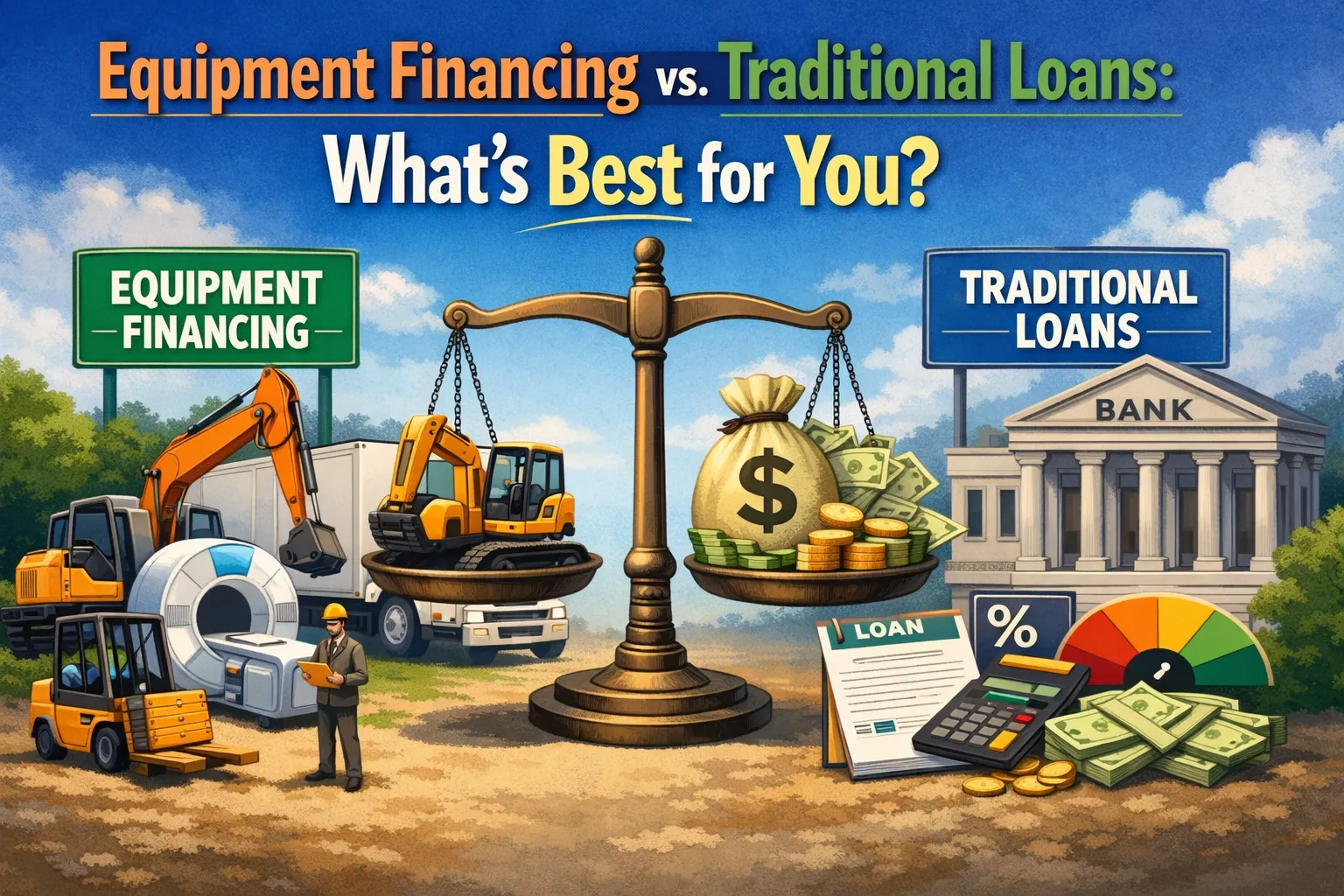
Equipment Financing vs. Traditional Loans: What’s Best for You?
Introduction
Choosing the Right Financing Can Make or Break Your Business
Every growing business reaches a critical moment. You need new equipment — a commercial vehicle, manufacturing machinery, medical devices, or IT infrastructure. The equipment is essential. The price tag is steep. Now comes the big decision: how do you pay for it?
Two of the most popular options are equipment financing and traditional business loans. Both provide access to capital. Both help businesses acquire the assets they need. However, the way they work, what they cost, and who they suit best are very different.
Why This Decision Matters More Than Ever
Getting this decision wrong can strain your cash flow, damage your credit profile, or saddle you with debt that outweighs the value of the asset. Getting it right, on the other hand, accelerates your growth, preserves working capital, and sets your business on a stronger financial footing.
This guide breaks down both options clearly and honestly. By the end, you will know exactly which path makes the most sense for your situation.
What Is Equipment Financing?
The Basics of Equipment Financing
Equipment financing is a type of funding specifically designed for purchasing business equipment. The equipment itself serves as collateral for the loan. This means the lender has a direct claim on the asset if you default — but it also means you can often secure funding without pledging other business or personal assets.
Repayment terms typically align with the useful life of the equipment. Monthly payments are predictable and fixed. At the end of the term, you own the equipment outright.
How Equipment Financing Works in Practice
Here is a straightforward example. A construction company needs a new excavator worth $120,000. An equipment financing lender provides the funds. The company makes fixed monthly payments over five years. The excavator acts as security for the loan throughout that period.
Once the final payment clears, full ownership transfers to the company. The equipment has been generating revenue throughout the entire repayment period — making the financing essentially self-funding in many cases.
Equipment Leasing as an Alternative Within This Category
Equipment financing also includes leasing arrangements. Rather than buying the equipment outright, your business leases it for a defined period. Monthly payments are typically lower than financing payments. At lease-end, you can return the equipment, renew the lease, or purchase the asset at a residual value.
Leasing suits businesses that need to upgrade equipment frequently — particularly in technology and healthcare sectors where assets become outdated quickly.
What Are Traditional Business Loans?
Understanding How Traditional Loans Work
A traditional business loan provides a lump sum of capital that your business can use for almost any purpose. Unlike equipment financing, the funds are not tied to a specific asset purchase. You might use a traditional loan to buy equipment, hire staff, expand your premises, or shore up working capital — all from the same facility.
Lenders assess your creditworthiness based on your business revenue, credit history, time in business, and overall financial health. Approval criteria tend to be more rigorous than equipment-specific financing.
Types of Traditional Business Loans
Traditional business loans come in several forms. Term loans provide a fixed amount repaid over a set period. Lines of credit give you flexible access to funds up to a defined limit. SBA loans — backed by the Small Business Administration — offer favorable terms for qualifying small businesses but require more documentation and longer processing times.
Each type carries its own interest rate structure, repayment terms, and eligibility requirements. Understanding these differences helps you match the loan type to your actual need.
What Lenders Look for in Traditional Loan Applications
Traditional lenders evaluate several factors carefully. Strong personal and business credit scores improve your approval chances significantly. Consistent revenue and positive cash flow demonstrate your ability to repay. Time in business matters too — most banks prefer lending to businesses operating for at least two years.
Collateral requirements vary. Some traditional loans are unsecured. Others require personal guarantees or business assets beyond the equipment you intend to purchase.
Equipment Financing vs. Traditional Loans: Key Differences
Collateral and Approval Requirements
This is where the two options diverge most clearly. Equipment financing uses the purchased asset as collateral. This self-collateralization makes approval more accessible — especially for newer businesses or those with less-than-perfect credit. The lender’s risk is directly tied to a tangible, insurable asset.
Traditional loans often require broader collateral. Lenders may request a blanket lien on business assets, personal guarantees from owners, or both. Meeting these requirements is harder for younger businesses or those without substantial existing assets.
Speed of Funding
Equipment financing decisions typically move faster. Because the underwriting focuses on the equipment’s value and your ability to service the debt, lenders can approve and fund equipment loans in days. Some online equipment financing platforms deliver decisions within 24 hours.
Traditional bank loans move more slowly. Documentation requirements are extensive. Underwriting can take weeks. SBA loans can take even longer — sometimes months. If your need is urgent, speed of access becomes a critical differentiator.
Flexibility of Use
Traditional loans win on flexibility. The funds can flow into any business need without restriction. Equipment financing, by contrast, ties capital directly to the asset purchase. You cannot use equipment financing proceeds to cover payroll, marketing, or operational expenses.
For businesses with a specific, clearly defined equipment need, this restriction is irrelevant. For businesses seeking broader working capital, traditional loans offer more versatility.
Tax Treatment and Depreciation Benefits
Equipment financing often carries meaningful tax advantages. Under Section 179 of the US tax code, businesses can deduct the full purchase price of qualifying equipment in the year of purchase rather than depreciating it over several years. Bonus depreciation provisions can further accelerate these benefits.
Traditional loans do not eliminate depreciation — but interest payments on business loans are generally tax-deductible. Both options offer tax advantages. Equipment financing tends to offer more significant upfront deductions when purchasing qualifying assets.
Impact on Cash Flow and Working Capital
Equipment financing preserves working capital more effectively. Because you finance a specific asset without disturbing your existing credit facilities or cash reserves, other resources stay available for day-to-day operations.
Traditional loans can serve the same function — but higher approval barriers and slower processing mean businesses sometimes deplete cash reserves while waiting. Additionally, traditional loan terms may require larger monthly repayments depending on the amount borrowed.
Pros and Cons at a Glance
Advantages of Equipment Financing
Equipment financing offers faster approval and funding. Collateral requirements are limited to the asset itself. Fixed monthly payments make budgeting straightforward. Tax deductions under Section 179 can deliver significant savings. Ownership at the end of the term builds asset equity.
Leasing within this category offers lower monthly payments and easy upgrade paths for technology-intensive industries.
Disadvantages of Equipment Financing
Financing ties you to a specific asset. If the equipment becomes obsolete before the loan matures, you are still making payments. Total interest costs over the loan term can exceed the equipment’s residual value in some cases. Early termination penalties can apply with some lenders.
Advantages of Traditional Loans
Traditional business loans offer unmatched flexibility. Funds can serve multiple business needs simultaneously. Strong borrowers can access large loan amounts at competitive rates. Established banking relationships may bring favorable terms over time.
Disadvantages of Traditional Loans
Approval requirements are stricter. Processing takes longer. Personal guarantees create personal liability for business owners. Broader collateral requirements can put other business assets at risk in the event of default.
So, Which Option Is Best for You?
Choose Equipment Financing If…
Equipment financing is the stronger choice in several specific situations. Your business is newer and lacks an extensive credit history. You need the equipment quickly and cannot wait weeks for bank approval. The asset you need is specific, high-value, and has a long, productive lifespan. Preserving your existing credit lines for operational flexibility is a priority.
Healthcare practices, construction companies, manufacturers, and logistics businesses frequently find equipment financing the ideal match for these reasons.
Choose a Traditional Loan If…
A traditional business loan makes more sense when your funding needs go beyond a single equipment purchase. Your business carries strong credit, consistent revenue, and meets standard bank eligibility criteria. You want the flexibility to allocate capital across multiple business needs. You have the time to navigate a more thorough application and approval process.
Retail businesses, service firms, and established companies with diversified capital needs often benefit most from traditional loan structures.
When a Hybrid Approach Works Best
Some businesses combine both options strategically. They use equipment financing for high-value, specific asset purchases while maintaining a traditional line of credit for operational flexibility. This approach maximizes both the speed and accessibility of equipment financing and the versatility of traditional credit facilities.
Talking to a business finance advisor helps you map the right combination to your specific situation and growth stage.
Conclusion
Making the Smartest Choice for Your Business
Equipment financing and traditional loans each serve a distinct purpose. Neither is universally superior. The best option depends on your business age, credit profile, the nature of your equipment need, and how quickly you need access to capital.
Equipment financing delivers speed, accessibility, and asset-specific tax advantages. Traditional loans deliver flexibility, scale, and long-term relationship benefits with lenders. Understanding both options clearly empowers you to make a confident, informed decision.
Do not let financing uncertainty slow your business growth. Evaluate your needs, compare your options, and choose the structure that puts your capital to work most effectively.
Frequently Asked Questions (FAQ)
Q1. What is the main difference between equipment financing and a traditional loan?
Equipment financing is specifically designed to fund the purchase of business equipment, using that equipment as collateral. Traditional business loans provide general-purpose capital that can be used for a wide range of business needs. Equipment financing tends to be faster to access and easier to qualify for, while traditional loans offer greater flexibility in how funds are used.
Q2. Can a startup qualify for equipment financing?
Yes. Equipment financing is often more accessible for startups than traditional loans because the equipment itself secures the debt. Lenders focus heavily on the asset’s value and the business’s ability to generate revenue from it. Some equipment financing providers work specifically with newer businesses that lack the credit history required for bank loans.
Q3. Is equipment financing tax deductible?
Equipment financing can deliver significant tax advantages. Under Section 179 of the US tax code, businesses may deduct the full cost of qualifying financed equipment in the year of purchase. Bonus depreciation provisions can apply in addition to Section 179. Always consult a qualified tax professional to confirm how these benefits apply to your specific situation.
Q4. How long does equipment financing approval typically take?
Many equipment financing providers approve and fund applications within 24 to 72 hours. Online lenders and specialist equipment financing companies operate faster than traditional banks. If speed is a priority, equipment financing has a significant advantage over conventional bank loan timelines, which can stretch from several weeks to a few months.
Q5. What types of equipment can be financed?
Almost any tangible business asset can qualify for equipment financing. Common examples include commercial vehicles, construction machinery, medical and dental equipment, restaurant kitchen equipment, manufacturing machinery, IT hardware and servers, and agricultural equipment. Lenders typically require the asset to have a defined useful life and measurable resale value.
Competitive service checklist
Before choosing a it equipment financing option, compare scope, response ownership, security duties, recovery testing, reporting, implementation effort, and exit terms. Ask what evidence the provider will return each month and which decisions remain with the customer. Comparing only the monthly payment while ignoring lifecycle and support obligations.
Measure the outcome
Set a baseline for the problem in this article, choose an owner, and review a small set of measures such as response time, repeat incidents, coverage, recovery tests, or time lost to workarounds. Review exceptions rather than assuming that a new tool fixed the operating cause.
How ECASYS can help
ECASYS can help business owners planning equipment purchases and replacements review it equipment financing. See it equipment financing services from ECASYS or request an ECASYS consultation.
Frequently Asked Questions
What should business owners planning equipment purchases and replacements review first for it equipment financing?
Start with the business activity affected, current evidence, dependencies, ownership, and the recovery or follow-up step. Tie the decision to the operating problem described in Equipment Financing vs. Traditional Loans: What's Best for You? rather than selecting a tool first.
How should a team compare it equipment financing providers?
Compare scope, response and escalation, security responsibilities, reporting, implementation ownership, exit terms, and the evidence each provider will supply. A lower price is not useful if important operating work remains unassigned.
How can success be checked after a it equipment financing change?
Record a baseline, choose a small set of measurable outcomes, review exceptions, and test the recovery path. Check user impact, security, documentation, and unresolved dependencies before calling the work complete.

No comment