
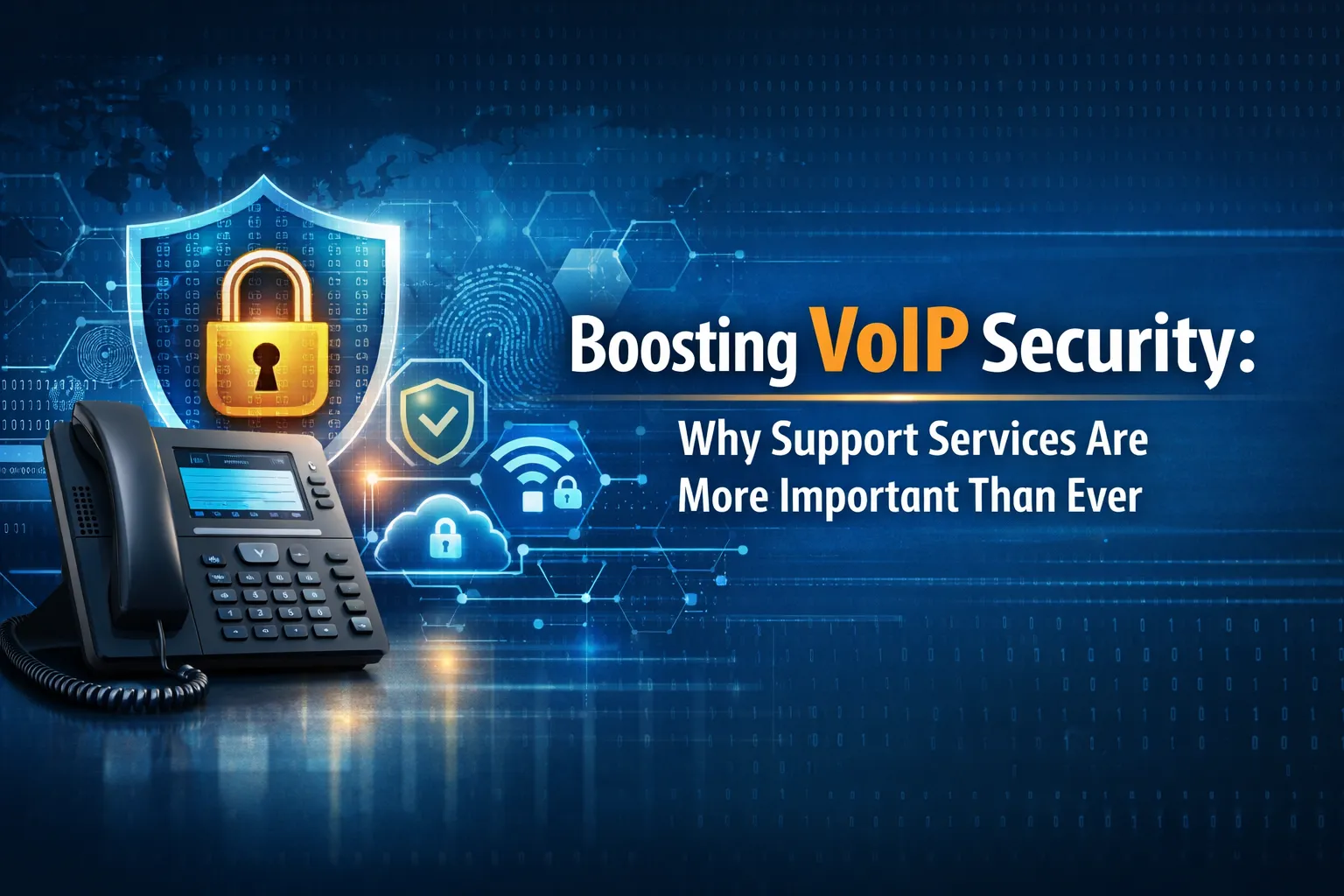
Boosting VoIP Security: Why Support Services Are More Important Than Ever
Your Phone System Is Now a Cybersecurity Risk
Business communication has changed dramatically over the past decade. Traditional landlines have given way to Voice over Internet Protocol — better known as VoIP. Today, millions of businesses worldwide rely on VoIP systems to handle calls, video conferences, and team collaboration.
The technology is fast, flexible, and cost-effective. Unfortunately, it also comes with serious security vulnerabilities that too many businesses overlook.
Why VoIP Security Can No Longer Be an Afterthought
Cybercriminals have taken notice of the rapid adoption of VoIP. Attacks targeting internet-based phone systems are increasing year over year. Hackers exploit weak configurations, outdated firmware, and unmonitored traffic to intercept calls, commit toll fraud, and disrupt business operations entirely.
Without proper VoIP security support services in place, your communication system becomes an open door for bad actors. This blog explains the key threats, why dedicated support services are essential, and how your business can take the right steps to stay protected.
Understanding the VoIP Security Landscape
How VoIP Differs From Traditional Phone Systems
Traditional phone systems ran on closed, dedicated copper networks. Accessing them required physical proximity. VoIP systems, on the other hand, run over the public internet. That openness makes them powerful — and exposed.
Every VoIP call travels across IP networks as data packets. Any point along that journey can become a vulnerability. From the device on your desk to the cloud server handling the call, each layer requires proper security controls.
The Growing Threat Surface in 2026
The threat surface for VoIP systems has expanded significantly in recent years. Remote work trends have pushed VoIP endpoints into home offices, coffee shops, and mobile devices. Each new endpoint represents a potential entry point for attackers.
Security researchers have identified a sharp rise in SIP-based attacks — targeting the Session Initiation Protocol that most VoIP systems use to establish calls. Attackers scan the internet constantly, looking for poorly secured VoIP deployments. When they find one, they move quickly.
What Attackers Are After
Understanding attacker motivation helps clarify the risk. Most VoIP attackers pursue one of three goals. Some want to eavesdrop on sensitive business conversations. Others want to commit toll fraud — making thousands of dollars in international calls on your account. A smaller group aims to disrupt your communication infrastructure entirely through denial-of-service attacks.
All three outcomes carry serious consequences for businesses of any size.
The Most Common VoIP Security Threats
Eavesdropping and Call Interception
Eavesdropping occurs when an attacker intercepts VoIP traffic and listens to private conversations. Without encryption, voice data packets travel in plain text across networks. A skilled attacker with the right tools can capture and reconstruct those conversations.
Business calls often contain sensitive information — client details, financial figures, legal discussions, and strategic plans. Compromised calls can lead to data breaches, regulatory penalties, and serious reputational damage.
Toll Fraud and Account Hijacking
Toll fraud is one of the most financially damaging VoIP threats. Attackers gain unauthorized access to your VoIP system and use it to make high-cost international calls. Bills can run into thousands of dollars before anyone notices.
Account hijacking follows a similar pattern. Attackers steal VoIP credentials through phishing, brute force attacks, or credential dumps from other breaches. Once inside, they exploit your system freely until detected.
Denial-of-Service (DoS) Attacks
Denial-of-service attacks flood VoIP systems with fake traffic. This overwhelms servers and prevents legitimate calls from connecting. For businesses that depend on phone communication to serve customers, even a short outage causes significant financial and reputational harm.
Distributed denial-of-service (DDoS) attacks scale this threat even further. Attackers use networks of compromised devices to generate traffic volumes that basic defenses cannot handle alone.
Vishing and Social Engineering
Vishing — voice phishing — uses VoIP infrastructure to impersonate trusted entities. Attackers spoof caller ID numbers to appear as banks, government agencies, or company executives. Employees receive convincing calls that trick them into sharing credentials or transferring funds.
VoIP makes vishing cheaper and easier to execute at scale. This threat targets people, not just technology — making training and support equally important components of your security strategy.
Why VoIP Security Support Services Are Essential
The Complexity Businesses Cannot Handle Alone
Securing a VoIP environment requires deep, specialized knowledge. Most internal IT teams are already stretched managing networks, endpoints, cloud services, and helpdesk requests. Adding VoIP security expertise on top of those responsibilities is unrealistic for the majority of organizations.
Professional VoIP security support services fill that gap. They bring dedicated expertise, purpose-built tools, and proven processes that most internal teams simply cannot replicate.
Continuous Monitoring That Never Switches Off
One of the most valuable services a VoIP security provider delivers is round-the-clock monitoring. Attacks do not follow business hours. A toll fraud incident that begins at midnight can rack up enormous costs by sunrise if no one catches it.
Dedicated support services monitor call traffic patterns continuously. Unusual spikes in international call volume trigger immediate alerts. Suspicious SIP registration attempts get blocked automatically. Problems surface before they escalate into full incidents.
Rapid Response When Incidents Occur
Even the best-secured systems experience incidents. What matters most at that point is speed. Every minute a VoIP security breach remains uncontained increases the potential damage.
Professional support services maintain incident response playbooks specifically for VoIP environments. Teams know exactly which steps to take, in which order, to isolate the threat, preserve evidence, and restore normal operations as quickly as possible.
Configuration Management and Hardening
Many VoIP vulnerabilities stem from misconfiguration rather than sophisticated attacks. Default passwords left unchanged, SIP ports left open unnecessarily, and encryption settings left disabled all create exploitable weaknesses.
VoIP security support services audit your configuration regularly. They apply hardening best practices, close unnecessary exposure points, and ensure every device and server in your VoIP environment meets current security standards. Prevention is always cheaper than remediation.
Key Features of Strong VoIP Security Support
Encryption Across Every Call
Strong VoIP security starts with encryption. Transport Layer Security (TLS) encrypts the SIP signaling that sets up and tears down calls. Secure Real-time Transport Protocol (SRTP) encrypts the actual voice data in transit.
Together, these protocols ensure that even if an attacker intercepts your traffic, they cannot read or listen to it. Any VoIP security support service worth considering must enforce both standards across your entire environment.
Multi-Factor Authentication for VoIP Access
Stolen credentials are a leading cause of VoIP account hijacking. Multi-factor authentication (MFA) adds a critical second layer of protection. Even if an attacker obtains a username and password, they cannot access your system without the second factor.
A strong support service implements MFA for all VoIP administration portals, softphone applications, and remote access points. This single control eliminates a large percentage of credential-based attack vectors.
Real-Time Fraud Detection
Toll fraud moves fast. Effective VoIP security support includes real-time fraud detection systems that analyze call patterns as they happen. Calls to high-risk destinations trigger automatic holds or alerts. Usage thresholds flag unusual volume. Administrators receive instant notifications when anomalies appear.
This proactive layer catches fraud in its early stages — before costs spiral out of control.
Regular Security Audits and Penetration Testing
The threat landscape evolves constantly. A configuration that was secure six months ago may be vulnerable today. Regular security audits and penetration testing ensure your VoIP environment stays hardened against current attack techniques.
Professional support services schedule these assessments proactively. Findings feed directly into remediation plans. Your security posture improves continuously rather than stagnating between reactive fixes.
The Business Case for Investing in VoIP Security Support
The Cost of a Breach Versus the Cost of Prevention
Businesses sometimes hesitate to invest in managed VoIP security support because of the ongoing cost. This perspective shifts quickly after a toll fraud incident or a data breach involving intercepted calls.
A single toll fraud attack can cost thousands to tens of thousands of dollars. A regulatory fine for a data breach involving communications can reach far higher. The cost of professional VoIP security support is modest by comparison — and it prevents both scenarios.
Compliance Requirements Are Tightening
Many industries face strict regulatory requirements around communication security. Healthcare organizations must protect patient conversations under HIPAA. Financial services firms must secure client communication under various regulatory frameworks. Legal and government organizations face similar mandates.
Professional VoIP security support helps businesses meet these compliance obligations. Providers maintain documentation, audit trails, and security controls that satisfy regulatory scrutiny. Non-compliance penalties make the investment even easier to justify.
Employee Confidence and Productivity
When employees trust that their communication tools are secure, they use them more effectively. Confidence in the phone system removes hesitation around discussing sensitive topics over calls. Productivity increases when people stop second-guessing their tools.
A well-supported VoIP environment also experiences fewer outages and disruptions. Less downtime means more time focused on work — and fewer costly interruptions to customer service operations.
How to Choose the Right VoIP Security Support Provider
Look for VoIP-Specific Expertise
General IT support providers are not always equipped to handle VoIP security. Seek out providers with demonstrated, specific expertise in VoIP environments. Ask about their experience with SIP security, VoIP fraud prevention, and encryption implementation.
Request case studies or references from businesses in your industry. Proven results in your sector carry far more weight than generic promises.
Evaluate Their Monitoring Capabilities
Find out exactly what they monitor and how quickly they respond to alerts. A provider that monitors call volume and traffic patterns continuously — with human oversight, not just automated rules — offers significantly stronger protection than one that only reacts to support tickets.
Clarify their average response time for security incidents. Measure this against the potential cost of delayed response in your specific environment.
Understand Their Approach to Updates and Patching
VoIP firmware updates and security patches close vulnerabilities as they emerge. Ask how the provider handles patch management for your devices and servers. Delays in patching leave known vulnerabilities open for exploitation.
The right provider applies patches promptly within defined windows, tests for compatibility issues, and communicates clearly about maintenance schedules.
Conclusion
VoIP technology has transformed business communication. Flexibility, cost savings, and collaboration features make it indispensable for modern organizations. However, that same technology introduces real, growing security risks that demand serious attention.
Eavesdropping, toll fraud, denial-of-service attacks, and vishing are not hypothetical threats. Businesses face them daily. Without dedicated VoIP security support services, organizations leave their communication infrastructure — and the sensitive data it carries — dangerously exposed.
Professional VoIP security support services bring continuous monitoring, rapid incident response, expert configuration management, and proactive threat prevention. They transform a potential liability into a secure, reliable communication asset.
The question every business leader should ask is simple: can your current setup protect everything being said on your phone system right now? If the answer is uncertain, investing in VoIP security support services is not optional it is urgent.
Frequently Asked Questions
Q1. What is VoIP security and why does it matter for businesses?
VoIP security refers to the practices, tools, and protocols used to protect Voice over Internet Protocol systems from unauthorized access, interception, and abuse. Because VoIP calls travel over the internet, they face the same threats as any other networked system. Without proper security controls, businesses risk eavesdropping, toll fraud, and service disruptions that can cause serious financial and reputational harm.
Q2. What are the most common VoIP security threats in 2026?
The most prevalent threats include call eavesdropping, toll fraud, SIP-based denial-of-service attacks, account hijacking through stolen credentials, and vishing — voice phishing that uses spoofed numbers to deceive employees. Each poses distinct risks, and effective VoIP security support addresses all of them through layered defenses.
Q3. How do VoIP security support services protect against toll fraud?
Professional support services deploy real-time fraud detection systems that monitor call traffic continuously. Unusual patterns — such as a sudden spike in international calls or activity during off-hours — trigger immediate alerts or automatic blocks. Combined with strong authentication controls and usage limits, these measures stop toll fraud before it generates significant costs.
Q4. Is VoIP encryption really necessary for small businesses?
Absolutely. Small businesses are frequently targeted precisely because attackers expect weaker defenses. Encrypting VoIP traffic using TLS and SRTP costs little to implement but prevents attackers from intercepting business calls. Any business that handles sensitive client conversations, financial discussions, or proprietary information needs call encryption in place.
Competitive service checklist
Before choosing a voip support option, compare scope, response ownership, security duties, recovery testing, reporting, implementation effort, and exit terms. Ask what evidence the provider will return each month and which decisions remain with the customer. Changing a phone system without testing routing, failover, and support ownership.
Measure the outcome
Set a baseline for the problem in this article, choose an owner, and review a small set of measures such as response time, repeat incidents, coverage, recovery tests, or time lost to workarounds. Review exceptions rather than assuming that a new tool fixed the operating cause.
How ECASYS can help
ECASYS can help small and midsize businesses review voip support. See voip support services from ECASYS or request an ECASYS consultation.
Frequently Asked Questions
What should small and midsize businesses review first for voip support?
Start with the business activity affected, current evidence, dependencies, ownership, and the recovery or follow-up step. Tie the decision to the operating problem described in Boosting VoIP Security: Why Support Services Are More Important Than Ever rather than selecting a tool first.
How should a team compare voip support providers?
Compare scope, response and escalation, security responsibilities, reporting, implementation ownership, exit terms, and the evidence each provider will supply. A lower price is not useful if important operating work remains unassigned.
How can success be checked after a voip support change?
Record a baseline, choose a small set of measurable outcomes, review exceptions, and test the recovery path. Check user impact, security, documentation, and unresolved dependencies before calling the work complete.





No comment