
VoIP Security Threats in 2026 and How Support Teams Prevent Them
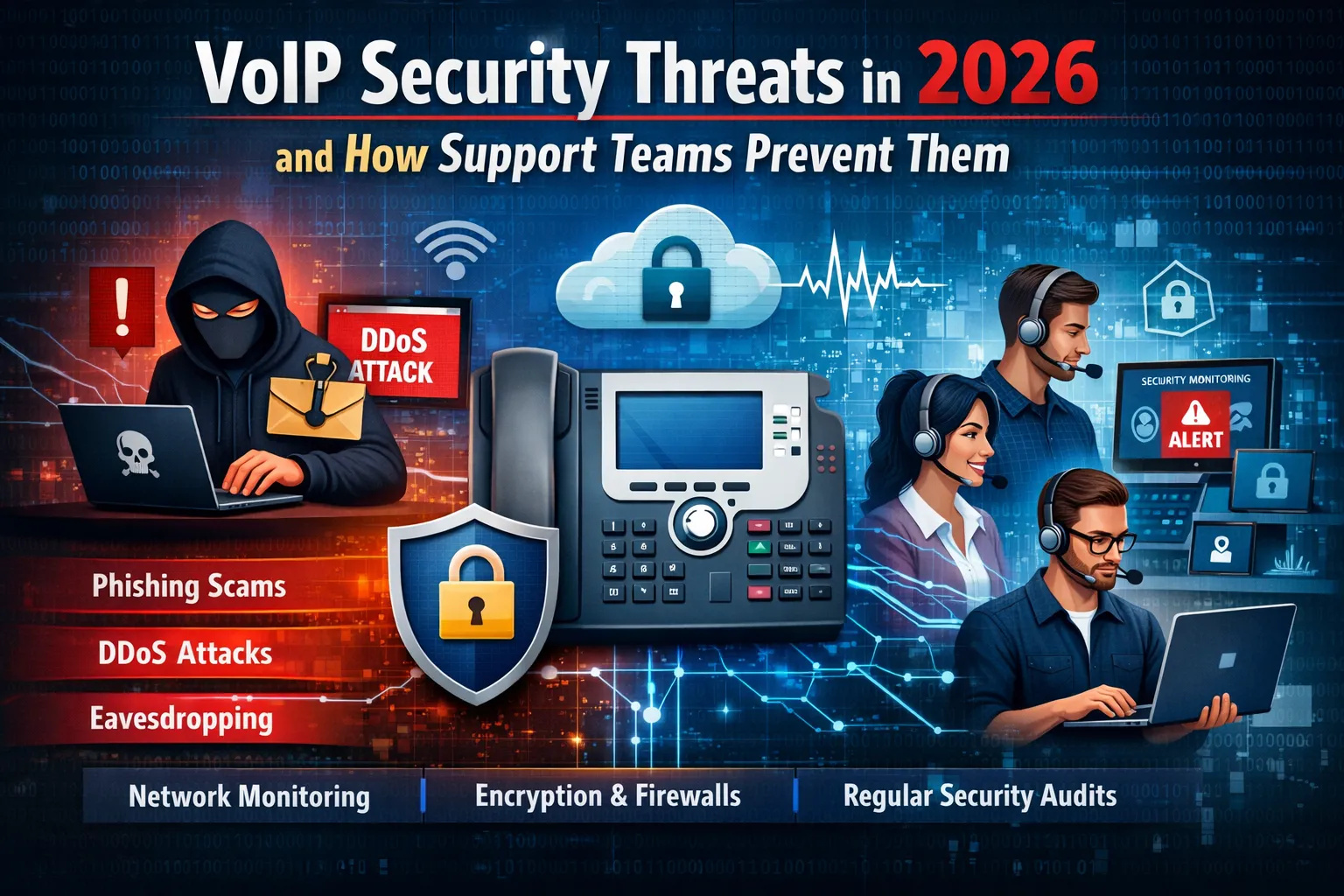
The landscape of business communications has fundamentally transformed, with Voice over Internet Protocol (VoIP) systems becoming the backbone of modern enterprise connectivity. As we navigate through 2026, organizations worldwide are witnessing an unprecedented surge in VoIP adoption, driven by remote work requirements, cost efficiency, and advanced collaboration features. However, this widespread adoption has also attracted sophisticated cybercriminals who recognize VoIP systems as lucrative targets for exploitation.
Recent cybersecurity reports indicate that VoIP-related securityincidents have increased by 47% since 2024, with businesses experiencing everything from eavesdropping attacks to complete system takeovers. The financial implications are staggering—companies face not only direct monetary losses from toll fraud but also devastating reputational damage from compromised confidential communications. For businesses competing in highly regulated industries, a single VoIP security breach can result in compliance violations, legal liabilities, and irreparable client trust erosion.
Understanding the evolving threat landscape and implementing robust preventive measures isn’t just an IT consideration—it’s a business imperative. Professional support teams play an increasingly critical role in safeguarding these communication systems, deploying advanced monitoring tools, implementing zero-trust architectures, and maintaining continuous vigilance against emerging threats.
The Growing VoIP Security Challenge
VoIP technology offers remarkable advantages over traditional phone systems, including scalability, flexibility, and integration with business applications. However, these same characteristics that make VoIP attractive also create unique security vulnerabilities. Unlike conventional telephone networks that operated on isolated infrastructure, VoIP systems transmit voice data across the same networks used for general internet traffic, exposing them to the full spectrum of cyber threats that plague digital communications.
The convergence of voice and data networks has created what security experts call an “expanded attack surface.” Cybercriminals now have multiple entry points to compromise VoIP systems—from exploiting network vulnerabilities to targeting endpoint devices, from intercepting SIP (Session Initiation Protocol) traffic to launching sophisticated social engineering campaigns against users. The complexity increases exponentially when businesses deploy hybrid environments that integrate cloud-based VoIP services with on-premises infrastructure.
Furthermore, the rapid advancement of artificial intelligence has armed attackers with powerful new tools. AI-powered voice synthesis can create convincing deepfakes for social engineering attacks, while machine learning algorithms help cybercriminals identify vulnerable systems and optimize their attack strategies. The democratization of these technologies means that sophisticated VoIP attacks are no longer limited to highly skilled hackers—automated tools have made these threats accessible to virtually anyone with malicious intent.
Top VoIP Security Threats Facing Businesses in 2026
Toll Fraud and Unauthorized Call Routing
Toll fraud remains one of the most financially damaging VoIP security threats, costing businesses billions annually. Attackers gain unauthorized access to VoIP systems and make expensive international calls or route calls through premium-rate services, leaving organizations with astronomical phone bills. In 2026, these attacks have become increasingly sophisticated, with criminals using AI algorithms to identify vulnerable systems and automate the exploitation process.
Modern toll fraud schemes often target businesses during off-hours or holiday periods when monitoring is reduced. Attackers exploit weak authentication mechanisms, compromised credentials, or misconfigured auto-attendant systems to gain system access. Once inside, they can make thousands of calls within hours, generating charges that sometimes exceed $100,000 before detection. Businesses with international operations face particularly high exposure, as their legitimate international calling patterns can mask fraudulent activity.
The economic impact extends beyond immediate phone bill charges. Organizations must invest time and resources investigating the breach, implementing remediation measures, and potentially dealing with service provider disputes regarding liability for fraudulent charges. Some businesses have faced months-long battles attempting to recover losses, diverting attention from core operations.
Eavesdropping and Call Interception
The interception of voice communications presents severe confidentiality risks, particularly for businesses handling sensitive information. VoIP eavesdropping attacks exploit unencrypted voice streams, allowing attackers to capture and record conversations without participants’ knowledge. In 2026, sophisticated man-in-the-middle attacks have evolved to bypass traditional detection methods, with attackers inserting themselves between communication endpoints to intercept real-time conversations.
Healthcare providers, legal firms, financial institutions, and businesses handling proprietary information face particularly acute risks. A single intercepted conversation containing patient information, legal strategy, or trade secrets can trigger HIPAA violations, compromise competitive positioning, or expose organizations to litigation. The challenge intensifies with remote work arrangements, where employees access VoIP systems across diverse networks with varying security postures.
Corporate espionage has found new opportunities through VoIP interception. Competitors or nation-state actors target business communications to gather intelligence on strategic plans, merger discussions, product development, or pricing strategies. The silent nature of these attacks means breaches often remain undetected for extended periods, allowing sustained intelligence gathering that can fundamentally undermine business objectives.
Denial of Service (DoS) Attacks
VoIP Denial of Service attacks aim to overwhelm communication systems, rendering them inoperable and disrupting business operations. These attacks flood VoIP servers with excessive traffic, consuming bandwidth and processing resources until legitimate calls cannot be completed. In 2026, distributed denial of service (DDoS) attacks leveraging massive botnets have become more powerful and difficult to mitigate.
For businesses relying on VoIP as their primary communication channel, even brief service disruptions create cascading problems. Customer service centers become unreachable, sales teams cannot connect with prospects, and time-sensitive business communications fail. The operational impact extends beyond immediate downtime prolonged or repeated attacks damage customer relationships and erode confidence in business reliability.
Some attackers use DoS attacks as cover for more sinister activities, overwhelming security teams with service restoration efforts while simultaneously executing data theft or system compromise operations. Others employ DoS attacks as extortion tools, demanding ransom payments in exchange for ceasing attacks. The multi-faceted nature of these threats requires comprehensive defense strategies that address both availability and broader security concerns.
Vishing (Voice Phishing) Attacks
Vishing represents the convergence of social engineering and VoIP technology, with attackers using phone calls to manipulate victims into divulging sensitive information or transferring funds. In 2026, AI-powered voice synthesis has made these attacks devastatingly effective, with criminals creating convincing voice deepfakes that impersonate executives, vendors, or trusted partners.
These sophisticated attacks exploit caller ID spoofing to display legitimate-appearing phone numbers, creating false confidence in call authenticity. Employees receive calls appearing to come from their CEO requesting urgent wire transfers, IT support requesting credential verification, or vendors requesting updated payment information. The psychological manipulation combined with technological deception creates a potent threat that traditional security measures struggle to address.
Financial losses from successful vishing attacks can be substantial, with individual incidents resulting in unauthorized transfers exceeding hundreds of thousands of dollars. Beyond direct financial impact, organizations face reputational damage when clients or partners learn their communications infrastructure facilitated fraud. Rebuilding trust after vishing incidents requires significant effort and transparent communication about implemented security improvements.
Session Initiation Protocol (SIP) Trunking Vulnerabilities
SIP trunking enables VoIP connectivity between enterprise systems and external networks, but implementation vulnerabilities create significant security exposures. Attackers exploit SIP protocol weaknesses to hijack communication sessions, inject malicious commands, or gain unauthorized system access. In 2026, automated scanning tools continuously probe internet-facing SIP infrastructure, identifying misconfigured systems within minutes of deployment.
Improperly secured SIP trunks allow attackers to register unauthorized devices, intercept call signaling information, or manipulate call routing. These vulnerabilities enable various secondary attacks, from toll fraud to eavesdropping, making SIP trunk security a foundational requirement for VoIP system protection.
The challenge compounds when organizations implement multiple SIP trunks across different locations or departments, creating management complexity that can result in inconsistent security postures. Each trunk represents a potential entry point, and comprehensive protection requires uniform security standards across all implementations.
VoIP Malware and Ransomware
Specialized VoIP malware targets communication systems specifically, distinguishing itself from general network threats. These malicious programs can hijack VoIP devices, redirect calls, steal credentials, or use compromised systems as platforms for launching additional attacks. In 2026, VoIP-specific ransomware has emerged as a particularly concerning threat, encrypting communication system configurations and call databases while demanding payment for restoration.
The operational paralysis caused by VoIP ransomware extends beyond typical data encryption scenarios. Organizations lose their primary communication capability, preventing customer interactions, internal coordination, and emergency communications. The pressure to restore services quickly often leads businesses to pay ransoms, perpetuating the criminal ecosystem and providing no guarantee of complete system restoration.
How Professional Support Teams Prevent VoIP Security Threats
Comprehensive Network Security Architecture
Experienced support teams implement multi-layered security architectures specifically designed for VoIP environments. This begins with network segmentation, isolating voice traffic on dedicated VLANs (Virtual Local Area Networks) separated from general data traffic. By creating logical network boundaries, support teams limit the potential impact of security breaches and prevent attackers from using compromised data systems as jumping-off points for VoIP attacks.
Advanced firewalls configured with VoIP-aware rules filter traffic based on SIP protocol understanding, blocking malicious signaling attempts while allowing legitimate communications. Session Border Controllers (SBCs) serve as protective barriers at network perimeters, normalizing SIP traffic, hiding internal network topology, and preventing various protocol-based attacks. Quality support teams continuously update firewall rules and SBC configurations based on emerging threat intelligence, ensuring protection evolves alongside the threat landscape.
Network security extends to intrusion detection and prevention systems (IDS/IPS) specifically tuned for VoIP traffic patterns. These systems analyze call signaling and media streams in real-time, identifying anomalous behaviors that indicate potential attacks. When suspicious activity is detected—such as unusual call volumes, geographic inconsistencies, or protocol violations—automated responses can block traffic, alert administrators, or trigger additional authentication requirements.
Encryption and Secure Communication Protocols
Professional support teams implement end-to-end encryption for all VoIP communications, ensuring that voice data remains confidential even if intercepted. Transport Layer Security (TLS) protects SIP signaling traffic, preventing attackers from reading call setup information or manipulating call routing. Secure Real-time Transport Protocol (SRTP) encrypts the actual voice streams, rendering intercepted audio unintelligible to eavesdroppers.
Implementation requires careful key management, certificate validation, and protocol configuration to ensure encryption doesn’t create new vulnerabilities. Support teams deploy proper certificate authorities, implement certificate pinning where appropriate, and maintain encryption key rotation schedules. They also ensure encryption extends across all communication endpoints, including mobile devices, softphones, and desk phones, creating a comprehensive protective envelope around voice data.
Beyond basic encryption implementation, advanced support teams configure perfect forward secrecy mechanisms that ensure past communications remain secure even if future encryption keys become compromised. This forward-thinking approach protects historical communication archives from retroactive decryption attempts.
Advanced Authentication and Access Controls
Robust multi-factor authentication (MFA) implementation stands as a critical defense against unauthorized VoIP system access. Support teams configure systems to require multiple verification factors—combining passwords with biometric verification, hardware tokens, or time-based one-time passwords. This dramatically reduces the effectiveness of credential theft attacks, as compromised passwords alone cannot grant system access.
Role-based access controls (RBAC) ensure users can only access VoIP features necessary for their specific job functions. Support teams implement granular permission structures, restricting international calling to authorized personnel, limiting administrative access to necessary staff, and preventing unauthorized system configuration changes. Regular access reviews identify and remove unnecessary permissions, maintaining the principle of least privilege across the organization.
Context-aware authentication adds additional security layers by evaluating authentication requests against expected patterns. Systems can flag login attempts from unusual geographic locations, unfamiliar devices, or during atypical hours, triggering additional verification steps or blocking suspicious access entirely. This intelligent approach adapts security requirements to risk levels rather than applying uniform controls across all scenarios.
Continuous Monitoring and Threat Detection
24/7 security monitoring enables support teams to identify and respond to threats before they cause significant damage. Advanced monitoring platforms analyze call detail records (CDRs), identifying unusual calling patterns such as sudden spikes in international calls, after-hours activity inconsistent with business operations, or calls to high-risk destinations. Machine learning algorithms establish baseline behaviors for individual users and organizational patterns, flagging deviations that may indicate compromise.
Real-time alerting systems notify support personnel immediately when suspicious activity is detected, enabling rapid investigation and response. Support teams establish clear escalation procedures, ensuring that potential security incidents receive appropriate attention based on severity. This continuous vigilance provides protection around the clock, identifying threats during off-hours when many attacks occur.
Advanced monitoring extends beyond simple threshold-based alerts, incorporating behavioral analytics that detect subtle anomalies potentially indicating sophisticated attacks. These systems identify gradual changes in usage patterns, unusual call timing correlations, or communication sequences that match known attack methodologies, providing early warning of emerging threats.
Regular Security Assessments and Penetration Testing
Proactive vulnerability assessments identify security weaknesses before attackers exploit them. Support teams conduct regular security audits of VoIP infrastructure, examining configurations, reviewing access controls, and testing security measures. Automated vulnerability scanners identify known weaknesses in VoIP equipment firmware, server software, and network configurations.
Penetration testing takes assessment further, with security professionals attempting to exploit identified vulnerabilities using the same techniques employed by real attackers. These ethical hacking exercises reveal not only technical vulnerabilities but also procedural weaknesses and gaps in security awareness. The insights gained inform remediation efforts, ensuring security investments address actual risks rather than theoretical concerns.
Testing schedules adapt to organizational change velocity, with major system upgrades, infrastructure modifications, or significant business changes triggering immediate reassessments. This responsive approach ensures security postures remain appropriate as environments evolve.
Patch Management and System Hardening
Systematic patch management ensures VoIP systems remain protected against known vulnerabilities. Support teams maintain detailed inventories of all VoIP components—from server software to endpoint firmware—and monitor vendor security advisories for relevant updates. Critical security patches receive priority deployment, often within hours of availability, while less urgent updates follow established testing and deployment schedules.
System hardening involves configuring VoIP components to minimize attack surfaces. Support teams disable unnecessary services, close unused network ports, remove default accounts, and implement secure configuration baselines. Regular configuration audits identify drift from security standards, triggering remediation before vulnerabilities can be exploited.
Hardening extends to endpoint devices, with support teams configuring desk phones, softphones, and mobile applications according to security best practices. This includes disabling administrative interfaces on phones, requiring secure boot processes, and implementing automatic security update mechanisms that keep devices protected without requiring manual intervention.
User Education and Security Awareness Training
Comprehensive security training equips employees to recognize and respond appropriately to VoIP-related threats. Support teams develop training programs addressing vishing attacks, social engineering tactics, and secure VoIP usage practices. Interactive training scenarios help employees practice identifying suspicious calls and following proper reporting procedures.
Training extends beyond initial onboarding, with regular refresher sessions reinforcing security concepts and introducing awareness of emerging threats. Simulated vishing exercises test employee readiness and identify individuals requiring additional training. Creating a security-conscious culture transforms employees from potential vulnerabilities into active participants in organizational defense.
Effective training programs adapt content to different roles and risk profiles, providing tailored guidance that addresses specific threats relevant to each employee’s position and responsibilities. Executive-level training emphasizes impersonation risks and secure communication practices, while customer service training focuses on caller verification techniques and suspicious request identification.
Incident Response Planning
Despite best preventive efforts, security incidents may still occur. Professional support teams develop comprehensive incident response plans specifically addressing VoIP security breaches. These plans outline clear procedures for incident detection, containment, investigation, remediation, and recovery, ensuring coordinated responses that minimize damage and restore services quickly.
Response plans identify key personnel, establish communication protocols, define authority structures, and specify required documentation. Regular incident response drills test plan effectiveness and familiarize team members with their responsibilities, ensuring smooth execution during actual incidents when stress and time pressure can impair decision-making.
Post-incident analysis examines attack vectors, identifies defensive gaps, and implements improvements preventing similar future incidents. This continuous improvement approach strengthens security postures progressively, learning from both successful defenses and incidents that penetrated existing protections.
Emerging Technologies Enhancing VoIP Security
Artificial Intelligence and Machine Learning
AI-powered security systems are revolutionizing VoIP threat detection and prevention. Machine learning algorithms analyze vast quantities of communication data, identifying subtle patterns indicative of attacks that human analysts might miss. These systems continuously learn from new threats, adapting detection capabilities without requiring manual rule updates.
Behavioral biometrics powered by AI can analyze voice characteristics, speech patterns, and communication behaviors to detect impersonation attempts even when attackers use sophisticated voice synthesis technology. These systems create unique voiceprints for authorized users, flagging communications that deviate from established patterns.
Zero Trust Network Architecture
Zero trust security models eliminate implicit trust from network designs, requiring continuous verification for all communication requests regardless of their origin. In VoIP environments, zero trust architectures verify every call initiation, require authentication for each session, and continuously monitor ongoing communications for signs of compromise.
This approach assumes that threats may already exist within network perimeters, defending against insider threats and compromised systems that traditional perimeter-focused security models might miss. By treating every request as potentially malicious until verified, zero trust architectures dramatically reduce successful attack rates.
Blockchain for Call Authentication
Blockchain technology offers promising solutions for caller ID authentication and call chain verification. Decentralized verification systems can validate caller identities without relying on easily-spoofed caller ID information, making vishing and caller ID spoofing attacks significantly more difficult.
Distributed ledgers create immutable records of call authentications, providing verifiable audit trails that assist post-incident investigations and compliance documentation. While still emerging, blockchain-based authentication may become standard practice for high-security communication requirements.
Building a Culture of VoIP Security
Technology alone cannot fully protect VoIP systems organizational culture plays an equally important role. Businesses must foster environments where security is viewed as everyone’s responsibility rather than solely an IT concern. Leadership commitment demonstrates security importance, allocating appropriate resources and modeling secure communication practices.
Regular communication about emerging threats keeps security awareness high, while transparent reporting about incidents and near-misses helps employees understand real risks rather than viewing security as theoretical concerns. Recognition programs that reward security-conscious behavior reinforce positive practices and encourage ongoing vigilance.
Security policies must balance protection with usability, avoiding overly restrictive measures that frustrate users and encourage workarounds that undermine security. Involving employees in security policy development creates buy-in and ensures policies reflect actual work patterns and requirements.
Frequently Asked Questions
What makes VoIP systems more vulnerable than traditional phone systems?
VoIP transmits voice over internet networks instead of isolated infrastructure, exposing them to all cybersecurity threats. Traditional systems used dedicated, separated networks with limited access points, while VoIP shares networks with data traffic, expanding the attack surface significantly.
How quickly can toll fraud attacks generate significant costs?
Toll fraud can create massive charges within hours. Automated tools make thousands of expensive calls simultaneously once attackers gain access. Businesses have reported charges exceeding $50,000 within a single weekend, with every undetected hour costing thousands of dollars.
Can encryption slow down VoIP call quality?
No. Modern encryption has negligible impact on call quality when properly configured. Today’s processors handle encryption efficiently with minimal latency. The performance impact is virtually unnoticeable in well-designed systems while providing essential security benefits.
What should employees do if they suspect a vishing call?
Never provide sensitive information during unexpected calls. Terminate the call immediately and verify the request independently using known contact information—not numbers provided by the caller. Report all suspicious calls to your security team promptly.
How often should VoIP security configurations be reviewed?
Conduct comprehensive reviews quarterly, with critical components checked monthly. Security logs need daily monitoring, and critical patches require immediate deployment. Major changes like system upgrades should trigger immediate security reassessments.
Are cloud-based VoIP systems more or less secure than on-premises solutions?
Neither is inherently more secure—they offer different security trade-offs. Cloud providers deliver robust infrastructure and dedicated security teams, but create dependencies on their practices. On-premises systems provide greater control but demand substantial internal expertise and resources.






No comment