
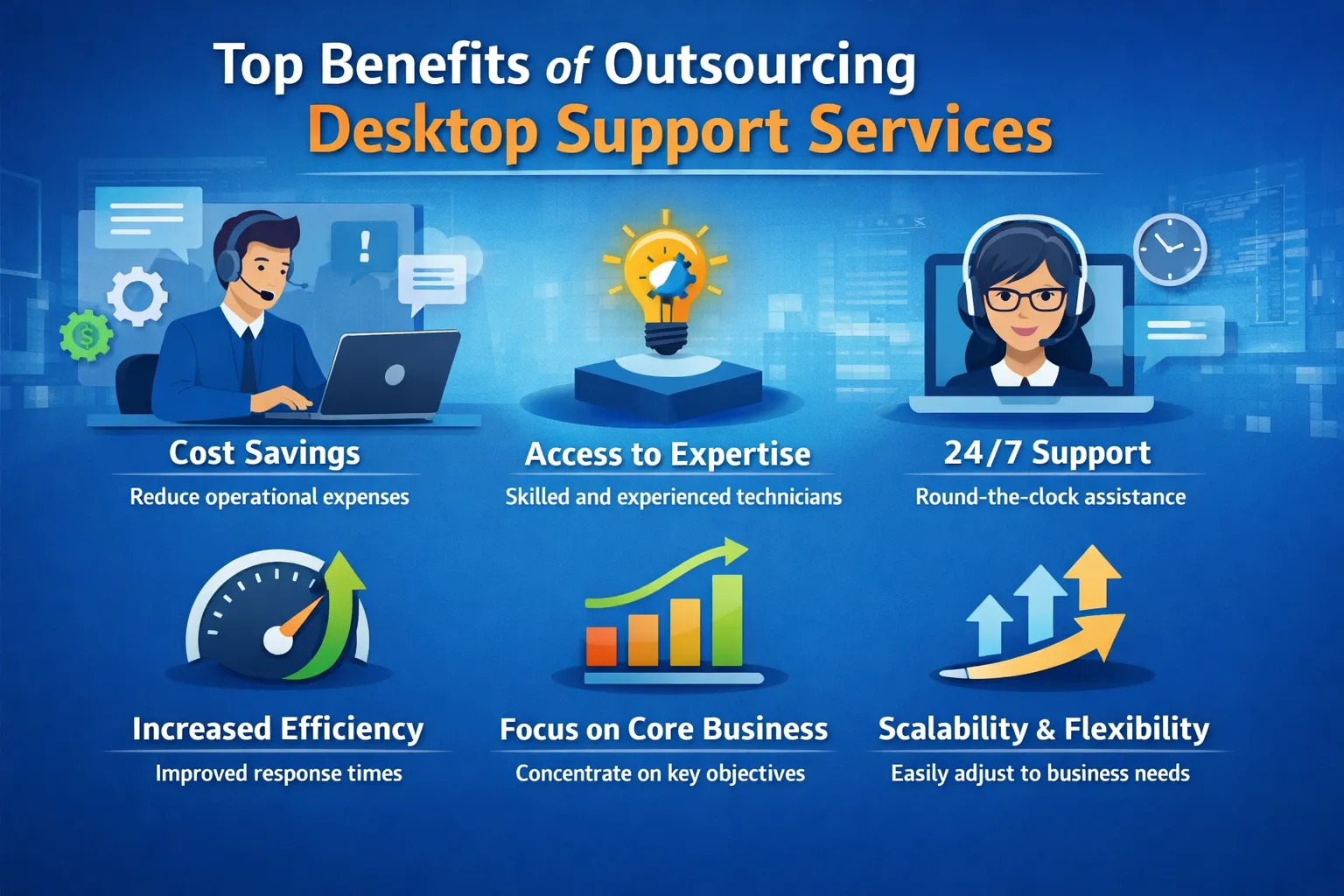
Top Benefits of Outsourcing Desktop Support Services
Introduction
Is Your Internal IT Team Stretched Too Thin?
Every business depends on its desktop environment. Laptops, workstations, software applications, operating systems, and peripherals all require constant attention. A single breakdown stops productivity instantly. Frustrated employees pile up alongside unresolved tickets. Before long, the entire business feels the strain of an overwhelmed IT team.
Many organizations have discovered a smarter way to manage this challenge. Outsourcing desktop support services to a specialist provider delivers faster resolution, broader expertise, and significant cost savings — without the overhead of building and maintaining a large internal IT team.
Why Outsourcing Is No Longer Just for Large Corporations
Outsourcing was once considered a strategy reserved for enterprise-level organizations with large IT budgets. That perception has shifted dramatically. Today, small and medium-sized businesses are among the biggest beneficiaries of outsourced desktop support.
Cloud technology, remote access tools, and managed service platforms have made professional desktop support accessible at every business size and budget level. This blog explores the top benefits of outsourcing desktop support services and why more businesses are making this move every year.
What Does Outsourcing Desktop Support Actually Mean?
Defining the Service
Outsourcing desktop support means partnering with a third-party provider to manage the day-to-day technical needs of your end users. Instead of relying solely on an in-house IT team, your business gains access to a dedicated team of support specialists who handle everything from software troubleshooting and hardware issues to user account management and security patching.
Support is typically delivered remotely through helpdesk platforms, screen-sharing tools, and ticketing systems. On-site visits are arranged when remote resolution is not possible.
What a Desktop Support Provider Handles
A quality desktop support provider covers a wide range of responsibilities. Common services include operating system support and updates, software installation and configuration, hardware diagnostics and replacement coordination, email and productivity suite support, antivirus and endpoint security management, and new employee device setup and onboarding.
Some providers also offer proactive monitoring — catching and resolving issues before end users even notice them. This shifts the support model from reactive to genuinely preventative.
Benefit 1: Significant Cost Savings
Reducing Overhead Without Reducing Quality
Hiring, training, and retaining skilled IT support staff is expensive. Salaries, benefits, ongoing training, certifications, and management overhead all add up quickly. For many businesses, maintaining a fully staffed internal desktop support team costs far more than the service actually requires year-round.
Outsourcing converts these unpredictable fixed costs into a manageable, predictable monthly fee. Businesses pay only for the support they need. Costs scale up during growth periods and down during quieter phases without the complexity of hiring or redundancy processes.
Eliminating Hidden IT Costs
Beyond salaries, internal IT teams generate hidden costs that businesses often underestimate. Recruitment fees, sick leave cover, training courses, software licenses for support tools, and the cost of downtime during staff vacancies all contribute to a figure far higher than most finance teams anticipate.
Outsourcing bundles these variables into a single service agreement. Budgeting becomes simpler. Financial surprises become rarer. Resources previously spent on IT administration redirect toward core business growth instead.
Benefit 2: Access to a Broader Range of Expertise
One Provider, Many Specialists
An in-house desktop support team — particularly in a small or medium-sized business — typically consists of a handful of generalists. They handle most issues well but may lack deep expertise in specific areas such as cybersecurity, cloud platforms, or enterprise software environments.
Outsourced desktop support providers employ entire teams of specialists. When a complex issue arises, the right expert handles it. Your business gains access to a depth of knowledge that would be impossible to replicate with a small internal team.
Staying Current With Rapidly Evolving Technology
Technology evolves faster than ever. Operating system updates, new application versions, security vulnerabilities, and hardware changes all require continuous learning. Internal teams struggle to stay current while simultaneously managing daily support queues.
Outsourced providers invest heavily in training and certification. Their teams stay current with the latest developments as part of their core business model. Your organization benefits from that expertise without bearing the training cost directly.
Benefit 3: Faster Response Times and Improved Helpdesk Coverage
Speed Is Everything in Desktop Support
When an employee cannot access their workstation, open a critical application, or send an email, every minute of delay costs productivity. Slow response times frustrate employees, damage morale, and — in customer-facing roles — directly impact revenue.
Professional desktop support providers operate under defined Service Level Agreements (SLAs). These agreements specify maximum response and resolution times for different issue categories. SLAs create accountability that internal teams often lack. Performance is measured, reported, and continuously improved.
24/7 Support That Never Switches Off
Internal IT teams work business hours. Problems do not. A system failure at 7 PM or a remote worker locked out of their account on a Saturday morning causes just as much disruption as a mid-morning incident.
Outsourced desktop support providers offer round-the-clock helpdesk coverage. Employees get help whenever they need it — regardless of time zone or working pattern. For businesses with remote teams, international operations, or shift-based workforces, this coverage is not a luxury. It is a necessity.
Benefit 4: Enhanced Security and Compliance
Desktop Endpoints Are a Primary Attack Surface
Cybercriminals frequently target desktop endpoints as entry points into business networks. Unpatched software, weak passwords, misconfigured security settings, and outdated antivirus definitions all create exploitable vulnerabilities. Managing these risks consistently across every device in an organization requires dedicated focus.
Outsourced desktop support providers integrate security into every aspect of their service. Patch management runs on defined schedules. Endpoint protection tools deploy and update automatically. Security configurations apply uniformly across all managed devices. This consistent approach significantly reduces exposure to cyber threats.
Meeting Compliance Requirements With Confidence
Many industries impose strict requirements on how business technology is managed and secured. Healthcare organizations must comply with HIPAA. Financial services firms operate under various regulatory frameworks. Retail businesses handling card payments must meet PCI-DSS standards.
A qualified desktop support provider understands these requirements and builds compliance into their service delivery. Documentation, audit trails, and security controls satisfy regulatory scrutiny. Businesses avoid the penalties and reputational damage that compliance failures bring.
Benefit 5: Scalability That Matches Your Business Growth
Support That Grows With You
One of the most practical advantages of outsourcing desktop support is scalability. Adding ten new employees next quarter? Your support provider accommodates that growth seamlessly. Opening a new office means onboarding devices and users into the support system happens without delay.
Building this scalability internally requires advance hiring, training lead times, and equipment investment. Outsourcing eliminates that lag entirely. Your support capacity expands as your headcount grows — without the operational friction.
Flexibility During Seasonal or Project-Based Demand
Many businesses experience fluctuating IT support demand. Seasonal peaks, major project launches, and rapid team expansions all create temporary spikes in support requirements. Outsourced providers absorb these fluctuations naturally within their existing capacity.
This flexibility gives businesses the confidence to grow aggressively without worrying whether their IT support infrastructure can keep pace. The provider handles scaling. Your leadership team focuses on strategy.
Benefit 6: Your Internal Team Can Focus on Strategic Priorities
Freeing Up Internal Resources
Even businesses with internal IT staff benefit from outsourcing desktop support. Routine helpdesk requests — password resets, printer issues, software installation, and connectivity troubleshooting — consume enormous amounts of internal IT time every week.
When an outsourced provider handles these day-to-day tasks, internal IT professionals reclaim time for higher-value work. Infrastructure projects, digital transformation initiatives, cybersecurity strategy, and technology roadmap planning all benefit from more focused attention.
Reducing Burnout in Your IT Team
IT burnout is a real and growing problem. Support staff who spend their entire day fielding repetitive helpdesk tickets quickly lose motivation. Turnover in IT teams is costly — both in recruitment expenses and in the institutional knowledge that walks out the door.
Outsourcing routine desktop support reduces the repetitive load on internal staff. Retained team members engage with more meaningful, challenging work. Job satisfaction improves. Retention improves. The business retains critical knowledge and experience it has invested years in building.
Benefit 7: Proactive Monitoring and Preventative Maintenance
Catching Problems Before They Impact Users
Reactive support waits for things to break. Proactive support prevents breakdowns from happening in the first place. Leading desktop support providers deploy monitoring tools across every managed endpoint. These tools track performance metrics, flag early warning signs, and trigger remediation actions automatically.
A workstation showing early signs of hardware failure gets flagged and addressed before the hard drive crashes and data is lost. A software conflict identified in its early stages gets resolved before it causes an application outage. Prevention is always faster and cheaper than cure.
Scheduled Maintenance That Keeps Systems Healthy
Proactive desktop support includes scheduled maintenance activities. Operating system updates, driver patches, disk cleanup, and performance optimization all happen on defined schedules — typically during off-hours to minimize disruption.
Employees arrive each morning to systems that are current, clean, and performing at their best. Unplanned outages caused by neglected maintenance become rare. Productivity improves. End-user satisfaction increases noticeably over time.
Conclusion
The Smart Choice for Modern Businesses
Outsourcing desktop support services is not about cutting corners. It is about making a strategic decision to access better expertise, faster response, stronger security, and more flexible capacity — at a cost that consistently outperforms the alternative.
From significant cost savings and round-the-clock helpdesk coverage to proactive monitoring and compliance support, the benefits are concrete and measurable. Businesses that outsource desktop support do not just solve their immediate IT challenges. They build a more resilient, scalable, and productive operational foundation.
If your current desktop support model is reactive, inconsistent, or simply struggling to keep pace with your business growth, now is the right time to explore what outsourcing can deliver. The results speak clearly — and your employees will feel the difference from day one.
Frequently Asked Questions (FAQ)
Q1. What types of businesses benefit most from outsourcing desktop support services?
Businesses of all sizes benefit from outsourcing desktop support, but small and medium-sized businesses often see the greatest return. These organizations typically lack the budget to staff a full internal IT department but face the same desktop support demands as larger enterprises. Outsourcing gives them access to enterprise-grade support without enterprise-level costs.
Q2. How does outsourced desktop support improve security?
Outsourced providers integrate security into every layer of their desktop support service. Patch management, endpoint protection, security configuration audits, and user access management all happen on defined schedules. This consistency closes the gaps that cybercriminals exploit. Businesses gain stronger, more uniform security across every managed device.
Q3. Will outsourcing desktop support disrupt my employees?
A well-managed transition to outsourced desktop support causes minimal disruption. Experienced providers follow structured onboarding processes. Employees interact with the new helpdesk through familiar channels — phone, email, chat, or a support portal. Most users notice faster response times and better resolution rates almost immediately.
Q4. Can outsourced desktop support work for remote and hybrid teams?
Absolutely. Remote desktop support is one of the greatest strengths of outsourced providers. Using secure remote access tools, support technicians resolve the vast majority of issues without requiring an on-site visit. For distributed teams working across multiple locations or time zones, outsourced support delivers far more consistent coverage than a centralized internal team can provide.
Q5. What is a Service Level Agreement (SLA) in desktop support?
An SLA is a formal agreement between your business and the support provider that defines performance standards. Key metrics typically include maximum response time for new tickets, target resolution times by issue severity, and system availability guarantees. SLAs create accountability and give businesses a clear benchmark for measuring provider performance.



No comment