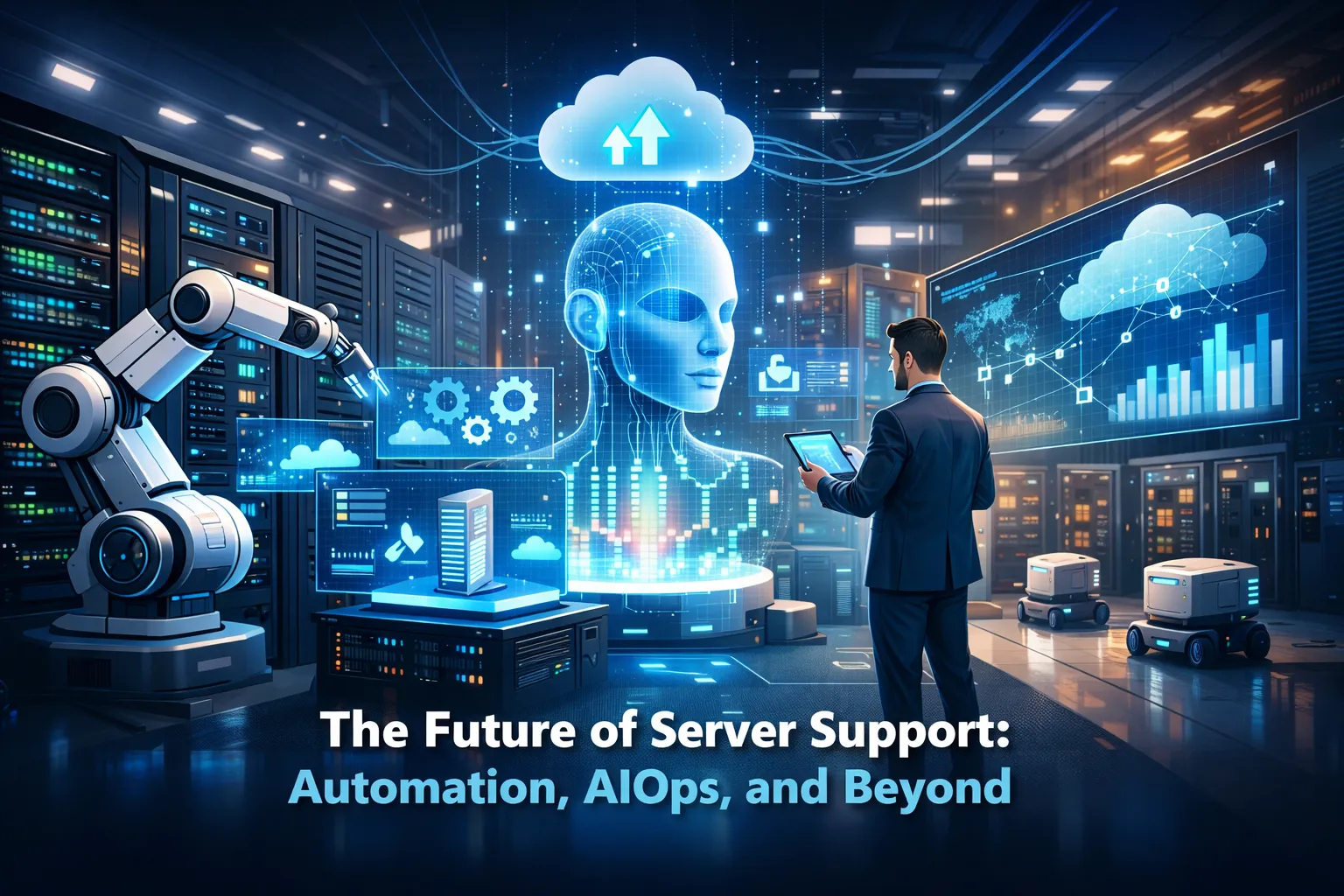
The Future of Server Support: Automation, AIOps, and Beyond
The landscape of server support is undergoing a revolutionary transformation. Traditional methods of managing IT infrastructure characterized by reactive troubleshooting and manual interventions are rapidly giving way to intelligent, automated systems that predict problems before they occur. For businesses in Orange County and beyond, understanding these emerging technologies isn’t just about staying current; it’s about maintaining competitive advantage in an increasingly digital marketplace.
The Evolution from Reactive to Proactive Server Management
Server support has come a long way from the days when IT teams would wait for systems to fail before springing into action. The traditional break-fix model, while still prevalent in some organizations, is becoming increasingly untenable as businesses depend more heavily on continuous uptime and seamless performance.
Modern server environments are vastly more complex than their predecessors. Cloud integrations, hybrid infrastructures, microservices architectures, and distributed applications have created ecosystems where thousands of interdependent components must work in harmony. A single misconfiguration or performance bottleneck can cascade into significant business disruptions, making proactive management not just preferable but essential.
This complexity has driven the evolution toward predictive and automated approaches. Rather than responding to failures, tomorrow’s server support systems will anticipate issues, automatically resolve routine problems, and provide IT teams with actionable intelligence about potential risks before they materialize.
Understanding AIOps: The Intelligence Behind Modern Server Management
Artificial Intelligence for IT Operations, commonly known as AIOps, represents the convergence of big data, machine learning, and traditional IT operations management. These platforms ingest massive volumes of operational data from servers, applications, networks, and security tools, applying sophisticated algorithms to identify patterns, anomalies, and correlations that would be impossible for human analysts to detect.
AIOps platforms excel at cutting through the noise that plagues modern IT environments. A typical enterprise server infrastructure generates millions of events, logs, and metrics daily. Without intelligent filtering and correlation, IT teams face alert fatigue and struggle to distinguish critical issues from benign anomalies. AIOps systems learn what constitutes normal behavior for your specific environment, automatically suppressing false positives while escalating genuine threats.
The predictive capabilities of AIOps extend beyond simple threshold monitoring. These systems can forecast capacity requirements, predict hardware failures based on performance degradation patterns, and identify security vulnerabilities by correlating seemingly unrelated events across your infrastructure. This intelligence transforms server support from a reactive discipline into a strategic function that actively contributes to business continuity and risk management.
Automation: From Scripts to Self-Healing Systems
Automation in server support has evolved significantly from basic scripting. Modern automation frameworks enable self-healing capabilities where systems can detect, diagnose, and remediate common issues without human intervention. When a web server becomes unresponsive, automated systems can restart services, redistribute workloads, or spin up replacement instances—all within seconds of detecting the problem.
Infrastructure as Code has revolutionized how organizations provision and manage server resources. Rather than manually configuring servers, IT teams define desired states in code, enabling consistent deployments, rapid scaling, and easy rollback capabilities. This approach reduces human error, accelerates deployment cycles, and ensures that development, testing, and production environments maintain parity.
Orchestration platforms take automation further by coordinating complex workflows across multiple systems. These tools can automatically patch servers during maintenance windows, rebalance workloads based on performance metrics, or execute disaster recovery procedures when specific conditions are met. The result is infrastructure that requires less hands-on management while maintaining higher reliability and performance standards.
The Role of Machine Learning in Predictive Maintenance
Machine learning algorithms are transforming server maintenance from scheduled interventions to truly predictive approaches. By analyzing historical performance data, these systems identify subtle indicators that precede hardware failures or performance degradation. A slight increase in disk latency, minor temperature fluctuations, or incremental memory consumption patterns can signal impending issues weeks before they become critical.
This predictive capability delivers substantial business value. Unplanned downtime costs organizations an average of thousands of dollars per minute, while scheduled maintenance can be planned during low-impact windows. Machine learning enables IT teams to transition from reactive firefighting to strategic resource planning, replacing components before they fail and optimizing maintenance schedules based on actual system behavior rather than arbitrary timelines.
Advanced analytics also improve capacity planning accuracy. Rather than relying on simple trend extrapolation, machine learning models account for seasonal variations, business cycle impacts, and complex usage patterns. This intelligence helps organizations right-size their infrastructure, avoiding both costly over-provisioning and performance-degrading resource constraints.
Hybrid and Multi-Cloud Complexity: The Automation Imperative
The proliferation of hybrid and multi-cloud architectures has made automation and AIOps essential rather than optional. Managing servers across on-premises data centers, multiple public cloud providers, and edge locations creates unprecedented complexity. Manual management approaches simply cannot scale to handle the diversity of platforms, APIs, and management interfaces that characterize modern infrastructure.
Unified management platforms leverage automation to provide consistent operational experiences across heterogeneous environments. These systems abstract away platform-specific differences, enabling IT teams to apply policies, monitor performance, and troubleshoot issues using common tools and workflows regardless of where workloads run.
Cost optimization in multi-cloud environments particularly benefits from intelligent automation. AIOps platforms can analyze usage patterns, identify underutilized resources, recommend right-sizing opportunities, and even automatically migrate workloads to more cost-effective platforms based on performance requirements and pricing dynamics.
Security Integration: Automated Threat Detection and Response
The convergence of server operations and security—often called SecOps or DevSecOps—represents another critical evolution. Modern server support must incorporate security considerations throughout the infrastructure lifecycle. Automated security scanning, vulnerability assessment, and compliance monitoring have become integral components of server management.
AIOps platforms excel at security correlation, identifying potential breaches by connecting dots across server logs, network traffic, authentication systems, and threat intelligence feeds. When suspicious patterns emerge—such as unusual access patterns, unexpected process executions, or anomalous network connections—automated systems can trigger containment procedures, isolate affected servers, and alert security teams with contextual information that accelerates investigation and remediation.
Compliance automation similarly reduces burden and risk. Rather than manually generating audit reports or conducting periodic compliance checks, automated systems continuously monitor configurations, access controls, and security policies, flagging deviations in real-time and maintaining comprehensive audit trails that satisfy regulatory requirements.
The Human Element in Automated Environments
Despite increasing automation, the human element remains crucial in server support. The future isn’t about eliminating IT professionals but rather elevating their roles from routine maintenance to strategic problem-solving. Automation handles repetitive tasks, monitors systems continuously, and resolves common issues, freeing skilled technicians to focus on complex challenges, architectural improvements, and business-aligned initiatives.
IT professionals must develop new competencies as server support evolves. Understanding automation frameworks, interpreting AIOps insights, and designing self-healing systems require different skills than traditional server administration. Organizations that invest in training and skill development will realize greater returns from their automation investments while maintaining the human judgment and creativity that machines cannot replicate.
Preparing Your Infrastructure for the Automated Future
Organizations looking to embrace these emerging technologies should begin with clear assessment of current capabilities and pain points. Which manual tasks consume disproportionate time? Where do failures most frequently occur? What compliance or security gaps exist? These insights guide prioritization of automation initiatives for maximum impact.
Starting with well-defined use cases allows teams to demonstrate value and build expertise incrementally. Automating server provisioning, implementing automated backup verification, or deploying basic anomaly detection provides tangible benefits while establishing foundational capabilities for more sophisticated implementations.
Partnership with experienced managed service providers can accelerate adoption while mitigating risks. Organizations specializing in modern IT infrastructure bring expertise in automation tools, AIOps platforms, and best practices developed across diverse client environments. This expertise helps businesses avoid common pitfalls and realize value more quickly than purely internal initiatives.
The future of server support promises more reliable, secure, and efficient infrastructure managed through intelligent automation and AI-driven insights. Organizations that embrace these technologies position themselves for success in an increasingly digital business landscape where infrastructure excellence directly impacts competitive positioning and customer satisfaction.
Frequently Asked Questions
What is AIOps and how does it differ from traditional monitoring?
AIOps uses artificial intelligence and machine learning to analyze IT operations data, automatically identifying patterns and anomalies that traditional rule-based monitoring would miss. Unlike conventional tools that rely on predefined thresholds, AIOps learns normal behavior patterns and adapts to changing environments, providing more accurate alerting and predictive insights.
Will automation replace IT support staff?
Automation enhances rather than replaces IT professionals. While routine tasks become automated, skilled technicians focus on strategic initiatives, complex problem-solving, and architectural improvements. The role evolves from manual execution to designing, managing, and optimizing automated systems.
How quickly can businesses implement server automation?
Implementation timelines vary based on current infrastructure complexity and organizational readiness. Basic automation can deliver value within weeks, while comprehensive AIOps deployments may require several months. Phased approaches starting with high-impact use cases typically provide the best balance of quick wins and long-term transformation.
What are the security implications of automated server management?
Properly implemented automation enhances security through consistent policy application, rapid threat detection, and automated response capabilities. However, automation systems themselves must be secured, and organizations should implement appropriate access controls, change management processes, and monitoring for automation platforms.
How does server automation impact compliance requirements?
Automation simplifies compliance by ensuring consistent configurations, maintaining comprehensive audit trails, and continuously monitoring for policy violations. Automated documentation and reporting capabilities reduce the manual effort required for compliance demonstrations while improving accuracy and completeness.



No comment