
Common VoIP Issues and How Professional Support Services Solve Them
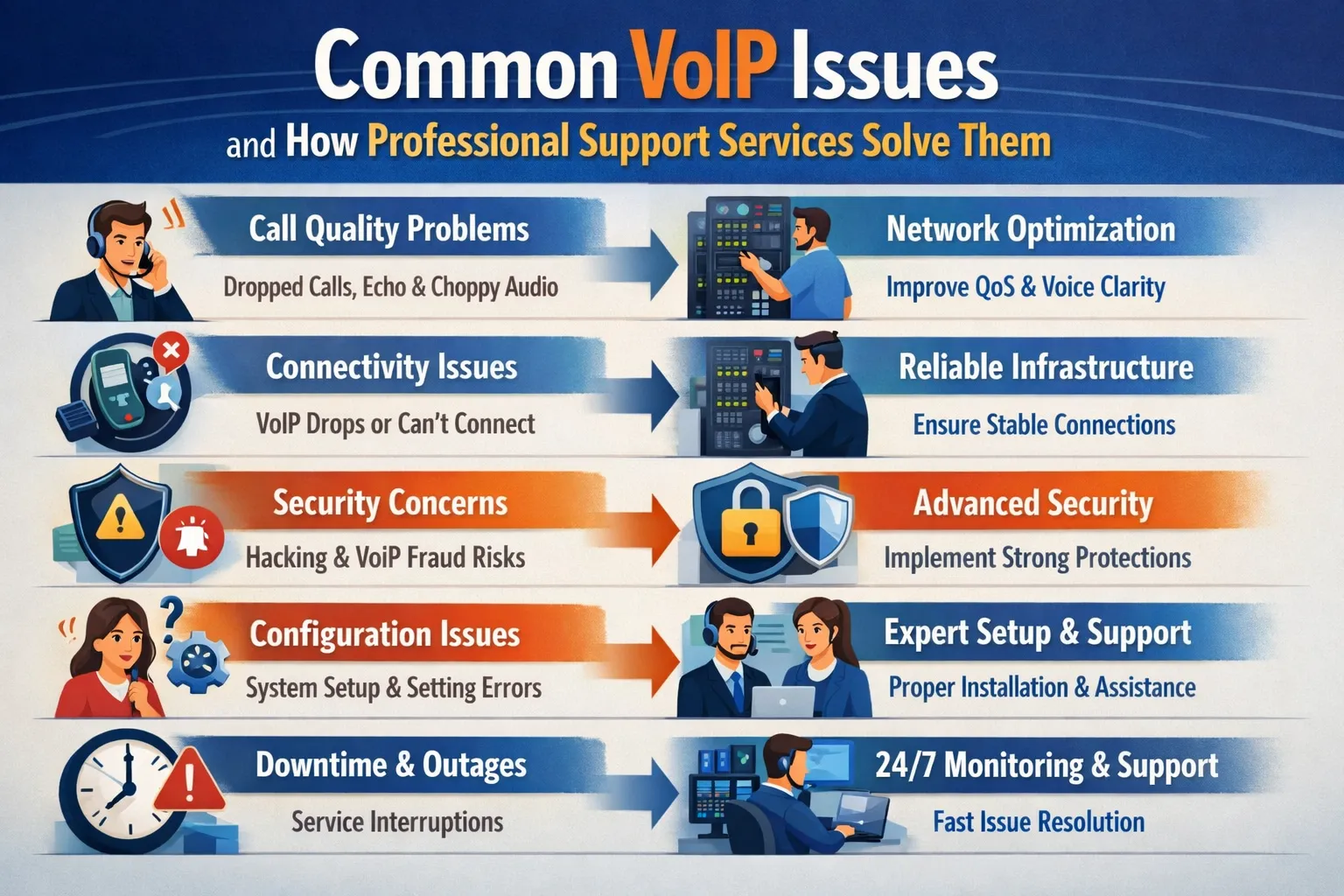
Voice over Internet Protocol (VoIP) has revolutionized business communications, offering cost savings, flexibility, and advanced features that traditional phone systems simply can’t match. However, like any technology, VoIP systems can experience technical challenges that disrupt communication and impact productivity.
When VoIP issues arise, they don’t just cause minor inconveniences they can lead to missed calls with potential clients, frustrated customers, and lost revenue opportunities. Understanding common VoIP problems and knowing how professional support services address them is crucial for maintaining reliable business communications.
This comprehensive guide explores the most frequent VoIP issues businesses encounter and demonstrates how expert support services provide effective, lasting solutions.
Poor Call Quality: The Most Frustrating VoIP Challenge
Understanding Audio Quality Problems
Poor call quality remains the most common complaint among VoIP users. This manifests as choppy audio, robotic-sounding voices, echo effects, or conversations where words drop out entirely. These issues create communication barriers that can damage professional relationships and decrease team efficiency.
Call quality problems typically stem from insufficient bandwidth, network congestion, or improper Quality of Service (QoS) configurations. When multiple applications compete for network resources, voice packets may arrive late or out of sequence, causing the degraded audio experience users dread.
How Professional Support Resolves Audio Issues
Professional VoIP support services tackle call quality problems through systematic network analysis. They perform bandwidth assessments to ensure your internet connection can handle voice traffic alongside other business applications. Support technicians configure QoS settings to prioritize voice packets over less time-sensitive data, guaranteeing smooth call quality even during peak usage periods.
Additionally, experts implement codec optimization, selecting the right balance between audio quality and bandwidth consumption. They monitor jitter and latency levels continuously, making real-time adjustments to maintain crystal-clear conversations throughout your organization.
Connectivity and Network Problems That Disrupt Service
Common Connection Failures
Intermittent connectivity issues plague many VoIP deployments. Users may experience dropped calls, inability to connect to the VoIP server, or complete system outages. These problems often occur without warning, leaving businesses scrambling to restore critical communication capabilities.
Network configuration errors, firewall restrictions, router compatibility issues, and insufficient network infrastructure commonly cause connectivity failures. For businesses without dedicated IT expertise, diagnosing the root cause can prove extremely challenging and time-consuming.
Professional Solutions for Connectivity Challenges
Professional support services provide comprehensive network assessments that identify potential connectivity vulnerabilities before they cause major disruptions. They configure firewalls and routers specifically for VoIP traffic, opening necessary ports and establishing proper network address translation (NAT) settings.
Support teams implement redundancy measures, including failover configurations that automatically switch to backup connections when primary links fail. They also establish proactive monitoring systems that alert technicians to connectivity issues before users even notice problems, enabling preventive intervention rather than reactive troubleshooting.
Echo and Feedback: When Conversations Become Confusing
The Echo Problem Explained
Echo occurs when speakers hear their own voice returned to them with a slight delay, making conversations extremely difficult. This issue typically results from acoustic feedback, where sound from a speaker gets picked up by a microphone, or from network-related problems that create packet reflection.
Feedback issues create unprofessional communication experiences and can make important business discussions nearly impossible to conduct effectively. Users often resort to raising their voices or repeating information multiple times, wasting valuable time and creating frustration.
Expert Approaches to Eliminating Echo
Professional VoIP support specialists employ echo cancellation technologies and properly configure audio settings across all endpoints. They assess hardware compatibility, ensuring that headsets, desk phones, and conference room equipment meet quality standards and function correctly with your VoIP system.
Technicians adjust impedance matching settings, fine-tune echo cancellation parameters, and implement acoustic treatments when necessary. For persistent echo problems, they may recommend specific hardware upgrades or replacements that eliminate the issue permanently.
Security Vulnerabilities and Fraud Prevention
VoIP Security Threats Businesses Face
VoIP systems face unique security challenges, including eavesdropping, toll fraud, denial-of-service attacks, and caller ID spoofing. Cybercriminals target VoIP infrastructure because successful breaches can result in substantial financial losses and expose sensitive business communications.
Toll fraud alone costs businesses millions annually, as hackers exploit poorly secured systems to make international calls at the company’s expense. Without proper security measures, VoIP deployments become attractive targets for increasingly sophisticated threat actors.
Professional Security Implementation
Expert support services implement comprehensive security frameworks that protect VoIP systems from multiple threat vectors. They deploy encryption protocols for both signaling and media streams, ensuring that conversations remain private and protected from interception.
Support teams configure session border controllers that act as security gateways, filtering malicious traffic while allowing legitimate communications. They establish strong authentication requirements, implement fraud detection systems that identify unusual calling patterns, and regularly update security policies to address emerging threats.
Integration Challenges with Business Applications
The Complexity of Unified Communications
Modern businesses expect VoIP systems to integrate seamlessly with CRM platforms, email clients, collaboration tools, and other business applications. However, achieving smooth integration often requires specialized knowledge and configuration expertise that internal teams may lack.
Poor integration results in inefficient workflows, duplicate data entry, and missed opportunities to leverage communication data for business intelligence. When systems don’t communicate properly, employees lose productivity and customer service quality suffers.
Professional Integration Services
Support specialists possess deep knowledge of various business platforms and understand the technical requirements for successful integration. They configure APIs, establish data synchronization protocols, and customize interfaces to create unified communication experiences.
Professionals ensure that caller information displays correctly, call logs synchronize with CRM systems, and voicemail transcriptions automatically route to appropriate team members. They test integration thoroughly across all use cases, eliminating the trial-and-error approach that often frustrates internal IT teams.
Scalability Issues as Businesses Grow
Growing Pains with VoIP Systems
As businesses expand, their communication needs evolve rapidly. Adding new users, establishing remote offices, or implementing new features can strain existing VoIP infrastructure if not properly planned. Many organizations discover scalability limitations only when growth initiatives stall due to communication system constraints.
Bandwidth requirements increase, server capacity becomes insufficient, and licensing models may not accommodate organizational growth efficiently. These scalability challenges can force expensive emergency upgrades or system replacements.
Professional Capacity Planning
Expert support services perform comprehensive capacity planning that anticipates future growth and ensures VoIP systems scale smoothly. They analyze usage patterns, forecast bandwidth requirements, and design architectures that accommodate expansion without major overhauls.
Professionals implement cloud-based solutions when appropriate, providing virtually unlimited scalability with minimal infrastructure investment. They establish monitoring dashboards that track system utilization, alerting administrators when capacity approaches predefined thresholds and enabling proactive upgrades before performance degrades.
The Value of Proactive VoIP Management
Professional VoIP support transcends reactive troubleshooting. Expert services provide continuous monitoring, regular system optimization, firmware updates, and performance tuning that prevent problems before they impact business operations.
Support teams conduct regular health checks, analyzing call quality metrics, system logs, and network performance indicators. They establish service level agreements that guarantee rapid response times and maintain detailed documentation of your VoIP environment for efficient troubleshooting.
By partnering with professional support services, businesses transform VoIP from a potential source of frustration into a reliable competitive advantage that enhances communication, supports growth, and delivers consistent value.
Frequently Asked Questions
What causes choppy audio during VoIP calls?
Choppy audio typically results from insufficient bandwidth, network congestion, or improper QoS settings that don’t prioritize voice traffic over other data types.
How quickly can professional support resolve VoIP issues?
Response times vary by service agreement, but many providers offer solutions within hours for critical issues, with some providing 24/7 emergency support for immediate assistance.
Is VoIP security really a significant concern?
Yes, VoIP systems face serious security threats including toll fraud, eavesdropping, and denial-of-service attacks that can result in substantial financial losses and data breaches.
Can professional support help with mobile VoIP integration?
Absolutely. Professional services configure mobile applications, ensure secure remote access, and optimize performance for employees working outside traditional office environments.
What’s the difference between in-house and professional VoIP support?
Professional support offers specialized expertise, 24/7 availability, advanced monitoring tools, and comprehensive experience across multiple VoIP platforms that most internal IT teams can’t match.
How do professionals prevent VoIP downtime?
Through proactive monitoring, redundancy configurations, regular maintenance, automated failover systems, and continuous performance optimization that identifies potential issues before they cause outages.
Are cloud-based VoIP systems more reliable than on-premise?
Cloud systems often provide better reliability through geographic redundancy and professional management, though both options can be highly reliable with proper support and configuration.
What should businesses look for in VoIP support services?
Prioritize providers offering 24/7 availability, demonstrated VoIP expertise, proactive monitoring capabilities, clear service level agreements, and experience with your specific VoIP platform.
Conclusion
VoIP technology delivers tremendous benefits for modern businesses, but realizing its full potential requires addressing technical challenges effectively. Common issues like poor call quality, connectivity problems, security vulnerabilities, and integration difficulties can undermine VoIP’s value proposition when left unresolved.
Professional support services provide the expertise, tools, and proactive management necessary to maintain reliable, high-performance VoIP systems. By partnering with qualified support providers, businesses eliminate communication disruptions, enhance security, and ensure their VoIP investment delivers consistent returns.
Whether you’re experiencing specific VoIP problems or want to prevent issues before they occur, professional support services offer the comprehensive solutions that keep your business communications running smoothly.







No comment