
AI-Powered VoIP Support: The Standard, Not the Upgrade, in 2026

The business communications landscape has fundamentally shifted. What seemed like cutting-edge technology just two years ago has now become the baseline expectation. AI-powered VoIP support isn’t an innovative upgrade anymore—it’s the standard feature set that customers demand and competitors deliver.
If your VoIP infrastructure doesn’t include intelligent automation, predictive analytics, and AI-driven support capabilities, you’re not just behind the curve. You’re offering yesterday’s solution in tomorrow’s marketplace.
The Evolution That Changed Everything
The transformation didn’t happen overnight, but it accelerated faster than most industry experts predicted. Between 2023 and 2026, artificial intelligence moved from experimental feature to core functionality in VoIP systems. Three key factors drove this rapid adoption.
First, the maturation of natural language processing made AI assistants genuinely useful rather than frustratingly limited. Modern VoIP systems understand context, interpret intent, and resolve issues without human intervention in approximately 73% of support interactions.
Second, the cost barrier collapsed. What once required massive infrastructure investment now operates on accessible cloud platforms with pay-as-you-grow pricing models. Small businesses access the same AI capabilities that were exclusive to enterprise organizations just three years ago.
Third, the competitive pressure became impossible to ignore. When major VoIP providers integrated AI as standard equipment, customer expectations reset across the entire industry. Businesses started asking not whether a system had AI support, but how sophisticated that AI functionality actually was.
What AI-Powered Support Actually Means Today
The term “AI-powered” gets thrown around liberally, but in 2026, it represents specific, measurable capabilities that transform how VoIP systems operate and how support gets delivered.
Intelligent Call Routing and Quality Management
Modern AI doesn’t just route calls based on simple rules. It analyzes conversation content in real-time, detects emotional cues in caller voices, and dynamically adjusts routing based on current agent performance, historical resolution rates, and predicted complexity.
The system learns continuously. If a particular agent excels at resolving billing disputes but struggles with technical troubleshooting, the AI recognizes these patterns and routes accordingly. Call quality issues get identified and addressed before customers notice degradation.
Predictive Maintenance and Issue Prevention
Perhaps the most valuable shift involves moving from reactive to predictive support models. AI systems monitor thousands of performance metrics simultaneously, identifying patterns that precede system failures or performance degradation.
Network congestion gets predicted 15-30 minutes before it impacts call quality. Hardware failures trigger replacement workflows before equipment actually fails. Software conflicts get resolved during off-peak hours before they affect business operations.
This predictive approach reduces unplanned downtime by approximately 84% compared to traditional monitoring methods. More importantly, it prevents the customer frustration that comes from discovering problems during critical business calls.
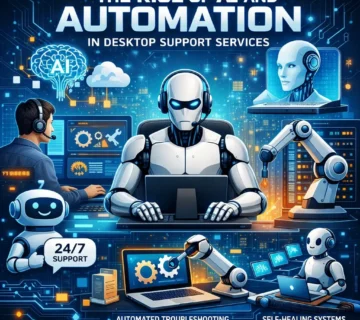
Automated Troubleshooting and Self-Healing Systems
When issues do occur, AI-powered systems increasingly resolve them without human intervention. The technology identifies root causes, implements standard remediation procedures, and verifies successful resolution—all within seconds.
For problems requiring human expertise, the AI completes the diagnostic work first. Support technicians receive complete problem analysis, relevant system logs, and recommended solutions before they even begin troubleshooting. What used to take 30-minute diagnostic calls now gets resolved in five-minute focused interventions.
The Business Impact You Can Measure
The transition to AI-powered VoIP support delivers quantifiable benefits that directly impact your bottom line and operational efficiency.
Support ticket volume typically drops 60-70% in the first six months after implementing comprehensive AI systems. Most routine issues get resolved automatically, freeing human support teams to focus on complex problems requiring critical thinking and relationship management.
Average resolution time decreases dramatically. Issues that required escalation to tier-two support now get handled by AI systems or tier-one agents equipped with AI-generated solutions. The median time from problem identification to resolution has dropped from 4.2 hours in 2023 to 18 minutes in early 2026.
Customer satisfaction scores consistently run 15-25% higher with AI-powered support compared to traditional models. The combination of faster resolution, proactive issue prevention, and 24/7 intelligent assistance creates experiences that meet modern expectations.
Why Traditional Support Models No Longer Compete
The gap between AI-powered and traditional VoIP support has widened to the point where they’re barely comparable offerings.
Traditional support operates reactively. Problems get reported, tickets get created, technicians investigate, solutions get implemented. This linear process introduces delays at every stage, even with well-trained support teams working efficiently.
AI-powered support operates proactively and simultaneously. The system monitors continuously, predicts problems, prevents issues, and resolves incidents—often before users know anything went wrong. When escalation becomes necessary, human technicians receive complete context instantly.
The cost structure also changed fundamentally. Traditional support scales linearly with customer base—more customers require proportionally more support staff. AI-powered support scales exponentially—the system gets smarter and more efficient as it handles more interactions, without requiring additional resources.
Implementation Realities in 2026
Despite AI becoming standard, implementation quality varies significantly across providers. Understanding what separates effective AI-powered support from marketing buzzwords protects you from disappointing investments.
Integration Depth Matters More Than Features
Surface-level AI integration—chatbots that handle password resets and basic FAQs—no longer impresses customers or delivers competitive advantage. Deep integration means AI touches every aspect of your VoIP infrastructure, from call quality monitoring to capacity planning to security threat detection.
The system should understand your specific business context, learn from your unique usage patterns, and adapt recommendations based on your organization’s communication needs and preferences.
Data Quality Determines AI Effectiveness
AI systems learn from data, which means their performance directly correlates with data quality and quantity. Providers with years of anonymized performance data, resolution patterns, and system behaviors deliver more sophisticated AI capabilities than newcomers building datasets from scratch.
Ask potential providers specific questions about their AI training data, model accuracy rates, and continuous learning processes. Vague answers or marketing generalities suggest less mature AI implementations.
Human Expertise Still Essential
The best AI-powered support systems augment human expertise rather than replacing it entirely. Complex troubleshooting, strategic planning, and relationship management still require human judgment and creativity.
Top providers maintain skilled technical teams who work alongside AI systems, handling escalations, refining AI recommendations, and ensuring the technology serves customer needs rather than just automating processes.
What This Means for Your Business Communications Strategy
Whether you’re evaluating new VoIP systems or assessing your current infrastructure, the standardization of AI-powered support creates clear decision points.
If your current VoIP provider hasn’t integrated meaningful AI capabilities, you’re paying premium prices for substandard service. The support experience you receive today should include predictive monitoring, intelligent troubleshooting, and proactive issue prevention as baseline features, not premium add-ons.
New system evaluations should start with AI capabilities as primary selection criteria, not secondary considerations. The provider’s AI sophistication will determine your support costs, system reliability, and competitive positioning for the next 3-5 years.
Budget planning should reflect this reality. AI-powered support typically costs 30-40% less than traditional support models while delivering significantly better outcomes. Organizations still paying traditional support pricing without receiving AI benefits are overspending dramatically.
The Competitive Implications
Your VoIP infrastructure has become strategic rather than just operational. The communications experience you deliver to customers—whether through support responsiveness, call quality consistency, or feature accessibility—directly impacts competitive positioning.
Companies with AI-powered VoIP support respond faster to customer needs, resolve issues before they impact satisfaction, and operate with lower overhead costs. These advantages compound over time, creating competitive moats that traditional support models cannot overcome.
The standardization timeline accelerated in 2026, but it’s still early enough that strategic investments in superior AI-powered systems create differentiation. Within 18-24 months, AI support will be so ubiquitous that it no longer provides competitive advantage—just prevents competitive disadvantage.
Moving Forward
AI-powered VoIP support represents one of those rare technology shifts where the hype actually understated the practical impact. The transformation from experimental feature to industry standard happened faster than most predictions, and the performance gap between AI and traditional support widened beyond initial expectations.
The question for business leaders isn’t whether to adopt AI-powered VoIP support that decision has already been made by market forces. The relevant questions focus on implementation quality, provider sophistication, and strategic positioning for the increasingly AI-native communications landscape ahead.
Your VoIP infrastructure should work smarter, not just harder. In 2026, that’s not an aspiration. It’s the baseline standard.
Frequently Asked Questions
What exactly makes VoIP support “AI-powered” in 2026?
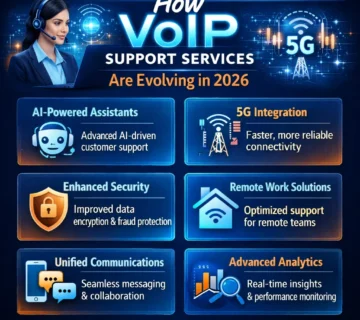
AI-powered VoIP support includes intelligent call routing based on real-time analysis, predictive maintenance that prevents issues before they occur, automated troubleshooting that resolves problems without human intervention, and continuous learning that improves performance over time. These capabilities should be integrated throughout the system, not just surface-level chatbot features.
How much does AI-powered VoIP support typically cost compared to traditional support?
AI-powered support generally costs 30-40% less than traditional support models while delivering faster resolution times and better outcomes. The cost savings come from reduced ticket volume, shorter resolution times, and lower staffing requirements for routine issues.
Can small businesses benefit from AI-powered VoIP support, or is it only for enterprises?
Small businesses now access the same AI capabilities that were enterprise-exclusive just three years ago. Cloud-based delivery and pay-as-you-grow pricing models make sophisticated AI support accessible regardless of company size. Many small businesses see proportionally greater benefits because they lack dedicated IT support teams.
What happens when AI can’t resolve a VoIP issue?
When AI encounters problems beyond its resolution capabilities, it escalates to human technicians with complete diagnostic information, relevant system logs, and recommended solutions. This dramatically reduces resolution time compared to starting troubleshooting from scratch. The best systems maintain skilled technical teams specifically for complex escalations.
How do I know if my current VoIP provider’s AI capabilities are actually competitive?
Ask specific questions about predictive maintenance capabilities, average automated resolution rates, system uptime statistics, and continuous learning processes. Request concrete performance metrics rather than general feature descriptions. Competitive providers should resolve 70%+ of issues automatically and predict problems 15-30 minutes before they impact service.
Will AI-powered support eventually eliminate human VoIP technicians entirely?
No. While AI handles routine troubleshooting and monitoring extremely well, complex problems, strategic planning, and relationship management still require human expertise. The role of human technicians has evolved toward higher-value activities rather than being eliminated. Top providers maintain balanced teams where AI and human expertise complement each other.
How quickly can businesses typically implement AI-powered VoIP support?
Implementation timelines vary based on system complexity and current infrastructure, but most cloud-based AI-powered VoIP systems deploy in 2-6 weeks for standard business environments. The AI begins learning your specific patterns immediately and reaches full effectiveness within 60-90 days as it accumulates organizational data.
What’s the biggest risk of not upgrading to AI-powered VoIP support?
The primary risk is competitive disadvantage. Organizations with AI-powered support respond faster, prevent more problems, and operate with lower costs. As customer expectations reset around AI-enabled experiences, companies still using traditional support appear slow and outdated regardless of other business strengths.




No comment