
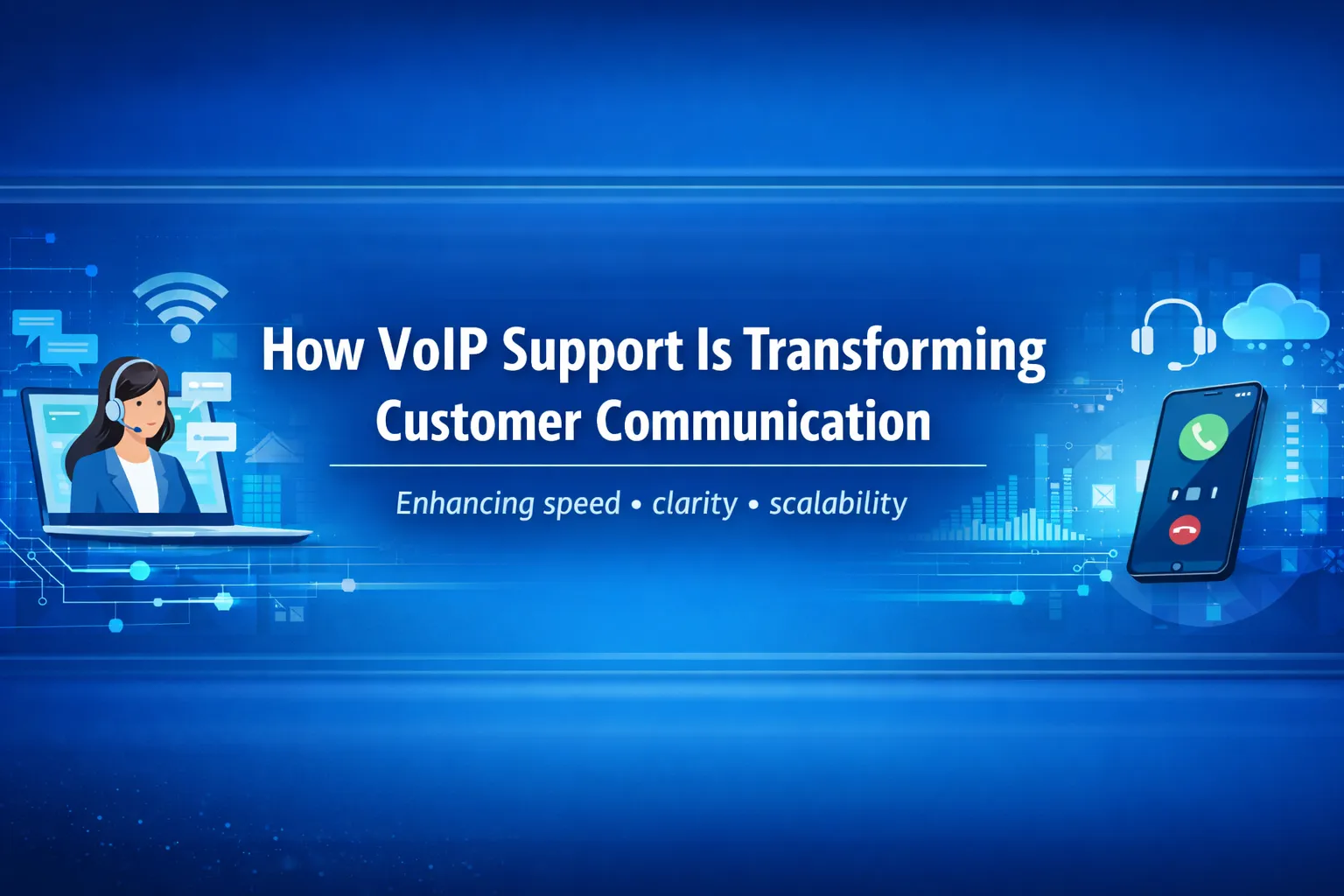
How VoIP Support Is Transforming Customer Communication
In today’s fast-paced business environment, customer communication has become more critical than ever. Customers expect immediate responses, seamless interactions, and consistent service quality regardless of when or how they reach out. Traditional phone systems, with their rigid infrastructure and limited capabilities, struggle to meet these modern demands.
Voice over Internet Protocol (VoIP) support has emerged as a transformative solution that’s fundamentally reshaping how businesses communicate with their customers. By transmitting voice calls over the internet rather than traditional phone lines, VoIP technology offers unprecedented flexibility, advanced features, and cost efficiencies that are revolutionizing customer service operations across all industries.
Understanding VoIP Technology
Voice over Internet Protocol fundamentally changes how voice communication travels from one point to another. Instead of using dedicated copper telephone lines maintained by traditional telecommunications companies, VoIP converts voice signals into digital data packets that travel over the internet alongside emails, file transfers, and web traffic.
This digital transformation unlocks several core advantages. VoIP systems are inherently more flexible than traditional counterparts because they rely on internet connectivity rather than physical phone lines. Support agents can take customer calls from home offices, remote locations, or while traveling, creating opportunities for distributed teams and flexible work arrangements that would be impossible with conventional phone systems.
VoIP technology also dramatically reduces communication costs, particularly for businesses with high call volumes or international customer bases. Traditional long-distance and international calls can be prohibitively expensive, but VoIP treats these calls the same as local calls since they’re all transmitted as data over the internet. For businesses serving customers across multiple countries, this cost reduction can translate to thousands or even millions of dollars in annual savings.
Enhanced Customer Experience Through Advanced Features
Modern VoIP systems come equipped with sophisticated features that directly enhance the customer experience in ways traditional phone systems simply cannot match. Interactive Voice Response (IVR) systems powered by VoIP allow customers to navigate support menus using voice commands or keypad inputs, routing themselves to the appropriate department without waiting for a receptionist. Advanced IVR systems can integrate with customer databases to provide personalized greetings and menu options based on caller identification and previous interaction history.
Call queuing and intelligent routing ensure customers reach the right support agent as quickly as possible. VoIP systems can analyze incoming calls based on multiple factors including customer priority level, agent expertise, language preferences, and current queue lengths. This intelligent routing reduces customer wait times and increases first-call resolution rates by connecting customers with agents best equipped to address their specific needs.
VoIP-enabled voicemail-to-email transcription ensures that messages never get lost or delayed. When customers leave voicemails, the system automatically transcribes the message and sends it to the appropriate agent’s email. Agents can quickly review transcribed messages, prioritize responses, and even respond via alternative channels if appropriate, creating a more responsive support environment.
Call recording and quality monitoring capabilities built into VoIP systems provide valuable tools for training and quality assurance. Support managers can review recorded calls to identify coaching opportunities, verify protocols are being followed, and resolve disputes about what was said during customer interactions.
Omnichannel Communication Integration
One of VoIP’s most transformative aspects is its ability to unify multiple communication channels into a single, cohesive platform. Today’s customers don’t limit themselves to phone calls—they expect to reach businesses through email, live chat, SMS, social media, and video conferencing. VoIP systems serve as the foundation for omnichannel communication strategies that meet customers wherever they prefer to engage.
Unified Communications as a Service (UCaaS) platforms built on VoIP technology allow support agents to handle voice calls, video chats, instant messages, and emails from a single interface. When a customer initiates contact through one channel and later switches to another, agents can access the complete conversation history regardless of the communication medium. This continuity eliminates the frustration customers feel when they have to repeat information after switching channels.
SMS and text messaging integration extends VoIP capabilities beyond traditional voice communication. Support teams can send appointment reminders, delivery notifications, account alerts, and even handle support inquiries via text message—all managed through the same system that handles voice calls.
Click-to-call functionality embedded in websites, mobile apps, and customer portals removes barriers to reaching support teams. Rather than requiring customers to find and dial phone numbers, VoIP-powered click-to-call buttons enable instant connection with a single click, while passing contextual information to agents about what the customer was viewing or attempting.
Scalability and Business Continuity
VoIP support systems offer scalability advantages that are particularly valuable for growing businesses or those with seasonal fluctuations in customer demand. Traditional phone systems require significant infrastructure investments and lengthy installation processes when adding new lines or locations. In contrast, VoIP systems can scale up or down rapidly with minimal hardware requirements and quick deployment timelines.
Adding new support agents to a VoIP system typically requires nothing more than setting up a user account and providing the agent with a VoIP-enabled device or softphone application. This ease of scaling means businesses can quickly respond to increased customer demand during peak seasons, product launches, or promotional campaigns without the lead times associated with traditional phone system expansion.
Geographic expansion becomes significantly simpler with VoIP technology. Opening support operations in new locations doesn’t require installing dedicated phone lines or purchasing local telecommunications infrastructure. Support agents anywhere in the world can connect to the company’s VoIP system using the internet, appearing to customers as seamlessly integrated team members regardless of their physical location.
Business continuity and disaster recovery capabilities built into VoIP systems protect customer communication channels during unexpected disruptions. Unlike traditional phone systems that cease functioning when physical locations become inaccessible, VoIP systems can automatically reroute calls to alternate locations, mobile devices, or work-from-home agents, ensuring customer support operations continue uninterrupted.
Data Analytics and Performance Insights
VoIP systems generate extensive data about customer interactions that can be analyzed to improve support operations and customer experiences. Call analytics dashboards provide real-time and historical visibility into key performance indicators including average wait times, call duration, abandonment rates, first-call resolution rates, and agent utilization.
Speech analytics capabilities use artificial intelligence and natural language processing to analyze the content of customer conversations. These systems can identify sentiment trends, detect specific keywords or phrases that indicate customer satisfaction or frustration, and flag calls that may require manager review. By analyzing large volumes of recorded calls, speech analytics can reveal recurring customer issues that might indicate product defects or process inefficiencies.
Agent performance management is enhanced through detailed metrics about individual agent activities and outcomes. Supervisors can track metrics such as calls handled, average handle time, customer satisfaction scores, and adherence to schedules. This data supports fair performance evaluations and identifies training opportunities.
Cost Efficiency and ROI
The financial advantages of VoIP support extend beyond simple per-minute calling cost reductions. Traditional PBX phone systems require significant upfront capital expenditures for equipment, dedicated phone lines, and professional installation. VoIP systems, particularly cloud-based solutions, typically operate on subscription pricing models that convert capital expenditures to predictable operational expenses.
Long-distance and international calling cost savings accumulate quickly for businesses with geographically dispersed customer bases. Organizations serving international markets can establish local phone numbers in dozens of countries while routing all calls through a single VoIP system, creating a local presence without establishing physical offices.
Improved agent productivity translates directly to financial returns through higher capacity without proportional staffing increases. Features like intelligent call routing, integrated customer information, and unified communications tools enable agents to handle more interactions more efficiently. When agents spend less time searching for information or switching between systems, they can serve more customers with higher quality.
Security and Compliance
As businesses entrust more customer communication to VoIP systems, security becomes a critical consideration. Modern VoIP platforms employ encryption protocols including SRTP (Secure Real-time Transport Protocol) for voice data and TLS (Transport Layer Security) for signaling information, ensuring that conversations cannot be intercepted during transmission.
Network security measures protect VoIP infrastructure from cyber threats. Implementing firewalls specifically configured for VoIP traffic, intrusion detection systems, and regular security updates protects VoIP systems from attacks. Session Border Controllers provide an additional security layer by controlling and monitoring VoIP traffic.
Regulatory compliance requirements vary by industry, but VoIP systems must support compliance with relevant standards. Healthcare organizations must ensure VoIP implementations meet HIPAA requirements, while financial services companies must comply with regulations governing customer communication and data retention. Quality VoIP platforms provide tools to support these compliance requirements, including call recording retention policies, audit trails, and access controls.
The Future of VoIP Customer Communication
VoIP technology continues evolving rapidly. Artificial intelligence integration is making VoIP systems increasingly intelligent, with AI-powered virtual assistants handling routine customer inquiries without human intervention. These AI assistants are becoming sophisticated enough to understand natural language, detect customer sentiment, and provide personalized responses.
Predictive analytics capabilities are enabling proactive customer communication rather than purely reactive support. By analyzing patterns in customer behavior and historical interaction data, VoIP systems can identify customers likely to experience issues before they even reach out, allowing support teams to initiate proactive assistance.
5G network adoption will eliminate many bandwidth and latency challenges, enabling mobile VoIP calls that match or exceed wired connection quality. WebRTC technology is making VoIP capabilities accessible directly through web browsers without requiring specialized applications, removing barriers to customer communication.
Conclusion
VoIP support is fundamentally transforming customer communication by delivering flexibility, advanced features, cost efficiency, and data-driven insights that traditional phone systems cannot match. From enhanced customer experiences through intelligent routing and omnichannel integration to improved business continuity and scalability, VoIP technology empowers businesses to meet and exceed modern customer expectations.
Organizations that embrace VoIP support position themselves to deliver responsive, personalized, and efficient customer experiences while simultaneously gaining competitive advantages through reduced costs and improved operational insights. As VoIP technology continues to evolve with artificial intelligence, predictive analytics, and emerging network capabilities, its transformative impact on customer communication will only accelerate.
Frequently Asked Questions
What is VoIP and how does it differ from traditional phone systems?
VoIP transmits voice calls as digital data over the internet rather than through traditional telephone lines. This enables greater flexibility, reduced costs, and advanced features like call recording, analytics, and CRM integration that traditional phone systems cannot provide.
Will VoIP work if my internet connection goes down?
Modern VoIP systems include failover mechanisms that automatically forward calls to mobile phones or alternate locations if your primary internet connection fails. Many businesses also implement redundant internet connections to ensure reliability.
How much does VoIP support typically cost?
VoIP systems typically cost $20-$50 per user monthly, compared to traditional PBX systems requiring $10,000-$50,000 upfront plus maintenance contracts. Total cost of ownership is often 30-50% lower over five years.
What internet bandwidth is required for quality VoIP calls?
Quality VoIP requires approximately 100-150 kbps per simultaneous call. A business with 20 agents should have at least 3-5 Mbps dedicated bandwidth, with latency below 150ms and packet loss below 1%.
Can VoIP integrate with existing CRM systems?
Yes, modern VoIP platforms integrate with popular CRM and helpdesk systems like Salesforce, HubSpot, Zendesk, and ServiceNow, enabling screen pops, click-to-dial, automatic call logging, and workflow automation.
Is VoIP secure for handling sensitive information?
When properly implemented, VoIP provides robust security through SRTP encryption for voice data, TLS for signaling, access controls, and compliance certifications including HIPAA, PCI DSS, and SOC 2.
How long does VoIP implementation typically take?
Small businesses can deploy VoIP in 1-2 weeks, mid-sized organizations need 4-8 weeks, and large enterprises may require 3-6 months depending on complexity and integration requirements.
Can remote agents use VoIP systems effectively?
Yes, VoIP is ideal for remote teams. Work-from-home agents access the same features as in-office staff through softphone applications or mobile devices, ensuring consistent customer experiences regardless of location.





No comment