
How Equipment Financing Improves Cash Flow and Business Efficiency
Running a successful business requires making strategic decisions about capital allocation, and few choices impact operations as significantly as equipment acquisition. Whether you need manufacturing machinery, medical devices, construction equipment, or office technology, the way you finance these assets can determine your company’s financial health and competitive position. Equipment financing has emerged as a powerful tool that allows businesses to acquire necessary assets while preserving capital, improving cash flow, and enhancing overall operational efficiency.
Understanding Equipment Financing
Equipment financing is a specialized form of business lending where the equipment itself serves as collateral for the loan. This arrangement differs fundamentally from traditional business loans because the asset being purchased secures the financing. Banks, credit unions, and specialized lenders offer various equipment financing options including equipment loans, equipment leases, and sale-leaseback agreements. Each structure provides different advantages depending on your business needs, tax situation, and long-term equipment strategy.
The fundamental appeal of equipment financing lies in its accessibility. Since the equipment serves as collateral, lenders face reduced risk compared to unsecured loans, which often translates to more favorable terms for borrowers. Businesses with limited operating history or those seeking to preserve their existing credit lines find equipment financing particularly valuable because approval criteria focus heavily on the equipment’s value rather than solely on the borrower’s credit profile.
Preserving Working Capital for Critical Operations
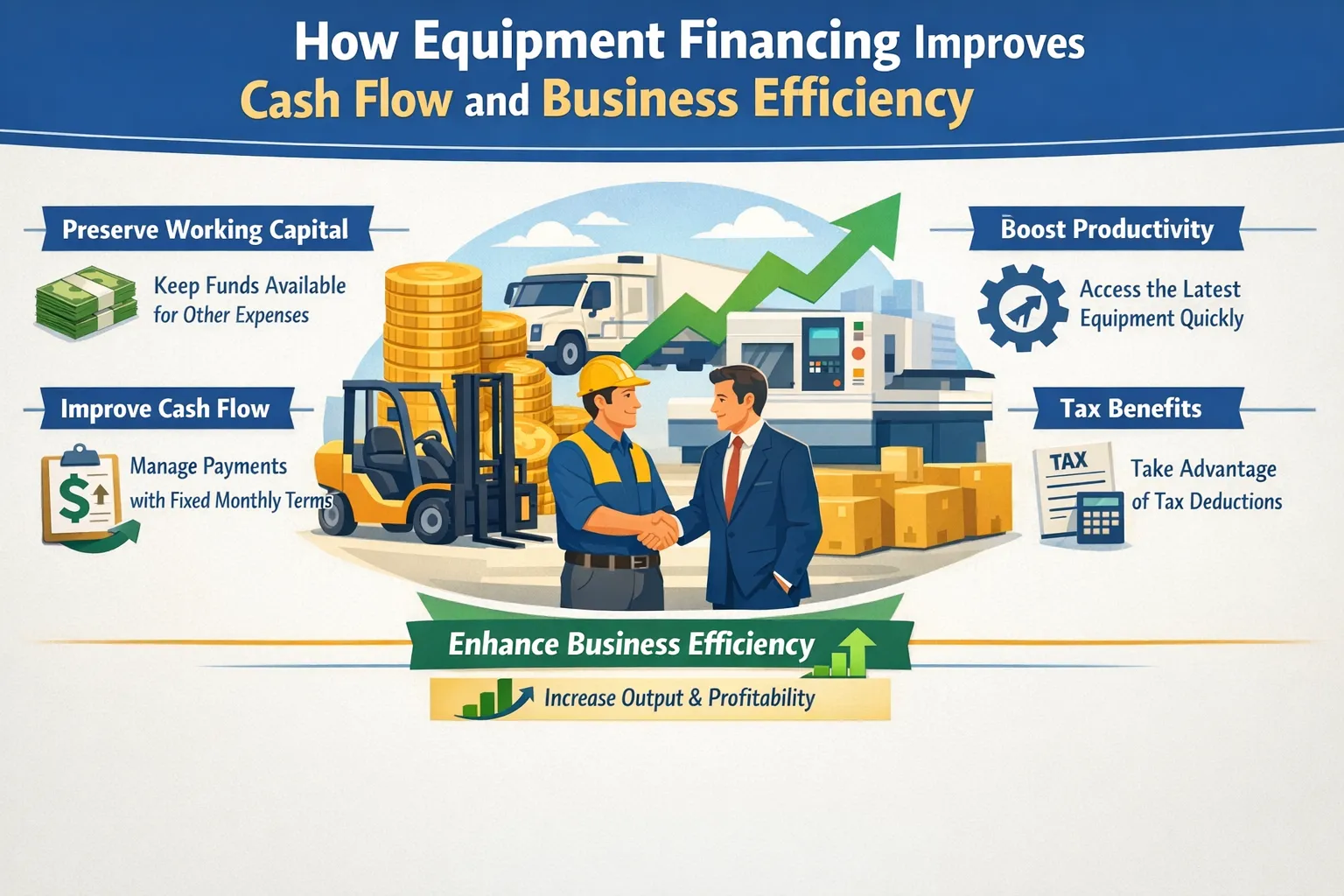
The most immediate benefit of equipment financing is working capital preservation. When businesses purchase equipment outright, they deplete cash reserves that could otherwise fund inventory, payroll, marketing initiatives, or emergency expenses. A manufacturing company spending two hundred thousand dollars on a new production line, for example, reduces its financial flexibility significantly. If an unexpected opportunity or crisis emerges, that capital is locked into a fixed asset rather than available for strategic deployment.
Equipment financing transforms this dynamic completely. Instead of a massive upfront expenditure, businesses make manageable monthly payments spread across the equipment’s useful life. This approach maintains liquidity for day-to-day operations and strategic investments. A restaurant can finance kitchen equipment while keeping cash available for seasonal inventory fluctuations. A construction company can acquire excavators through financing while maintaining funds for project deposits and operating expenses. The preserved working capital acts as a financial cushion that supports business stability and growth opportunities.
This capital preservation becomes especially critical for growing businesses. Companies in expansion mode face numerous competing demands for capital, from hiring talented employees to entering new markets or developing new products. Equipment financing allows businesses to acquire the tools they need for growth without sacrificing their ability to pursue other strategic initiatives simultaneously.
Improving Cash Flow Predictability
Cash flow consistency ranks among the top concerns for business owners, and equipment financing directly addresses this challenge. Purchasing equipment outright creates an immediate, substantial cash outflow that can strain finances and complicate budgeting. Equipment financing converts this large, irregular expense into predictable monthly payments that integrate seamlessly into financial planning.
Fixed monthly payments enable accurate forecasting and budgeting. Finance teams can project expenses with confidence, knowing exactly what equipment costs will be each month throughout the financing term. This predictability facilitates better decision-making across all business functions. Companies can commit to long-term contracts, plan hiring schedules, and invest in marketing campaigns with clear understanding of their financial obligations.
The predictability extends beyond simple payment schedules. Many equipment financing agreements include maintenance and service provisions, further stabilizing costs. A medical practice financing diagnostic equipment might include maintenance contracts that prevent unexpected repair expenses. An IT company leasing servers could bundle support services into their monthly payment, eliminating surprise technical support costs. This comprehensive cost predictability transforms equipment from a potential financial wildcard into a manageable, forecastable business expense.
Accessing Better Equipment Through Manageable Payments
Equipment financing democratizes access to high-quality assets. Many businesses compromise on equipment quality when facing budget constraints, purchasing adequate but suboptimal machinery that limits productivity and competitiveness. This compromise might seem financially prudent initially but often proves costly through reduced efficiency, higher operating costs, and premature obsolescence.
Financing enables businesses to acquire superior equipment that would be financially unreachable through outright purchase. A small manufacturer might afford basic machinery with available cash but can finance state-of-the-art equipment with advanced automation features. The productivity gains from better equipment often exceed the financing costs substantially. Faster production cycles, reduced waste, lower maintenance requirements, and improved product quality collectively enhance profitability far beyond the interest expense on the financing.
This access to better equipment creates competitive advantages. In industries where technology evolves rapidly, staying current with equipment capabilities can differentiate market leaders from struggling competitors. A printing company with the latest digital printing technology can offer services and turnaround times that businesses using older equipment cannot match. The financing structure makes this competitive positioning accessible to businesses across the size spectrum.
Tax Advantages and Financial Benefits
Equipment financing offers significant tax advantages that improve its economic attractiveness. Section 179 of the Internal Revenue Code allows businesses to deduct the full purchase price of qualifying equipment financed during the tax year, up to specified limits. This immediate expense deduction reduces taxable income substantially, creating meaningful tax savings that offset financing costs partially.
Beyond Section 179, businesses can claim bonus depreciation on qualifying assets, accelerating tax deductions even further. For leased equipment, monthly lease payments are typically fully deductible as business expenses. These tax benefits effectively reduce the net cost of equipment acquisition, making financing even more economically efficient compared to outright purchase with cash reserves.
The tax advantages combine with other financial benefits to create compelling economics. Equipment financing preserves the ability to deduct interest payments, and the overall tax treatment often results in lower effective costs than alternative financing methods. Working with tax professionals to structure equipment financing optimally can maximize these benefits and improve overall return on investment.
Flexibility and Equipment Management
Equipment financing provides operational flexibility that outright ownership cannot match. Technology and business needs evolve constantly, and equipment that serves your business perfectly today may become obsolete or inadequate within a few years. Financing agreements can include upgrade provisions that allow businesses to refresh equipment regularly without the financial burden of disposing of older assets and purchasing new ones outright.
Leasing arrangements offer particular flexibility. At lease end, businesses can return equipment, purchase it at fair market value, or upgrade to newer models. This flexibility proves invaluable in fast-changing industries. An IT services company can lease servers with confidence that they can upgrade to more powerful systems when the lease expires, avoiding the problem of owning outdated equipment with diminished resale value. A medical practice can lease diagnostic equipment knowing they can adopt improved technology as it becomes available.
This flexibility extends to scaling operations. Businesses can finance additional equipment as they grow without major capital outlays. A transportation company expanding its fleet can add vehicles through financing as contracts increase, matching capacity precisely to demand. This scalability supports growth without the financial risk of premature large-scale equipment purchases based on optimistic projections.
Protecting Balance Sheet Strength
Equipment financing’s impact on financial statements deserves careful consideration. How equipment financing affects your balance sheet depends on the financing structure. Operating leases keep equipment off the balance sheet entirely, avoiding asset and liability entries that affect debt-to-equity ratios. This treatment can be advantageous when seeking additional financing, as it presents a stronger balance sheet to potential lenders or investors.
Capital leases and equipment loans do appear on the balance sheet but still offer advantages over purchasing with existing credit lines. Equipment financing is secured by the specific asset, which financial analysts view differently than unsecured debt. This secured nature often results in more favorable debt covenants and maintains borrowing capacity for other business needs.
The balance sheet treatment also affects financial ratios that stakeholders scrutinize. Return on assets improves when valuable equipment is financed rather than purchased with cash, since the asset generates revenue without reducing liquid assets significantly. These financial metrics matter when seeking additional capital, negotiating supplier terms, or positioning the business for sale or acquisition.
Accelerating Business Growth and Revenue Generation
Perhaps the most compelling argument for equipment financing is its ability to accelerate business growth. Equipment that generates revenue or reduces costs begins providing benefits immediately, even as you make incremental payments. A landscaping company financing commercial mowers can take on additional contracts immediately, generating revenue that covers financing payments while building the business. The alternative of saving cash to purchase equipment outright delays revenue generation significantly.
This acceleration effect compounds over time. Businesses that can respond quickly to opportunities gain competitive advantages that extend far beyond the specific equipment acquisition. A manufacturing business that can quickly add capacity through financing can accept large orders that competitors lacking similar financial flexibility must decline. These captured opportunities generate profits and strengthen customer relationships, creating value that dwarfs the financing costs.
The growth acceleration becomes particularly powerful for businesses in their expansion phase. Rather than growing incrementally as cash reserves allow equipment purchases, financing enables rapid scaling that capitalizes on market opportunities. This aggressive growth positioning can establish market leadership, build brand recognition, and create economies of scale that fundamentally improve business economics.
Streamlined Approval and Acquisition Process
Equipment financing typically involves faster, simpler approval processes than traditional business loans. Since the equipment secures the financing, lenders focus primarily on the equipment’s value and the business’s ability to make payments rather than requiring extensive financial documentation and lengthy underwriting processes. Many equipment financing providers offer approval decisions within days or even hours, allowing businesses to acquire needed equipment quickly.
This streamlined process reduces the opportunity cost of financing delays. In competitive markets, the ability to acquire equipment quickly can determine whether a business captures an opportunity or loses it to faster-moving competitors. A construction company bidding on a major project can secure necessary equipment financing rapidly, allowing them to bid competitively without the risk of equipment procurement delays.
The simplified documentation requirements also reduce administrative burden. While traditional business loans might require comprehensive financial statements, tax returns, business plans, and personal guarantees, equipment financing often requires less extensive documentation. This efficiency saves time and allows business owners to focus on operations rather than financing paperwork.
Risk Mitigation and Financial Protection
Equipment financing provides built-in risk mitigation that benefits businesses significantly. If financed equipment fails to perform as expected or becomes obsolete, the business hasn’t invested substantial cash reserves that are now locked into an underperforming asset. With financing, businesses can potentially restructure terms, upgrade equipment, or in worst-case scenarios, return leased equipment without the total loss that outright purchase represents.
This risk reduction proves especially valuable for equipment with uncertain longevity or return on investment. A restaurant investing in specialized cooking equipment for a new menu concept faces uncertainty about customer reception. Financing this equipment limits downside risk if the concept underperforms, while outright purchase would represent a potentially total loss of substantial capital.
Equipment financing also provides protection against technological obsolescence. In industries where technology advances rapidly, equipment can lose value quickly not through physical wear but through functional obsolescence. Financing structures that include upgrade paths or lease returns protect businesses from being stuck with outdated equipment that hampers competitiveness.
Conclusion
Equipment financing represents a strategic financial tool that extends far beyond simple asset acquisition. By preserving working capital, improving cash flow predictability, enabling access to superior equipment, providing tax advantages, offering operational flexibility, protecting balance sheet strength, accelerating growth, streamlining acquisition processes, and mitigating risks, equipment financing transforms how businesses approach capital equipment needs.
The most successful businesses recognize that equipment financing decisions involve more than comparing interest rates or monthly payments. These decisions fundamentally affect business agility, competitive positioning, and growth potential. Companies that leverage equipment financing strategically maintain financial flexibility while ensuring they have the tools necessary for operational excellence and market competitiveness.
As business environments become increasingly competitive and capital-intensive, equipment financing will continue growing in importance as a financial strategy. Business owners who understand and utilize equipment financing effectively position their companies for sustainable growth, operational efficiency, and long-term success in their respective markets.
Frequently Asked Questions
Q: What types of equipment can be financed?
A: Nearly any business equipment can be financed, including manufacturing machinery, medical equipment, office technology, vehicles, restaurant equipment, construction equipment, agricultural machinery, and specialized tools. Most lenders require that equipment be essential to business operations and retain value throughout the financing term. Soft assets like software subscriptions or inventory typically don’t qualify, but hardware, vehicles, and machinery almost always do.
Q: How does equipment financing differ from a traditional business loan?
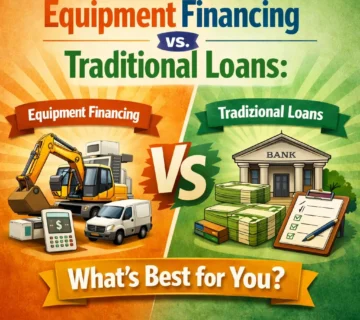
A: Equipment financing uses the equipment itself as collateral, while traditional business loans may be unsecured or secured by other assets. This distinction means equipment financing typically offers easier approval, requires less documentation, and provides terms specifically matched to the equipment’s useful life. Traditional business loans provide more flexibility in how funds are used but often come with more stringent credit requirements and shorter repayment terms.
Q: What credit score do I need for equipment financing?
A: Credit requirements vary by lender and equipment value, but many equipment financing providers work with businesses across a wide credit spectrum. While excellent credit may qualify for the best rates, businesses with credit scores as low as 600 can often secure equipment financing. Lenders emphasize the equipment’s value and the business’s revenue more than traditional credit metrics, making equipment financing accessible to businesses that might not qualify for conventional loans.
Q: Should I lease or finance equipment purchases?
A: The choice between leasing and purchasing through financing depends on your specific circumstances. Leasing offers lower monthly payments, easier upgrades, and potential off-balance-sheet treatment, making it ideal for technology that becomes obsolete quickly or when preserving maximum flexibility matters. Equipment loans result in ownership, build equity, and may provide better long-term economics for equipment with long useful lives. Consider your industry, equipment type, cash flow needs, and long-term plans when deciding.
Q: How quickly can equipment financing be approved?
A: Many equipment financing providers offer decisions within 24 to 48 hours, with some providing same-day approvals for qualified applicants. The approval timeline depends on factors including the equipment value, your business’s financial strength, and documentation completeness. Straightforward applications for standard equipment from established businesses often receive the fastest approvals, while complex transactions or startup businesses may require additional time.
Q: Can startups qualify for equipment financing?
A: Yes, startups can often qualify for equipment financing more easily than other business financing types. Since the equipment serves as collateral, lenders face reduced risk and may approve startups that lack extensive operating history. However, startups may face higher interest rates, larger down payment requirements, or need personal guarantees from business owners. Strong business plans and industry experience improve startup approval odds significantly.
Q: What happens if I can’t make equipment financing payments?
A: Missing equipment financing payments can result in late fees, damage to your business credit, and potentially equipment repossession. However, most lenders prefer working with borrowers to restructure payment terms rather than repossessing equipment. If you anticipate payment difficulties, contact your lender immediately to discuss options, which might include temporary payment reductions, term extensions, or refinancing arrangements. Proactive communication often leads to solutions that avoid repossession and credit damage.
Q: Are there prepayment penalties for equipment financing?
A: Prepayment penalties vary by lender and agreement type. Some equipment financing agreements include prepayment penalties to compensate lenders for lost interest revenue, while others allow penalty-free early payoff. Before signing financing agreements, clarify prepayment terms, especially if you anticipate potentially paying off the equipment early. This information should be clearly stated in your financing contract and discussed during the application process.

No comment